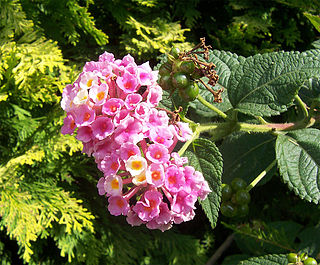
The Verbenaceae, the verbena family or vervain family, is a family of mainly tropical flowering plants. It contains trees, shrubs, and herbs notable for heads, spikes, or clusters of small flowers, many of which have an aromatic smell.

Peter Wilhelm Lund was a Danish Brazilian paleontologist, zoologist, and archeologist. He spent most of his life working and living in Brazil. He is considered the father of Brazilian paleontology as well as archaeology.

Aloysia citrodora, lemon verbena, is a species of flowering plant in the verbena family Verbenaceae, native to South America. Other common names include lemon beebrush. It was brought to Europe by the Spanish and the Portuguese in the 17th century and cultivated for its oil.

Verbena, also known as vervain or verveine, is a genus in the family Verbenaceae. It contains about 150 species of annual and perennial herbaceous or semi-woody flowering plants. The majority of the species are native to the Americas and Asia; however, Verbena officinalis, the common vervain or common verbena, is the type species and native to Europe.
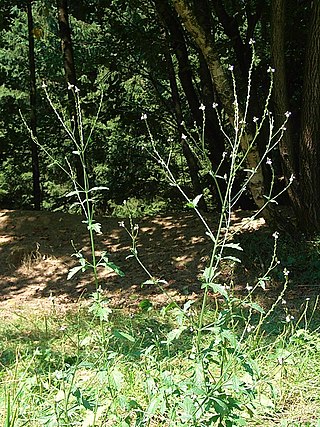
Verbena officinalis, the common vervain or common verbena, is a perennial herb native to Europe. It grows up to 70 cm high, with an upright habitus. The lobed leaves are toothed, and the delicate spikes hold clusters of two-lipped mauve flowers.

Verbena brasiliensis, the Brazilian verbena or Brazilian vervain, is a flowering plant species from the vervain family (Verbenaceae). It is native to parts of South America, namely Brazil, but has spread its range in recent times and has occasionally become an invasive weed. It is an annual plant with purple flowers, and it has been introduced outside of its native range as an ornamental plant, and is now largely considered an invasive weed in these regions.

The Saint Helena olive is an extinct species of flowering plant. It is the only member of the genus Nesiota. It was endemic to the island of Saint Helena in the South Atlantic Ocean. Despite its name, it is unrelated to the true olive, but is instead a member of the family Rhamnaceae, the family which contains buckthorns and jujube. The last remaining tree in the wild died in 1994, and the last remaining individual in cultivation died in December 2003, despite conservation efforts. It is thus a prime example of recent plant extinction. The Saint Helena olive belongs to the tribe Phyliceae, which are mostly endemic to Southern Africa.

Aloysia is a genus of flowering plants in the verbena family, Verbenaceae. They are known generally as beebrushes. They are native to the Americas, where they are distributed in temperate climates, as well as in subtropical and desert climates. The genus is named for Maria Luisa of Parma (1751-1819), wife of King Charles IV of Spain.

Verbena bonariensis, the purpletop vervain, clustertop vervain, Argentinian vervain, tall verbena or pretty verbena, is a member of the verbena family cultivated as a flowering annual or herbaceous perennial plant. In USA horticulture, it is also known by the ambiguous names purpletop and South American vervain. For the misapplication "Brazilian verbena" see below.

Verbena hastata, commonly known as American vervain, blue vervain, simpler's joy, or swamp verbena, is a perennial flowering plant in the vervain family Verbenaceae. It grows throughout the continental United States and in much of southern Canada.

Abronia ammophila, the Yellowstone sand verbena, or Wyoming sand verbena, is a plant unique to Yellowstone National Park lakeshores and is endemic to the park. Part of the "Four o'clock" family (Nyctaginaceae), the abronia ammophila is best suited in sandy soils and lake shores.

Abronia mellifera is a species of sand verbena known by the common name white sand verbena.

Verbena bracteata is a species of verbena known by the common names bracted vervain, bigbract verbena, prostrate vervain, and carpet vervain. It is native to North America where it is widespread, occurring throughout the continent except for northern Canada and southern Mexico. It occurs in many types of habitat, especially disturbed areas. It typically blooms between the months of May and October. This annual or biennial herb produces several hairy, spreading stems up to 30 centimeters long forming a low mat on the ground. The hairy leaves are toothed or lobed. The inflorescence is a spike of flowers which is dense with long, pointed, leaflike bracts each up to 8 millimeters long. Each small tubular flower is about half a centimeter wide and white to pale purple in color.

Abronia, the sand-verbenas or wild lantanas, is a genus of about 20 species of annual or perennial herbaceous plants in the family Nyctaginaceae. Despite the common names, they are not related to Verbena (vervains) or lantanas in the family Verbenaceae. They are closely allied with Tripterocalyx.
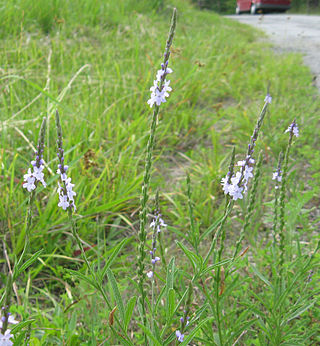
Verbena simplex, commonly known as narrowleaf vervain, is a perennial herbaceous plant plant in the Verbenaceae (vervain) family. It is native to central and eastern North America where it is found in open, dry, habitats on calcareous soil. It produces lavender flowers in the summer.
Lily May Perry (1895-1992) was a Canadian-American botanist who worked at Arnold Arboretum and is most known for detailed compilation of information on medicinal plants of East and Southeast Asia and her assistance with the Flora of New Guinea. Perry also has the legacy of authoring the third highest number of land plant species among female scientists, in total naming 414 species.

Verbena stricta, also known as hoary verbena or hoary vervain, is a small purple wildflower native to a large region of the central United States.
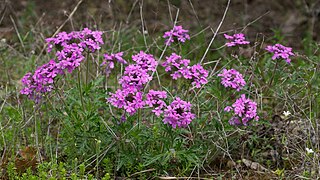
Verbena canadensis, commonly known as rose mock vervain, rose verbena, clump verbena or rose vervain is a perennial herbaceous flowering plant in the verbena family (Verbenaceae) with showy pink to purple flowers.. It is native to the eastern and south-central areas of the United States. This species is widely cultivated as an ornamental, and naturalized populations have been established outside its native range, such as in the northeastern U.S.

Verbena amoena is a plant species in the genus Verbena.

Verbena aristigera, variously called the moss verbena, desert verbena, fine leafed verbena, wild verbena, tuber vervain, South American mock vervain, Mayne's curse and Mayne's pest, is a species of flowering plant in the family Verbenaceae. It is native to Bolivia, southern Brazil, northern Argentina, Paraguay and Uruguay. It has been widely introduced to the rest of the world's drier tropics and subtropics, including California, Guatemala, Honduras, Nicaragua, Venezuela, Greece, Nigeria, eastern and southern Africa, India, and all of Australia except Tasmania.


