It has been requested that the title of this article be changed. Please see the relevant discussion on the discussion page. Do not move the page until the discussion has reached consensus for the change and is closed. |
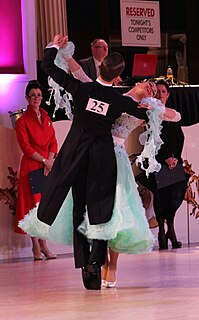
Waltz is one of the five dances in the Standard (or Modern) category of the International Style ballroom dances. It was previously referred to as Slow Waltz or English Waltz.
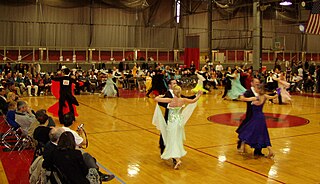
Ballroom dance is a set of partner dances, which are enjoyed both socially and competitively around the world. Because of its performance and entertainment aspects, ballroom dance is also widely enjoyed on stage, film, and television.
Waltz is usually the first dance in the Dancesport competition rounds. It is danced exclusively in the closed position, unlike its American Style counterpart.
Dancesport denotes competitive ballroom dancing, as contrasted to social or exhibition dancing. In the case of wheelchair dancesport, at least one of the dancers is in a wheelchair.
In partner dancing, closed position is a category of positions in which partners hold each other while facing at least approximately toward each other.
The Waltz originated as a folk dance from Austria. Predecessors include the "Matenick" and a variation called the "Furiant" that were performed during rural festivals in Bohemia. The French dance, "Walt", and the Austrian Ländler are the most similar to the waltz among its predecessors.
The waltz is a ballroom and folk dance, normally in
A furiant is a rapid and fiery Bohemian dance in alternating 2/4 and 3/4 time, with frequently shifting accents; or, in "art music", in 3/4 time "with strong accents forming pairs of beats".
The Ländler is a folk dance in 3
4 time which was popular in Austria, Bavaria, German Switzerland, and Slovenia at the end of the 18th century.
The "king of dances" acquired different national traits in different countries. Thus there appeared the English Waltz, the Hungarian Waltz, and the Waltz-Mazurka. The "Waltz" is derived from the old German word "walzen" meaning "to roll, turn", or "to glide". Waltz was danced competitively since 1923 or 1924.
The mazurka is a Polish folk dance in triple meter, usually at a lively tempo, and with "strong accents unsystematically placed on the second or third beat".
International Standard Waltz is a Waltz dance and danced to slow waltz music, preferably 28-30 bars per minute (84-90 beats per minute). [1] [2] Waltz music is in 3/4 time and the 1st beat of a measure is strongly accented. [3]
In music and music theory, the beat is the basic unit of time, the pulse, of the mensural level. The beat is often defined as the rhythm listeners would tap their toes to when listening to a piece of music, or the numbers a musician counts while performing, though in practice this may be technically incorrect. In popular use, beat can refer to a variety of related concepts including: pulse, tempo, meter, specific rhythms, and groove.
In musical notation, a bar is a segment of time corresponding to a specific number of beats in which each beat is represented by a particular note value and the boundaries of the bar are indicated by vertical bar lines. Dividing music into bars provides regular reference points to pinpoint locations within a musical composition. It also makes written music easier to follow, since each bar of staff symbols can be read and played as a batch. Typically, a piece consists of several bars of the same length, and in modern musical notation the number of beats in each bar is specified at the beginning of the score by the time signature. In simple time,, the top figure indicates the number of beats per bar, while the bottom number indicates the note value of the beat.
Like all Standard category dances, Waltz is a progressive dance, meaning that dancers travel along a path known as the line of dance. It is characterized by pendulum swing movements and incorporates general elements of ballroom technique such as foot parallelism, rise and fall, contra body movement and sway.
Contra body movement (CBM) is a term used in ballroom dances, such as Waltz, Foxtrot, Tango, Quickstep. It describes a specific coordination of the movement of a dancer's body when doing or preparing to do a step which involves rotation.
The term sway has a specific meaning in the technique of ballroom dances. Sway describes a dancer's body position in which the entire body gracefully deflects from the vertical. Entrance to and exit from this position are matters of fine technical detail and differ in various dance figures.
Most of the basic figures[ clarify ] have one step per beat (three per measure), whereas advanced figures[ clarify ] have four to six steps per measure. The faster pace of the advanced figures, especially when combined with dance turns, results in fast-paced, dynamic dancing despite the relatively slow music tempo. Slow steps and elegant poses are often used to contrast fast-paced dance segments, resulting in what is sometimes referred to as light and shade.
This is the ISTD International Standard syllabus. [4]
Note that Pre-Bronze is included as part of the Bronze syllabus. [5]
xx. Drag Hesitation
xx. Fallaway Whisk
Viennese waltz is a genre of ballroom dance. At least four different meanings are recognized. In the historically first sense, the name may refer to several versions of the waltz, including the earliest waltzes done in ballroom dancing, danced to the music of Viennese waltz.
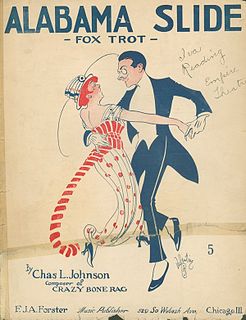
The foxtrot is a smooth, progressive dance characterized by long, continuous flowing movements across the dance floor. It is danced to big band music. The dance is similar in its look to waltz, although the rhythm is in a 4
4 time signature instead of 3
4. Developed in the 1910s, the foxtrot reached its height of popularity in the 1930s and remains practiced today.
This is a list of dance terms that are not names of dances or types of dances. See List of dances and List of dance style categories for those.
Rhumba, also known as ballroom rumba, is a genre of ballroom music and dance that appeared in the East Coast of the United States during the 1930s. It combined American big band music with Afro-Cuban rhythms, primarily the son cubano, but also conga and rumba. Taking its name from the latter, ballroom rumba differs completely from Cuban rumba both in its music and dance. Hence, authors prefer the Americanized spelling of the word (rhumba) to distinguish between them.
The quickstep is a light-hearted dance of the standard ballroom dances. The movement of the dance is fast and powerfully flowing and sprinkled with syncopations. The upbeat melodies that quickstep is danced to make it suitable for both formal and informal events. Quickstep was developed in the 1920s in New York City and was first danced by Caribbean and African dancers. Its origins are in combination of slow foxtrot combined with the Charleston, a dance which was one of the precursors to what today is called swing dancing.
In many forms of dance medal examinations are held. They are organised by leading dance teaching organisations, such as the Imperial Society of Teachers of Dancing (ISTD), the International Dance Teachers Association (IDTA), and other organisations.
The Closed Change is a Pre-Bronze, or newcomer Waltz figure, performed in closed position.
V6 is a silver level dance pattern of the quickstep International Standard Ballroom dance syllabus. The couple moves diagonally to the center (DC) and then diagonally to the wall (DW), thus sweeping a V-shape on the floor.
Ballroom tango is a ballroom dance that branched away from its original Argentine roots by allowing European, American, Hollywood, and competitive influences into the style and execution of the dance.
The whisk is a ballroom dance step used in the waltz or Viennese waltz. It is one of several ways to get into promenade position and is used to turn dancers around corners or change their direction on the dance floor. It is often performed after a complete reverse turn.
A natural turn is a dance step in which the partners turn around each other clockwise. Its near-mirror counterpart is the reverse turn, which is turning to the counterclockwise.
The double reverse spin is a ballroom dance used in the waltz and the quickstep. It typically rotates a full turn in one measure of music, although it can rotate anywhere from a full turn to 3/4.
The impetus is a ballroom dance step used in the waltz, foxtrot or quickstep. The open impetus is one of several ways to get into promenade position and is used to turn dancers around corners or change their direction on the dance floor. It is often performed after a natural turn.
The Telemark is a ballroom dance step; in waltz competition, it is in the Silver syllabus. Telemarks are reverse turns where the follower does a heel turn as the leader travels around her. There are similar Telemarks in foxtrot and quickstep.
A wing is a ballroom dance move, in the silver syllabus of competition waltz. It is a transitional movement that repositions the follower to the leader's left side. Thus, while many dance moves can precede a wing, only a reverse movement can follow a wing, such as a reverse turn, double reverse spin, Telemark, fallaway reverse, or drag hesitation.
There are several types of lock step in waltz dancing, including International Standard Waltz. A "lock step" is when the moving foot approaches to the standing foot and crosses in front of or behind it, creating a "check" position.