2009 Hotel Shamo bombing

Last updated

2009 Hotel Shamo bombing
LocationSomalia.svg
Location of Somalia in Africa
2009 Hotel Shamo bombing
Interactive map of 2009 Hotel Shamo bombing
Location 2°01′51″N45°18′14″E / 2.0309°N 45.3039°E / 2.0309; 45.3039
Mogadishu, Somalia
Date3 December 2009
Attack type
Suicide bombing
Deaths25
Injured60

The 2009 Hotel Shamo bombing occurred at the Hotel Shamo in Mogadishu, Somalia, on 3 December 2009. The suicide bombing killed 25 people, including three ministers of the Transitional Federal Government, [1] and injured 60 more, [2] making it the deadliest attack in Somalia since the Beledweyne bombing on 18 June 2009 that claimed more than 30 lives. [3]

Contents

The bombing

The hall had been brightly decorated, and there was a feeling of excitement – such ceremonies rarely happen in Mogadishu. [4]

Mohammed Olad Hassan, BBC News
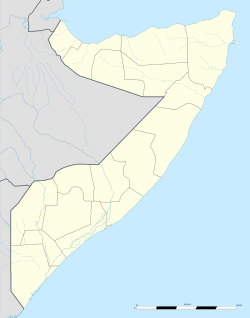
Somalia location map.svg
Green pog.svg
Mogadishu
Mogadishu in Somalia

The attack took place inside the meeting hall of the Hotel Shamo in Mogadishu during a commencement ceremony for medical students of Benadir University and was carried out by a suicide bomber standing near the front of the stage. [5] The ceremony—the second since Benadir University was formed in 2002 and a rare event in war-torn Somalia—had attracted hundreds of people. [6] In attendance were the graduates and their family members, University officials, [7] and five ministers of the Transitional Federal Government (TFG). [6] Security inside the meeting hall was light and all of the ministers' bodyguards were outside the hall. [6]

Casualties

Suddenly, the hall shook and I heard a PAW! sound from the front of the ceremony, where most government officials and dignitaries were sitting. I got down on the ground and looked back. Dozens of people were on the ground under a huge cloud of smoke. Others were stampeding to the exit for safety. [8]

Abdinasir Mohamed, The Wall Street Journal

The bombing killed 24 people [1] and injured 60 others. [2] Most of those killed were students, [2] but also among the dead were two doctors, three journalists, [9] and three government ministers—Minister of Education Ahmed Abdulahi Waayeel, Minister of Health Qamar Aden Ali, and Minister of Higher Education Ibrahim Hassan Addow were killed. [6] [10] Minister of Sports Saleban Olad Roble was critically injured, and was hospitalised. He was later reported to have been flown to Saudi Arabia for treatment, [11] where he died on 13 February 2010. [12]

The three journalists killed in the bombing were: Mohamed Amiin Abdullah of Shabelle Media Network, a Somali television and radio network; [10] [9] freelance photographer Yasir Mairo, who died of injuries in hospital; [9] and a cameraman alternately identified as freelancer Hassan Ahmed Hagi [10] and Al Arabiya cameraman Hassan Zubeyr [9] or Hasan al-Zubair. [7] Their deaths raised to nine the number of journalists killed in Somalia during 2009, including four for Radio Shabelle. [9] The explosion also injured six other journalists, including two—Omar Faruk, a photographer for Reuters, and Universal TV reporter Abdulkadir Omar Abdulle—who were taken to Medina Hospital in critical condition. [9]

The dean of Benadir University's medical college was among the wounded. [7]

Perpetrator

The Danish newspaper Berlingske Tidende reported the bomber was a 24-year-old citizen of Denmark. The Danish intelligence service, the PET, said in a statement that the man was born in Somalia and had been living in Denmark for 20 years. The police chose not to release the name of the suspect, however, a documentary released in 2014 names him as "Abdirahman Mohamed", with one of his friend's giving details regarding his radicalisation. [13] Initially, reports suggested that the bomber had entered the building dressed as a woman in an abaya. During a news conference held in the Hotel Shamo after the attack, President Ahmed called for international assistance to Somalia. [5] He also displayed, according to a local journalist, what he identified as the bomber's body and remains of an explosive belt and a hijab. [10] However, he was later found to have been in a white shirt, standing near the stage, with a camera. [14]

Aftermath

President Sharif Sheikh Ahmed accused the Islamist group al-Shabaab of perpetrating the attack. Somali President Sheik Sharif visits Balad Town 12 (7703057976) (cropped).jpg
President Sharif Sheikh Ahmed accused the Islamist group al-Shabaab of perpetrating the attack.

No one immediately claimed responsibility for orchestrating the bombing, [6] but Sheikh Sharif Sheikh Ahmed, the President of Somalia, blamed the Somali Islamist group al-Shabaab. [10] [15]

According to Idd Mohamed, a senior Somali diplomat, the attack was carried out to foster "terror" and "panic" and undermine the legitimacy of the Transitional Federal Government. [5] Wafula Wamunyini, the acting head of the African Union Mission to Somalia (AMISOM), expressed a similar opinion, claiming that the attack had the purpose of "intimidat[ing] and blackmail[ing]" the Somali government. [2] Stephanie McCrummen of The Washington Post described the attack as "the worst blow in months" to the United Nations-supported government of Somalia. [5]

Reactions

The attack drew condemnation from a number of organisations, including the African Union (AU), the European Union, the United Nations Security Council, and the National Union of Somali Journalists. [6] [10]

AMISOM described the bombing as "inhumane and cowardly", [6] and characterised it as a "heinous [crime] against humanity". [10] AMISOM also promised to "spare no efforts" to identify and bring to justice the perpetrators of the attack, [10] and stated that the attack would not deter the AU from continuing to carry out its mission in Somalia. [2]

Baroness Catherine Ashton, the High Representative for Common Foreign and Security Policy for the European Union (EU), echoed AMISOM's sentiment, calling the bombing a "cowardly attack against civilians including students, doctors and journalists". [6]

The UN Security Council president Michel Kafando labelled the attack an act of terrorism [10] and a "criminal act", [5] called for a "thorough investigation", and conveyed "sympathies and condolences" to the victims of the attack, their families, the TFG, and the Somali people. [10]

A joint statement by the UN, the EU, the Arab League and the United States affirmed that the international community would continue its support of the Transitional Federal Government; [6] however, a senior European diplomat indicated that any additional military support to the TFG was unlikely. [5]

President Ahmed characterised the attack as a "national disaster". [2]

The Committee to Protect Journalists issued a statement expressing condolences to the families of the three journalists killed in the bombing and noted that the attack "cemented" Somalia's "position as the deadliest country in Africa for journalists". [9]

See also

References

  1. 1 2 "4th minister dies of wounds". The Straits Times . 6 December 2009. Retrieved 6 December 2009.
  2. 1 2 3 4 5 6 "Somalia al-Shabab Islamists deny causing deadly bomb". BBC News . 4 December 2009. Retrieved 4 December 2009.
  3. Guled, Abdi; Ibrahim Mohamed (4 December 2009). "Bomber kills 19 in Somalia". National Post . Retrieved 4 December 2009.[ dead link ]
  4. Hassan, Mohammed Olad (3 December 2009). "Somalia bomb attack: 'Light turned to dark'". BBC News . Retrieved 4 December 2009.
  5. 1 2 3 4 5 6 McCrummen, Stephanie (4 December 2009). "Bombing kills 19 in Somali capital". The Washington Post . Retrieved 4 December 2009.
  6. 1 2 3 4 5 6 7 8 9 "Somalia ministers killed by hotel suicide bomb". BBC News. 3 December 2009. Retrieved 4 December 2009.
  7. 1 2 3 "Govt ministers killed in Somalia blast". RTÉ News and Current Affairs . 3 December 2009. Retrieved 4 December 2009.
  8. Mohamed, Abdinasir (4 December 2009). "I Looked to My Right and Saw a Colleague Dead and Bleeding". The Wall Street Journal . Retrieved 4 December 2009.
  9. 1 2 3 4 5 6 7 "Explosion kills three Somali journalists in Mogadishu". Committee to Protect Journalists. 3 December 2009. Retrieved 4 December 2009.
  10. 1 2 3 4 5 6 7 8 9 10 "Blast kills 19 at graduation ceremony in Somalia". CNN. 3 December 2009. Retrieved 4 December 2009.
  11. Somalia: Patients flown to Saudi Arabia
  12. "Humanitarian | Thomson Reuters Foundation News".
  13. Jespersen, Søren Steen; Farah, Nasib; Faber, Helle; Christiansen, Kim; Payne-Frank, Noah; Phillips, Charlie; Riddell, Juliet; theguardian.com (23 February 2015). "My friend the suicide bomber: meet the men recruited to kill – video". The Guardian. ISSN   0261-3077 . Retrieved 9 July 2024.
  14. Jespersen, Søren Steen; Farah, Nasib; Faber, Helle; Christiansen, Kim; Payne-Frank, Noah; Phillips, Charlie; Riddell, Juliet; theguardian.com (23 February 2015). "My friend the suicide bomber: meet the men recruited to kill – video". The Guardian. ISSN   0261-3077 . Retrieved 9 July 2024.
  15. Somalia suicide bomber from Denmark Archived 12 December 2009 at the Wayback Machine The Copenhagen Post.