
Eucalyptus dives, commonly known as the broad-leaved peppermint or blue peppermint, is a species of tree that is endemic to south-eastern Australia. It has rough, finely fibrous bark on the trunk and larger branches, smooth bark above, lance-shaped or curved adult leaves, flower buds in groups of eleven or more, white flowers and cup-shaped, hemispherical or conical fruit.

Eucalyptus melliodora, commonly known as yellow box, honey box or yellow ironbark, is a species of medium-sized to occasionally tall tree that is endemic to south-eastern, continental Australia. It has rough, flaky or fibrous bark on part or all of the trunk, smooth greyish to yellowish bark above. The adult leaves are lance-shaped to egg-shaped, the flower buds are arranged in groups of seven and the fruit is more or less hemispherical.
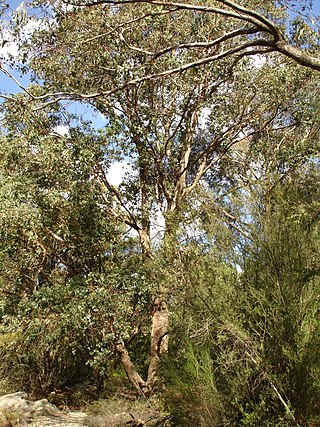
Eucalyptus baueriana, commonly known as blue box or round-leaved box, is a tree that is endemic to south-eastern Australia. It has rough, fibrous or flaky bark on the trunk and branches, egg-shaped adult leaves, oval to diamond-shaped flower buds arranged in groups of seven, white flowers and conical fruit.

Eucalyptus miniata, commonly known as the Darwin woollybutt or woolewoorrng, is a species of medium-sized to tall tree that is endemic to northern Australia. It has rough, fibrous, brownish bark on the trunk, smooth greyish bark above. Adult leaves are lance-shaped, the flower buds are ribbed and arranged in groups of seven, the flowers orange or scarlet and the fruit is cylindrical to barrel-shaped or urn-shaped, with ribs along the sides.

Eucalyptus acmenoides, commonly known as white mahogany or barayly, is a tree that is endemic to eastern Australia. It is a large tree with grey to reddish brown, stringy bark, lance-shaped leaves, oval to spindle-shaped buds and more or less hemispherical fruits. The two sides of adult leaves are very different shades of green.
Melaleuca saligna is a shrub or tree in the myrtle family (Myrtaceae) and is endemic to Cape York Peninsula in Queensland. It is a small tree with papery bark on the trunk, pendulous branches and white to greenish-yellow flowers between February and November. This species should not be confused with Callistemon salignus. If that species were to be moved to the genus Melaleuca, as proposed by some authors, its name would become Melaleuca salicina. Melaleuca saligna has its stamens arranged in bundles; the stamens of Callistemon salignus/Melaleuca salicina are all free.

Melaleuca sieberi is a shrub or tree in the myrtle, family Myrtaceae, which is endemic to coastal areas of New South Wales and Queensland. It is a large shrub or small tree with papery bark on the trunk, small, sharp leaves and small heads of fluffy flowers in spring. It should not be confused with Callistemon sieberi. When the callistemons were moved to Melaleuca, Callistemon sieberi became Melaleuca paludicola.

Eucalyptus dealbata, known as the tumbledown red gum or hill redgum, is a species of small tree that is endemic to eastern Australia. It has mostly smooth, white to grey or brownish bark, lance-shaped to egg-shaped adult leaves, flower buds in groups of between seven and eleven, white flowers and hemispherical fruit with the valves extended well beyond the rim of the fruit.

Eucalyptus oligantha, commonly known as the broad-leaved box, is a species of tree that is native to the Kimberley region of Western Australia and parts of the Northern Territory. It has rough, fibrous or flaky greyish bark, broadly egg-shaped to almost round adult leaves that are lost in the dry season, flower buds in groups of three or seven, creamy yellow to whitish flowers and cup-shaped to more or less cylindrical, bell-shaped or conical fruit.

Eucalyptus pruinosa, commonly known as silver box, silver leaf box, apple box or smoke tree, is a species of tree or a mallee that is endemic to northern Australia. The Jaminjung peoples know the tree as yarrirra or jarnbiny, the Jaru as wararn and the Wagiman as wararn. It has rough, fibrous to flaky bark on the trunk and branches, a crown composed of juvenile, glaucous, heart-shaped to broadly elliptical leaves arranged in opposite pairs, flower buds arranged in groups of seven on the ends of branches, creamy white to pale yellow flowers and cylindrical to conical fruit.

Corymbia clavigera, commonly known as apple gum or cabbage gum, is a species of tree that is endemic to a small area in the north-west Kimberley region of Western Australia. It has smooth, pale grey and white bark, lance-shaped or elliptical adult leaves, flower buds in groups of three or seven, white flowers and urn-shaped to barrel-shaped fruit.
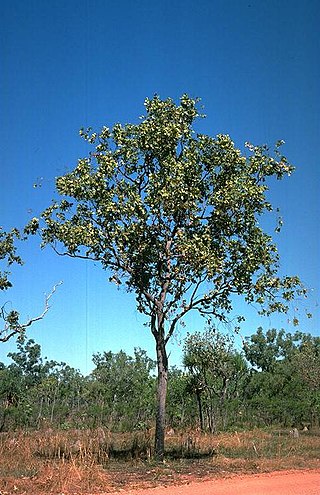
Corymbia ferruginea, commonly known as rusty bloodwood, is a species of tree that is endemic to northern Australia. It has rough, tessellated bark on the trunk and branches, a crown of sessile juvenile leaves, flower buds in groups of three or seven, pale creamy yellow flowers and urn-shaped fruit.

Corymbia setosa, commonly known as rough leaved bloodwood or desert bloodwood, is a species of small tree that is endemic to north-eastern Australia. It has rough, tessellated brown bark on the trunk and branches, a crown of juvenile, heart-shaped leaves arranged in opposite pairs, flower buds in groups of three or seven, white flowers and urn-shaped to shortened spherical fruit.
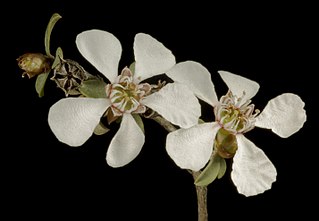
Leptospermopsis erubescens, commonly known as the roadside tea tree, is a species of shrub that is endemic to southwest of Western Australia. It has thin, fibrous bark, egg-shaped leaves, small white flowers and woody fruit.

Baeckea gunniana, commonly known as alpine baeckea, is a species of flowering plant in the family Myrtaceae and is endemic to alpine and sub-alpine areas of south-eastern Australia. It is a densely-branched shrub with egg-shaped to oblong leaves and small white flowers with four to six stamens.

Kunzea phylicoides, commonly known as the slender burgan, is a flowering plant in the myrtle family, Myrtaceae and is endemic to south-eastern Australia. It is an erect shrub with drooping branches, fibrous or corky bark, bright green, narrow leaves and clusters of white flowers in spring.

Gaudium divaricatum is a species of plant that is endemic to inland New South Wales. It is an erect or weeping shrub with compact fibrous bark, elliptical to egg-shaped leaves, white flowers arranged singly on short axillary side shoots and woody fruit that fall off when mature.

Teucrium junceum is a species of flowering plant in the family Lamiaceae, and is endemic to eastern Australia. It is a scrambling, openly-branched shrub, with small leaves, white flowers and orange to red fruit.
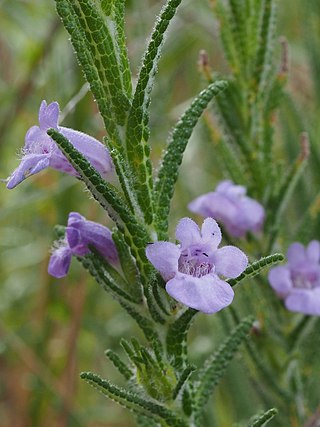
Chloanthes parviflora is a species of flowering plant in the family Lamiaceae. It is a small, rounded shrub with dark green, linear leaves and mauve tubular flowers. It grows in New South Wales and Queensland.
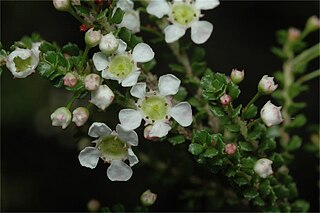
Sannantha cunninghamii is a species of flowering plant in the myrtle family, Myrtaceae and is endemic to eastern New South Wales. It is a shrub with round to broadly elliptic leaves with irregular edges, and white flowers arranged singly, in pairs or groups of three in leaf axils.

