
Fallugia is a monotypic genus of flowering plants containing the single species Fallugia paradoxa, which is known by the common names Apache plume and póñil. This plant is native to the southwestern United States and northern Mexico, where it is found in arid habitats such as desert woodlands and scrub.

Atriplex leucophylla is a species of saltbush known by the common names beach saltbush and white orache. It is native to the coastline of California and Baja California, and the Channel Islands, where it is a resident of beach dunes and other sandy areas.
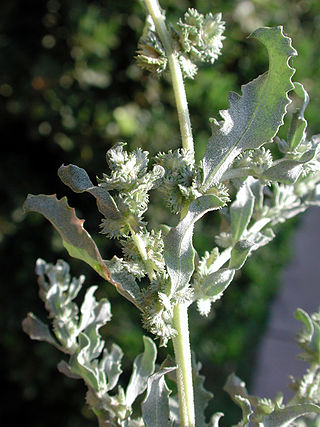
Atriplex elegans is a species of saltbush known by the common name wheelscale saltbush, Mecca orach, or wheelscale. It is native to the Southwestern United States, and northern Mexico, where it grows in areas of saline or alkaline soils, such as alkali flats and desert dry lakebeds.

Atriplex lentiformis is a species of saltbush.
Atriplex parishii is an uncommon species of saltbush known by the common names Parish's saltbush and Parish's brittlescale. It is native to central and southern California where it can occasionally be found along the immediate coastline, and the Channel Islands. Its distribution extended historically into the western edges of the Mojave Desert and Baja California and it may still exist there.
Atriplex serenana is a species of saltbush known by the common names bractscale and stinking orach. It is native to California and Baja California, where it grows in saline and alkaline soils such as those on alkali flats and beach bluffs.
Atriplex spinifera is a species of saltbush, known by the common names spiny saltbush and spinescale saltbush.
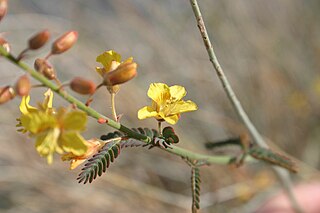
Hoffmannseggia microphylla is a species of flowering plant in the legume family known by the common name wand holdback. It is native to the southwestern United States and Baja California and grows in gullies, canyons, slopes and primarily creosote bush scrub.

Eriophyllum mohavense, also known as the Mojave woolly sunflower or the Barstow woolly sunflower, is a rare species of small annual flowering plant in the family Asteraceae, found only (endemic) in the Mojave Desert of California.

Eriogonum butterworthianum is a rare species of wild buckwheat known by the common name Butterworth's buckwheat. It is endemic to the Santa Lucia Mountains of central Monterey County, California, where it is known from a few occurrences in the wilderness southeast of Big Sur in the vicinity of Junipero Serra Peak. Its native habitats include oak and conifer woodlands, chaparral communities, and sandstone outcrops. Eriogonum butterworthianum is a small clumpy shrub or subshrub that grows up to about 30 centimeters tall and wide. Leaves are 2 centimeters long and reddish-green in color. They are woolly, oval in shape, and curled under at the edges. The inflorescence is a cluster of flowers up to 2 or 3 centimeters wide. Each individual flower is a few millimeters wide and dull yellowish to pinkish in color. Flowers bloom June to September.
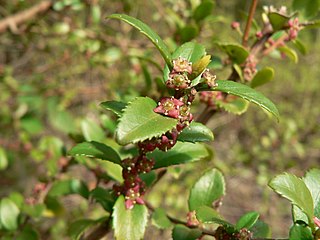
Paxistima myrsinites is a species of shrub in the family Celastraceae. It is native to western North America from British Columbia to northern Mexico to the Rocky Mountains, where it grows in forests, often in the understory.
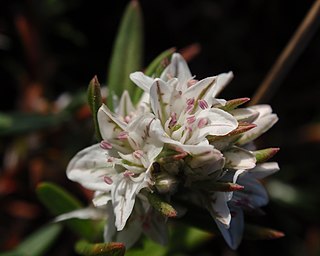
Polygonum paronychia is a species of flowering plant in the knotweed family known by the common names dune knotweed, black knotweed, and beach knotweed. It is native to the coastline of western North America from British Columbia to California, where it grows in sandy coastal habitat such as beaches, dunes, and scrub.

Ribes indecorum is a species of currant known by the common names white-flowered currant and white chaparral currant. It is native to the southern California Coast Ranges, Transverse Ranges, and Peninsular Ranges, from around Santa Barbara County in California south into northern Baja California.

Rosa spithamea is a species of rose known by the common names ground rose and coast ground rose. It is native to Oregon and California, where it grows in forest and chaparral habitats, especially areas recently burned.

Rosa woodsii is a species of wild rose known by the common names Woods' rose, interior rose, common wild rose, mountain rose, pear-hip rose, and prairie rose.
Clinopodium mimuloides is a species of flowering plant in the mint family known by the common name monkeyflower savory. It is endemic to California.
Agave phillipsiana is a rare species of flowering plant in the asparagus family known by the common names Grand Canyon century plant and Phillips agave. It is endemic to Arizona in the United States, where it lives only in Grand Canyon National Park. It is a perennial herb or shrub.

Ericameria paniculata is a species of flowering plant in the sunflower family Asteraceae, native to the southwestern United States. It is an evergreen yellow-flowered desert shrub.
Atriplex acanthocarpa is a species of flowering plant in the amaranth family known by the common names armed saltbush, tubercled saltbush, and huaha. It is native to North America, where it is limited to the US states of Arizona, New Mexico, and Texas, and adjacent Mexico.

Atriplex stipitata, commonly known as mallee saltbush, bitter saltbush and kidney saltbush, is a species of shrub in the family Amaranthaceae, found in all mainland states of Australia.

