
Senecio vulgaris, often known by the common names groundsel and old-man-in-the-spring, is a flowering plant in the daisy family Asteraceae. It is an annual herb, native to Europe and widely naturalised as a ruderal species in suitable disturbed habitats worldwide.

Brodiaea, also known by the common name cluster-lilies, is a monocot genus of flowering plants of the family Themidaceae, in the order Asparagales.

Vitis californica, with common names California wild grape, Northern California grape, and Pacific grape, is a wild grape species widespread across much of California as well as southwestern Oregon.

Torreya californica is a species of conifer endemic to California, occurring in the Pacific Coast Ranges and the foothills of the Sierra Nevada. It is commonly known as California torreya or California nutmeg tree.

Aesculus californica, commonly known as the California buckeye or California horse-chestnut, is a species of buckeye native to California and southwestern Oregon.

Oenothera lindheimeri, formerly Gaura lindheimeri, and commonly known as Lindheimer's beeblossom, white gaura, pink gaura, Lindheimer's clockweed, and Indian feather, is a species of Oenothera.

Kallstroemia is a genus of flowering plants in the caltrop family, Zygophyllaceae. The approximately 17 species it contains are native to tropical and warm temperate regions of the Americas. The flower and fruit morphology is similar to Tribulus. The convex fruits separate into about 10 nutlets each with one seed. The genus is named after A. Kallstroem who lived in the 18th century.

Verbena bonariensis, the purpletop vervain, clustertop vervain, Argentinian vervain, tall verbena or pretty verbena, is a member of the verbena family cultivated as a flowering annual or herbaceous perennial plant. In USA horticulture, it is also known by the ambiguous names purpletop and South American vervain. For the misapplication "Brazilian verbena" see below.

Rosa californica, the California wildrose, or California rose, is a species of rose native to the U.S. states of California and Oregon and the northern part of Baja California, Mexico. The plant is native to chaparral and woodlands and the Sierra Nevada foothills, and can survive drought, though it grows most abundantly in moist soils near water sources.

Triteleia laxa is a triplet lily known by several common names, including Ithuriel's spear, common triteleia and grassnut. It is native to California where it is a common wildflower, and it is occasionally found in southwestern Oregon. It bears a tall, naked stem topped with a spray of smaller stalks, each ending in a purple or blue flower. The flower is tubular, opening into a sharply six-pointed star. The plant grows from a corm which is edible and similar in taste and use as the potato. The most used common name for the species, Ithuriel's spear, is a reference to the angel Ithuriel from Milton's Paradise Lost.

Cucurbita palmata is a species of flowering plant in the squash family known by the common names coyote melon and coyote gourd. It is similar to Cucurbita californica, Cucurbita cordata, Cucurbita cylindrata, and Cucurbita digitata and all these species hybridize readily. It was first identified by Sereno Watson in 1876. These species form the only restricted xerophyte species group in the genus Cucurbita. Each member of this species group is native to the Southwestern United States and Northwestern Mexico where they are relatively uncommon. Each group member is found in hot, arid regions with low rainfall. They prefer soil that is loose, gravelly, and well-drained. C. palmata is native to northeastern Baja California, southeastern California, and southwestern Arizona to a point near the Colorado River. The juvenile leaves of C. cylindrata, C. cordata, C. digitata, and C. palmata show a high degree of similarity, but their mature leaves are visibly different, as are their root structures. C. palmata and C. digitata are sympatric, with C. palmata separating the ranges of C. digitata at the juncture of Baja California, California, and Arizona. C. palmata fruits are diffuse green mottle that turns yellow at maturity, striped, and round.

Brodiaea terrestris, the dwarf brodiaea, is a species of plant in the genus Brodiaea that is native to California and Oregon.
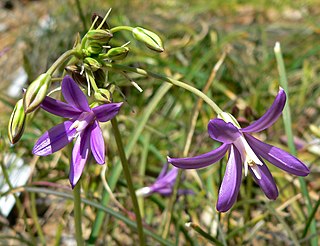
Brodiaea appendiculata, the appendage brodiaea or appendage cluster-lily,) is an uncommon species of plant in the genus Brodiaea.
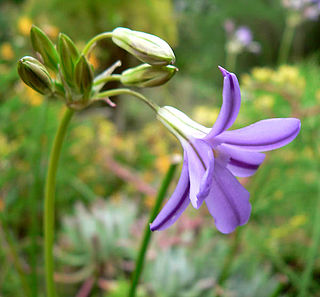
Brodiaea kinkiensis is a species of Brodiaea also with the common name San Clemente Island brodiaea. This flower is endemic to San Clemente Island, one of the Channel Islands of California.

Calliandra californica, the Baja fairy duster, is an evergreen, woody shrub which is native to Baja California, Mexico. In Spanish, the plant is also known vernacularly as tabardillo,zapotillo or chuparosa. The flowers, which appear in early summer, have clusters of red stamens. The shrub is usually between 0.6 and 1.8 metres in height and has bipinnate leaves. The leaves have been described as "fern-like." Leaves close at night time.

Brodiaea coronaria is the type species of Brodiaea and also known by the common names harvest brodiaea and crown brodiaea. It is native to western North America from British Columbia to northern California, where it grows in mountains and grasslands.
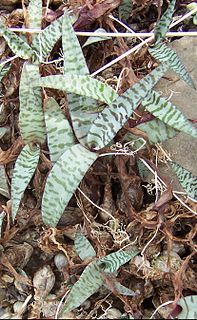
Ledebouria socialis, the silver squill or wood hyacinth, is a geophytic species of bulbous perennial plant native to the Eastern Cape Province of South Africa. It was first described by John Gilbert Baker as Scilla socialis in 1870. John Peter Jessop later revised the genus Scilla and split off several species, reclassifying Scilla socialis into the genus Ledebouria in 1970. It is often cultivated and grows well with minimal care.

Jasminum multiflorum, commonly known as star jasmine, is a species of jasmine, in the family Oleaceae.

Pyrostegia venusta, also commonly known as flamevine or orange trumpetvine, is a plant species of the genus Pyrostegia of the family Bignoniaceae originally endemic to southern Brazil, Bolivia, northeastern Argentina and Paraguay, but is now a popularly cultivated garden species.


