Cambodian general election, 2003

Last updated
Cambodian general election, 2003
Flag of Cambodia.svg
  1998 27 July 2003 2008  

All 123 seats to the National Assembly
62 seats needed for a majority
Registered 6,341,834 Increase2.svg 17.5%
Turnout 5,277,494 (83.2%) Decrease2.svg 10.5%

 First partySecond partyThird party
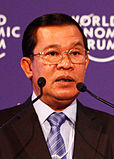
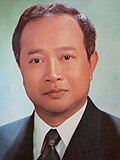
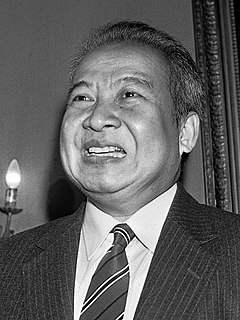
  Hun Sen.jpg Ranariddh 1990s.jpg Sam Rainsy.jpg
Leader Hun Sen Norodom Ranariddh Sam Rainsy
Party CPP FUNCINPEC SRP
Leader since14 January 1985February 1992June 1995
Leader's seat Kandal Kampong Cham Kampong Cham
Last election64 seats, 41.4%43 seats, 31.7%15 seats, 14.3%
Seats before644315
Seats won732624
Seat changeIncrease2.svg 9Decrease2.svg 17Increase2.svg 9
Popular vote2,447,2591,072,3131,130,423
Percentage47.3%20.8%21.9%
SwingIncrease2.svg 5.9%Decrease2.svg 10.9%Increase2.svg 7.6%

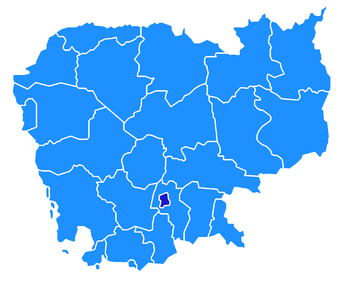
Cambodia election map 2003.png

Prime Minister before election

Hun Sen
CPP

Elected Prime Minister

Hun Sen
CPP

Royal Arms of Cambodia.svg
This article is part of a series on the
politics and government of
Cambodia
Foreign relations

General elections were held in Cambodia on 27 July 2003 to elect members of the National Assembly. The election was won by the incumbent Prime Minister Hun Sen's Cambodian People's Party, who claimed a majority of 73 seats in the 123-seat parliament. However, due to the requirement for a two-thirds majority to elect a Prime Minister, a new government was not formed until July 2004 when a deal was reached with the Funcinpec party.

Cambodia Southeast Asian sovereign state

Cambodia, officially the Kingdom of Cambodia, is a country located in the southern portion of the Indochina peninsula in Southeast Asia. It is 181,035 square kilometres in area, bordered by Thailand to the northwest, Laos to the northeast, Vietnam to the east and the Gulf of Thailand to the southwest.

National Assembly of Cambodia National Assembly of Cambodia

The National Assembly is one of the two houses (chambers) of the Parliament of Cambodia. It is referred to as the lower house, with the Senate being referred to as the upper house.

The incumbent is the current holder of an office. This term is usually used in reference to elections, in which races can often be defined as being between an incumbent and non-incumbent(s). For example, in the Hungarian presidential election, 2017, János Áder was the incumbent, because he had been the president in the term before the term for which the election sought to determine the president. A race without an incumbent is referred to as an open seat.

Contents

Background

Cambodia became a democracy in the early 1990s with the first democratic election held in 1993. [1] After both elections during the 1990s the Cambodian People's Party formed coalition governments with the royalist Funcinpec party. [1] The last election in 1998 saw significant amounts of violence and intimidation of opposition supporters. [2] It took place a year after Funcinpec had been violently ousted from the coalition government by the Cambodian People's Party. [3] However following the election they once more formed a coalition with Hun Sen as Prime Minister and Funcinpec's leader Prince Norodom Ranarridh, the son of King Norodom Sihanouk, as his deputy. [1]

Prime Minister of Cambodia

The Prime Minister of the Kingdom of Cambodia is the head of government of Cambodia. The prime minister is also the chairman of the Cabinet and leads the executive branch of the Royal Cambodian Government. The prime minister is required to be a member of parliament, and is appointed by the monarch for a term of five years. Since 1945, 36 individuals have served as prime minister.

Norodom Sihanouk Cambodian King

Norodom Sihanouk was a Cambodian royal, politician, composer and filmmaker who was twice the King of Cambodia. He was the son of King Norodom Suramarit and Queen Sisowath Kossamak. In Cambodia, he is also known as Samdech Euv.

In local elections in 2002 the Cambodian People's Party performed strongly leading in 1,597 of the 1,621 communes of Cambodia. [4] Meanwhile, the Funcinpec party suffered a setback dropping to only 22% of the vote. [4]

Administrative divisions of Cambodia have several levels. Cambodia is divided into 24 provinces and the special administrative unit Phnom Penh. Though a different administrative unit, Phnom Penh is at province level, so de facto Cambodia has 25 provinces and municipality.

Campaign

The run-up to the election saw some violence including the killing of a judge and a royalist politician, [5] however it was much reduced from previous elections. [6] During the campaign the United States Secretary of State Colin Powell visited Cambodia, met all three main party leaders and called on all parties to have fair coverage in the media. [1] The opposition were able to get some time on television during the campaign, [4] but there were many reports in rural areas of voters being intimidated by the Cambodian People's Party. [7] In total 22 parties contested the election but only three were seen as real contenders in the election. [8]

Judge official who presides over court proceedings

A judge is a person who presides over court proceedings, either alone or as a part of a panel of judges. The powers, functions, method of appointment, discipline, and training of judges vary widely across different jurisdictions. The judge is supposed to conduct the trial impartially and, typically, in an open court. The judge hears all the witnesses and any other evidence presented by the barristers of the case, assesses the credibility and arguments of the parties, and then issues a ruling on the matter at hand based on his or her interpretation of the law and his or her own personal judgment. In some jurisdictions, the judge's powers may be shared with a jury. In inquisitorial systems of criminal investigation, a judge might also be an examining magistrate.

United States Secretary of State U.S. cabinet member and head of the U.S. State Department

The Secretary of State is a senior official of the federal government of the United States of America, and as head of the United States Department of State, is principally concerned with foreign policy and is considered to be the U.S. government's equivalent of a Minister for Foreign Affairs.

Colin Powell Former U.S. Secretary of State and retired four-star general

Colin Luther Powell is an American statesman and a retired four-star general in the United States Army. During his military career, Powell also served as National Security Advisor (1987–1989), as Commander of the U.S. Army Forces Command (1989) and as Chairman of the Joint Chiefs of Staff (1989–1993), holding the latter position during the Persian Gulf War. Powell was the first, and so far the only, Jamaican American to serve on the Joint Chiefs of Staff. He was the 65th United States Secretary of State, serving under U.S. President George W. Bush from 2001 to 2005, the first black person to serve in that position.

The Cambodian People's Party had control of much of the media in Cambodia, the most money and a superior party machine. [2] The party campaigned on the economic development they said that they were bringing to Camdodia and in the March before the election they announced a 1.5 billion dollar program to counter poverty. [2] The party and their leader Hun Sen won support from voters due to their presiding over the most peaceful period in the countries recent history after ending the rule of the Khmer Rouge. [4] The party had the strongest support in rural areas of Cambodia, but younger voters in urban areas were more desirous of change and therefore supportive of the opposition. [9]

News media elements of the mass media that focus on delivering news

The news media or news industry are forms of mass media that focus on delivering news to the general public or a target public. These include print media, broadcast news, and more recently the Internet.

Political machine

A political machine is a political group in which an authoritative boss or small group commands the support of a corps of supporters and businesses, who receive rewards for their efforts. The machine's power is based on the ability of the boss or group to get out the vote for their candidates on election day.

Economic development is the process by which a nation improves the economic, political, and social well-being of its people. The term has been used frequently by economists, politicians, and others in the 20th and 21st centuries. The concept, however, has been in existence in the West for centuries. "Modernization, "westernization", and especially "industrialization" are other terms often used while discussing economic development. Economic development has a direct relationship with the environment and environmental issues. Economic development is very often confused with industrial development, even in some academic sources.

The two main opposition parties criticised the government of Hun Sen for its corruption and pledged to improve health and education in Cambodia. [8] Funcinpec called for reform of the economy and for more foreign investment, but their leader, Norodom Ranariddh, was seen as being ineffective and his party's popularity was in decline. [2] [8] Meanwhile, the Sam Rainsy Party criticised corruption, pledged more money for health, education and civil servant pay and attempted to attract the poor. [8] The party had grown in strength since the previous election but their leader Sam Rainsy was seen as being authoritarian. [2]

A foreign direct investment (FDI) is an investment in the form of a controlling ownership in a business in one country by an entity based in another country. It is thus distinguished from a foreign portfolio investment by a notion of direct control.

Norodom Ranariddh 20th and 21st-century Cambodian politician

Norodom Ranariddh is a Cambodian royal politician and law academic. He is the second son of Norodom Sihanouk of Cambodia and a half-brother of the current king, Norodom Sihamoni. Ranariddh is the president of FUNCINPEC, a Cambodian royalist party. He was also the First Prime Minister of Cambodia following the restoration of the monarchy, serving between 1993 and 1997, and subsequently as the President of the National Assembly between 1998 and 2006.

Sam Rainsy Cambodian politician

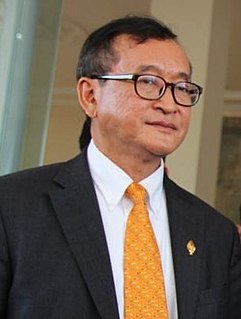
Sam Rainsy is a Cambodian activist and politician who most recently served as the Leader of the Opposition. He is now the president of the Cambodia National Rescue Movement (CNRM), launched in January 2018. He was a Member of Parliament (MP) for Kampong Cham, first from 1998 until 2005, then from 2008 to 2011, and finally from 2014 until 2015; he has been revoked of parliamentary immunity three times. He was previously the MP for Siem Reap from 1993 until 1995 when he was expelled from the Constituent Assembly. A co-founder of the Cambodia National Rescue Party (CNRP), Rainsy was previously a member of the royalist Funcinpec Party and served as the Minister of Economy and Finance during Norodom Ranariddh's administration from 1993 until his sacking in 1994. In June 1995, he was expelled from the National Assembly, and formed the Khmer Nation Party (KNP), which changed its name before the 1998 elections to the Sam Rainsy Party (SRP) to avoid registration issues. From 2000 to 2002 and again from 2012 to 2014, Rainsy was the chairperson of the Council of Asian Liberals and Democrats.

Results

Voter turnout in the election was high with over 80% casting ballots. [10] The results saw the Cambodian People's Party win a clear majority of seats but fell short of the two-thirds majority required in order to elect a Prime Minister on their own. [11] Funcinpec lost ground dropping from the 31% they had won in 1998 to only just over 20% this time, while the Sam Rainsy Party rose to 22% from 14% in 1998. [12]

Cambodian National Assembly composition, 2003-2008.svg
PartyVotes%Seats+/–
Cambodian People's Party 2,447,25947.3573+9
FUNCINPEC 1,072,31320.7526–17
Sam Rainsy Party 1,130,42321.8724+9
Khmer Democratic Party 95,9271.8600
The Rice Party76,0861.470New
Indra Buddra Party62,3381.210New
Khmer Soul Party56,0101.080New
Cambodian Development Party36,8380.710New
Khmer Angkor Party26,3850.5100
Cambodian Women's Party23,5380.460New
Khmer Front Party20,2720.390New
Khmer Unity Party18,3090.3500
Hang Dara Democratic Movement Party 15,6710.300New
Khmer Spiritual Aspiration Party14,3420.280New
Kon Khmer Party14,0180.270New
Union of National Solidarity Party11,6760.230New
Khmer Help Khmer9,4820.180New
Farmer's Party9,4490.180New
Molinaka and the Khmer Freedom Fighters Party6,8080.1300
Cambodian Free Independent Democratic Party6,8060.130New
Khmer Citizens' Party6,5260.1300
National Khmer Party4,2320.080New
Liberal Democratic Party 4,1290.0800
Invalid/blank votes108,657
Total5,277,494100123+1
Registered voters/turnout6,341,83483.22
Source: COMFREL
73
26
24
CPP
FCP
SRP

Aftermath

Following the election Funcinpec and the Sam Rainsy Party refused to attend parliament and formed an "Alliance of Democrats" in order to block Hun Sen from being elected Prime Minister again. [13] They rejected the official results and said that they had been manipulated by the Cambodian People's Party. [11] After initially boycotting parliament the two parties were persuaded by the King to attend the swearing in at the end of September, but remained firm in rejecting joining a government led by Hun Sen. [14] However, despite no government being formed, a caretaker administration run by Hun Sen and the Cambodian People's Party was able to continue. [14]

A provisional agreement was said to have been reached in November on a three party government led by Hun Sen but the opposition later denied this. [13] Personal dislike between the three parties and the opposition of the Cambodia People's Party to a three party government meant negotiations on forming a government dragged on into 2004. [13] Eventually, 11 months after the election, [15] towards the end of June 2004 the Cambodia People's Party and Funcinpec reached an agreement under which ministerial seats would be divided up 60-40 between them and Hun Sen would remain Prime Minister. [16] On the 15 July 2004 the Cambodian parliament finally approved the new government with 96 of the 123 members voting in favour. [17] There was a significant increase in the number of ministers to 207, including 7 deputy prime ministers and 180 cabinet ministers, in order to reach agreement on the new government. [15]

Literature

Related Research Articles

Politics of Cambodia

The Kingdom of Cambodia is a unitary state that is governed within the framework of a constitutional monarchy, in which the monarch serves as the head of state, while the prime minister is the head of government. The collapse of the Soviet Union in 1989 had set in motion events that led to withdrawal of the Vietnamese armed forces that had established their presence in the country since the fall of the Khmer Rouge in 1979. The 1993 constitution, which is currently in force, was promulgated as a result of the 1991 Paris Peace Agreements, followed by the elections organized under the aegis of the United Nations Transitional Authority in Cambodia. The constitution proclaims a liberal, multiparty democracy in which powers are devolved to the three arms of the state: the executive, the judiciary and the legislature. Furthermore, the governing charter declares Cambodia to be an "independent, sovereign, peaceful, permanently neutral and non-aligned State."

After the fall of the Pol Pot regime of Democratic Kampuchea, Cambodia was under Vietnamese occupation and a pro-Hanoi government, the People's Republic of Kampuchea was established. A civil war raged during the 1980s opposing the government's Kampuchean People's Revolutionary Armed Forces against the Coalition Government of Democratic Kampuchea, a government in exile composed of three Cambodian political factions: Prince Norodom Sihanouk's Funcinpec party, the Party of Democratic Kampuchea and the Khmer People's National Liberation Front (KPNLF).

Hun Sen Prime Minister of Cambodia

Hun Sen is a Cambodian politician and the Prime Minister of Cambodia, President of the Cambodian People's Party (CPP) and Member of Parliament (MP) for Kandal. He has served as Prime Minister since 1985, making him the world’s longest-serving prime minister, the longest-serving head of government of Cambodia and one of the longest-serving leaders in the world. From 1979 to 1986 and again from 1987 to 1990, Hun Sen also served as Cambodia's foreign minister. His full honorary title is Samdech Akka Moha Sena Padei Techo Hun Sen. Born Hun Bunal, he changed his name to Hun Sen in 1972 two years after joining the Khmer Rouge.
FUNCINPEC political party

FUNCINPEC, National United Front for an Independent, Neutral, Peaceful and Cooperative Cambodia in English, is a royalist political party in Cambodia. Founded in 1981 by Norodom Sihanouk, it started off as a resistance movement against the People's Republic of Kampuchea (PRK) government. In 1982, it formed a resistance pact, the Coalition Government of Democratic Kampuchea (CGDK), together with the Khmer People's National Liberation Front (KPNLF) and the Khmer Rouge. It was one of the signatory parties of the 1991 Paris Peace Accords, which paved the way for the formation of the United Nations Transitional Authority in Cambodia (UNTAC). In 1992, FUNCINPEC became a political party and participated in the 1993 general elections organised by UNTAC. It won the elections, and formed a coalition government with the Cambodian People's Party (CPP), with which it jointly headed. Norodom Ranariddh, Sihanouk's son who had succeeded him as the party president, became First Prime Minister while Hun Sen, who was from the CPP, became Second Prime Minister.
Chea Sim Cambodian politician

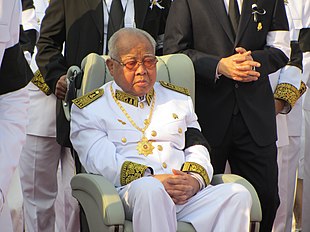
Chea Sim was a Cambodian politician. He was President of the Cambodian People's Party from 1991 to 2015, President of the National Assembly of Cambodia from 1981 to 1998 and President of the Senate from 1999 to 2015. His official title was Samdach Akeak Moha Thomak Pothisal Chea Sim, Protean Protsaphea ney Preah Reacheanachak Kampuchea.

Norodom Chakrapong Cambodian prince

Norodom Chakrapong is a Cambodian royal politician, businessman and former major-general of the Royal Cambodian Armed Forces. He is the fourth son of Norodom Sihanouk of Cambodia and also a half-brother of the current king, Norodom Sihamoni. Chakrapong started his career as a military pilot in 1963. After Sihanouk was overthrown in 1970, Chakrapong spent time under house arrest, then in Beijing as the Head of Protocol of then-Prince Sihanouk, afterwards living overseas before he joined the Funcinpec in 1981 and fought against Vietnamese occupation as a commander of the Armée Nationale Sihanoukiste. In 1991, Chakrapong left Funcinpec to join the Cambodian People's Party (CPP) and served as the Deputy Prime Minister of Cambodia between 1992 and 1993. When the CPP lost the 1993 general elections, Chakrapong led a secession attempt in 1993. In 1994, he was accused of joining a failed coup attempt which led him to be sent into exile. After Chakrapong was pardoned in 1998, he founded a private airline company, Royal Phnom Penh Airways. The airlines later stopped all operations in early 2006.

Ung Huot is a Cambodian politician who served from 1997 to 1998 as Prime Minister of Cambodia, alongside Hun Sen. A member of the FUNCINPEC Party, he first served as Minister of Education, and later as Minister of Foreign Affairs before being appointed as Prime Minister.

Sar Kheng Cambodian Minister of the Interior

Sar Kheng is a Cambodian politician. One of the highest-ranking members of the ruling Cambodian People's Party, he is the current Minister of the Interior and has served as a Deputy Prime Minister since 1992. He also represents the province of Battambang in the Cambodian Parliament. Kheng has been the Minister of the Interior since 1992. Until March 2006, he shared the position with FUNCINPEC party member You Hockry as co-Ministers of the Interior, but then became sole interior minister in a cabinet reshuffle as FUNCINPEC ended its coalition with the CPP. He is currently the second longest serving government minister of Cambodia after Prime Minister Hun Sen. On June 14, 2015, King Norodom Sihamoni awarded Kheng the honorary title of "Samdech". His official title is "Samdech Kralahom Sar Kheng". Kheng is married to Nhem Sakhan with whom he has three children.

2008 Cambodian general election

General elections were held in Cambodia on 27 July 2008. The result was a victory for the ruling Cambodian People's Party, which won 90 of the 123 seats.

Mu Sochua Cambodian politician

Mu Sochua is a Cambodian politician and rights activist. She was a Member of Parliament (MP) for Battambang from 2013 to 2017, a seat which she previously held from 1998 to 2003. She was a member and Vice President of the Cambodia National Rescue Party (CNRP) until its dissolve, and previously a member of the Sam Rainsy Party (SRP) prior to its merger with the Human Rights Party. As a member of FUNCINPEC, she also served as Minister of Women and Veterans' Affairs in Hun Sen's coalition government from 1998 to 2004. She is currently one of 118 senior opposition figures serving a five-year ban from politics following a court ruling on 16 November 2017.

1997 clashes in Cambodia

The 1997 clashes in Cambodia, also referred to as the 1997 coup in Cambodia, took place in Cambodia in July to September 1997. As a result, co-premier Hun Sen ousted the other co-premier Norodom Ranariddh. Dozens of people were killed during the conflict.
1998 Cambodian general election

General elections were held in Cambodia on 26 July 1998. The result was a victory for the Cambodian People's Party (CPP), which won 64 of the 122 seats, resulting in its leader Hun Sen becoming Prime Minister. Opposition parties sought a recount and claimed there had been irregularities, claims supported by many international observers. Voter turnout was 93.7%.

2013 Cambodian general election

General elections were held in Cambodia on 28 July 2013. The National Election Committee (NEC) announced that some 9.67 million Cambodians were eligible to cast their ballots to elect the 123-seat National Assembly. Voter turnout was reported to be 69.6%, making it the lowest turnout in history. Polling precincts opened 7:00 a.m. and closed at 3:00 p.m. The Cambodian Minister of Information, Khieu Kanharith announced in preliminary results that the Cambodian People's Party won 68 seats and the opposition Cambodia National Rescue Party won all the remaining 55 seats. This election marked the largest seat loss by the Cambodian People's Party to date, and their lowest share of seats since 1998.

2013–14 Cambodian protests Cambodian anti-government protests in 2013 and 2014

Anti-government protests were ongoing in Cambodia from July 2013 to July 2014. Popular demonstrations in Phnom Penh have taken place against the government of Prime Minister Hun Sen, triggered by widespread allegations of electoral fraud during the Cambodian general election of 2013. Demands to raise the minimum wage to $160 a month and resentment at Vietnamese influence in Cambodia have also contributed to the protests. The main opposition party refused to participate in parliament after the elections, and major demonstrations took place throughout December 2013. A government crackdown in January 2014 led to the deaths of 4 people and the clearing of the main protest camp.

Tboung Khmum Province Province in Cambodia

Tboung Khmum, officially Tbong Khmum, is a province (khaet) of Cambodia located on the central lowlands of the Mekong River. It borders the provinces of Kampong Cham to the west, Kratié to the north, Prey Veng to the south, and shares an international border with Vietnam to the east. Its capital and largest city is Suong. The province's name consists of two words in Khmer, tboung and khmum (bee), which together mean "amber".

Community of Royalist Peoples Party

The Community of Royalist People's Party was a Cambodian political party that lasted from March 2014 until January 2015. It was founded and led by Norodom Ranariddh, who had been ousted from FUNCINPEC back in 2006. Ideologically a royalist party, the CRPP drew its inspiration from the political legacy of the former King of Cambodia, Norodom Sihanouk, and competed for its voter base with both FUNCINPEC and the Cambodia National Rescue Party (CNRP). In January 2015, the CRPP was dissolved when Ranariddh returned to FUNCINPEC.

2018 Cambodian general election

General elections were held in Cambodia on Sunday, 29 July 2018 to elect members of the sixth National Assembly. Polling stations opened at 07:00 and closed at 15:00. The number of registered voters has decreased for the first time since 1993 and was down 13% from the 2013 general elections.

References

  1. 1 2 3 4 Kazmin, Amy (2003-06-20). "Powell call over Cambodian poll media US OFFICIAL'S VISIT:". Financial Times. p. 10.
  2. 1 2 3 4 5 "Asia: Limousines and poverty; Cambodia". The Economist. 2003-06-07. p. 62.
  3. Spillius, Alex (2003-07-28). "Hun Sen on his way to poll win in Cambodia". The Daily Telegraph. p. 12.
  4. 1 2 3 4 "Asia: Stronger and stronger; Cambodia's election". The Economist. 2003-07-26. p. 59.
  5. Madra, Ek (2003-04-24). "Senior Cambodian judge assassinated". The Independent. p. 16.
  6. Aglionby, John (2003-07-26). "Cambodia edges towards change". The Guardian. p. 17.
  7. Kazmin, Amy (2003-07-26). "Dark threats likely to keep Cambodia's ruling party in power". Financial Times. p. 5.
  8. 1 2 3 4 "Cambodia Election Guide". BBC Online . 2003-07-25. Retrieved 2009-05-27.
  9. Kazmin, Amy (2003-07-22). "Cambodia's disenchanted young grow restless for a brighter future: Many are fervently hoping for a new government when this Sunday the country goes to its first poll since 1998, Amy Kazmin reports". Financial Times. p. 9.
  10. Aglionby, John (2003-07-28). "80% turnout for Cambodian vote". The Guardian. p. 10.
  11. 1 2 Kazmin, Amy (2003-07-30). "Opposition rejects Hun Sen victory claim CAMBODIAN ELECTIONS:". Financial Times. p. 9.
  12. Kazmin, Amy (2003-07-31). "Cambodian prime minister rejects calls to step down". Financial Times. p. 9.
  13. 1 2 3 "Asia: Deadlock; Cambodia;". The Economist. 2004-02-21. p. 66.
  14. 1 2 Kazmin, Amy (2003-09-29). "Cambodian parties boycott parliament over resignation call". Financial Times. p. 2.
  15. 1 2 "Cambodian government faces uphill task". BBC Online . 2004-07-15. Retrieved 2009-05-27.
  16. Kazmin, Amy (2004-06-28). "Coalition deal in Cambodia ends 11-month post-election standoff". Financial Times. p. 2.
  17. "Cambodian parliament ends deadlock". BBC Online . 2004-07-15. Retrieved 2009-05-26.