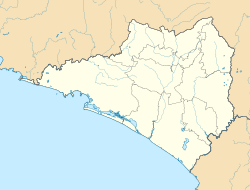
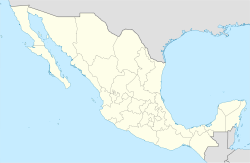
Colima Airport (Spanish: Aeropuerto Internacional de Colima), officially Aeropuerto Internacional Licenciado Miguel de la Madrid (Licenciado Miguel de la Madrid International Airport) (IATA: CLQ, ICAO: MMIA), is an international airport in Colima, Mexico. It handles scheduled passenger flights and general aviation operations. The airport is named after former President of Mexico Miguel de la Madrid and was designated as an international airport in September 2025. It is operated by Grupo Aeroportuario de la Marina under the Secretaría de Marina (SEMAR).
Construction of the airport began in 1983. The airport's first flight occurred on September 17, 1987, when an Aeroméxico DC-9 transported special guests for Governor Elías Zamora Verduzco's state address.[2] On October 8, 1987, the Secretaría de Comunicaciones y Transportes (SCT) transferred the airport to Aeropuertos y Servicios Auxiliares (ASA) for operational management.[3]
Early operations and route development (1988-2008)
By 1989, Aero California had expanded service to include nonstop flights to Mexico City and Tijuana.[6] On November 24, 1992, regional carrier Aeromar began daily service to Mexico City.[7] By July 1999, Aeroméxico also operated four weekly flights to Mexico City and Tijuana, with Aeromar providing additional daily service as an Aeroméxico Connect partner.[8]
On April 3, 2006, all Aero California operations were suspended by the Secretaría de Comunicaciones y Transportes for administrative and operational deficiencies.[9] The airline resumed service on August 11, 2006,[10] with Colima among the first destinations restored.
On July 23, 2008, Aero California was suspended again due to unpaid debts totaling 259.5 million pesos and never resumed operations.[11] The airport handled 102,896 passengers in 2008, which dropped to 43,610 passengers in 2009, a 57% decline.[12]
Recovery and expansion (2009-2023)
Following Aero California's closure, Aeromar became the primary carrier with service to Mexico City. Volaris entered the market on May 31, 2012, with service to Tijuana.[13] Passenger traffic gradually recovered, reaching 138,962 by 2016.
Aeroméxico launched daily service on September 18, 2017, but discontinued it on June 30, 2018.[14] Volaris added Mexico City service on November 15, 2018, operating three weekly flights. Passenger numbers reached 194,471 in 2019, the highest level prior to the COVID-19 pandemic.
The pandemic reduced passenger traffic to 105,671 in 2020. On February 15, 2023, Aeromar ceased operations after 35 years of service.[15] Aeroméxico resumed service on March 16, 2023,[16] and transferred its service to Felipe Ángeles International Airport on October 5, 2023.[17] The airport handled 201,243 passengers in 2023 and reached a record 212,435 passengers in 2024.
International designation (2025)
On September 18, 2025, the airport was officially designated as international, with management transferred from ASA to Grupo Aeroportuario de la Marina under the Secretaría de Marina (SEMAR).[18] A modernization project valued at 327 million pesos (US$17.5 million) commenced to expand capacity and improve facilities in preparation for international operations.
Facilities
The control tower at CLQPassenger terminal landside
The airport is located at an elevation of 752 metres (2,467ft) and covers an area of 386 hectares (950 acres). It has a single 2,300 metres (7,500ft)asphaltrunway designated 07/25. The apron measures 16,200 square metres (174,000sqft) and includes three parking positions for narrow-body aircraft, as well as spaces for smaller aircraft and helicopters.
The passenger terminal is a single-story facility handling both arrivals and departures. The terminal includes parking facilities, a check-in area with ticketing counters, security screening, a baggage claim area, and an arrivals hall with car rental services and taxi stands. The departure concourse has two gates with direct apron access, allowing passengers to board aircraft via walking.
In addition to commercial operations, the airport includes a cargo handling facility, a dedicated general aviation terminal for private and charter flights, and administrative offices.
↑"Mañana llega el Primer Vuelo al Aeropuerto de Buenavista" [Tomorrow the first flight arrives at Buenavista Airport]. Diario de Colima (in Spanish). 16 September 1987.
↑"SCT Entrego Oficialmente el Aeropuerto a ASA" [SCT officially handed over the airport to ASA]. Diario de Colima (in Spanish). 8 October 1987.
↑"Ayer llegó el Primer Vuelo Comercial al aeropuerto Buenavista" [Yesterday the first commercial flight arrived at Buenavista airport]. Diario de Colima (in Spanish). 13 February 1988.
↑Cárdenas Rangel, Efrén (12 March 1988). "MMH Inauguró Ayer el Aeropuerto Colima" [MMH inaugurated Colima Airport yesterday]. Diario de Colima (in Spanish).
↑"Ayer por la mañana, un grupo de usuarios de la aerolínea Aerocalifornia se manifestaron" [Yesterday morning, a group of Aerocalifornia users protested]. Diario de Colima (in Spanish). 4 April 2006.
↑Fuentes González, Arturo (10 August 2006). "La aerolínea Aerocalifornia confirmó que reiniciará operaciones" [Aerocalifornia airline confirmed it will resume operations]. Diario de Colima (in Spanish).
↑"Suspende la SCT los vuelos de Aerocalifornia" [SCT suspends Aerocalifornia flights]. Diario de Colima (in Spanish). 24 July 2008.
This page is based on this Wikipedia article Text is available under the CC BY-SA 4.0 license; additional terms may apply. Images, videos and audio are available under their respective licenses.