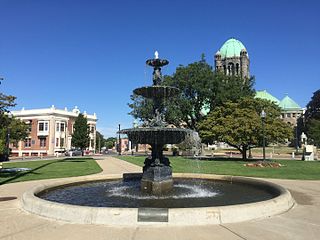
Taunton is a city and county seat of Bristol County, Massachusetts, United States. Taunton is situated on the Taunton River, which winds its way through the city on its way to Mount Hope Bay, 10 miles (16 km) to the south. As of the 2020 census, the city had a population of 59,408, the third most populated municipality in Bristol County behind New Bedford and Fall River. Shaunna O'Connell is the mayor of Taunton.

B.M.C. Durfee High School is an historic former high school building at 289 Rock Street in Fall River, Massachusetts. The school was built in 1886 and added to the National Register of Historic Places in 1981. In 1978, it was replaced by the current B.M.C. Durfee High School building. The old building was restored in the early 1990s and is now operated as a probate and family courthouse by the Commonwealth of Massachusetts.

St. Joseph's Orphanage is an historic former orphanage and school located at 56 St. Joseph Street in Fall River, Massachusetts.

St. Anne Shrine is a historic local landmark located at the intersection of South Main and Middle streets in Fall River, Massachusetts. Until 2018, it was a parish in the Roman Catholic Diocese of Fall River. In addition to the church, the complex also includes the former Dominican Order monastery as well as the former Dominican Academy, constructed in 1894. The great upper church was formally dedicated on July 4, 1906 and closed November 25, 2018. The Lower Crypt Church shrine was re-opened July 4, 2019, but the upper part of the church remains closed for restoration and renovation.

Central Congregational Church is a historic church at 100 Rock Street in Fall River, Massachusetts.

The Unitarian Society was a historic church building located in Fall River, Massachusetts.
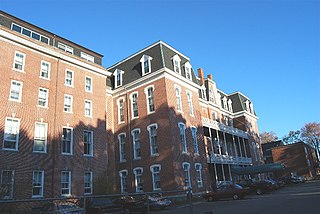
The Jesus Mary Convent is a historic former convent located at 138 St. Joseph's Street in Fall River, Massachusetts. It was built in 1887 and designed by local architect and parish member Louis G. Destremps, who also designed the nearby orphanage, school and church.

The John Mace Smith House is a historic house at 399 N. Main Street in Fall River, Massachusetts. The house was built in 1844 and added to the National Register of Historic Places in 1983.

Notre Dame School is a historic former school building located at 34 St. Joseph's Street in Fall River, Massachusetts. Located in the Flint neighborhood, it was built in 1899, and designed by local architect and parish member Louis G. Destremps, who also designed the nearby St. Joseph's Orphanage and Notre Dame de Lourdes Church.

The Osborn Street School is a historic school building located at 160 Osborn Street in Fall River, Massachusetts. It was built in 1893, to replace an earlier schoolhouse on the same site. It also briefly served as the city's normal school for training new teachers before it was moved to the William S. Greene School.

Corky Row Historic District is a historic district located in Fall River, Massachusetts bounded by Plymouth Avenue, Interstate-195 and Second Street. The district contains many early multi-family mill tenement houses, along with the Davol Mills, the Tecumseh Mill No. 1 and several commercial properties.

Davol School is a historic school at 112 Flint Street in Fall River, Massachusetts. It was built in 1892 and added to the National Register of Historic Places in 1983. The eight room elementary schoolhouse was designed by notable city architect Joseph M. Darling, on the same plan as Connell School located on Plymouth Avenue. The brick Romanesque Revival structure is two stories in height, with a projecting entry section that is topped by a square tower with an open belfry and pyramidal roof. The school was built during a major expansion of the school system, increasing the number of classrooms by 20%.

William M. Connell School is a historic school located at 650 Plymouth Avenue in Fall River, Massachusetts. It was built in 1893 and added to the National Register of Historic Places in 1983. It was designed by notable city architect Joseph M. Darling on the same plan as the Davol School. The school is named after William Connell, who served as the city's Superintendent of Schools from 1872 to 1894.

The N. B. Borden School is a historic school building at 43 Morgan Street in Fall River, Massachusetts. It is a three-story red brick building with a mansard roof pierced by shed-roof dormers, and brownstone beltcourses above each level. It was built in 1867–68, during a period of growth in the city, and was used for many years as a vocational training school. It was listed on the National Register of Historic Places in 1983.

Our Lady Help of Christians Historic District encompasses a complex of Roman Catholic religious buildings in the Nonantum village of Newton, Massachusetts. It includes four fine examples of brick Gothic Revival architecture: the church, convent, and rectory, as well as Trinity Catholic High School. The first three buildings were designed by noted ecclesiastical architect James Murphy, and were built between 1873 and 1890. The high school building was built in 1924, also in the Gothic Revival style. The district was added to the National Register of Historic Places in 1986.

The Newton School is a historic school at 70 Shelburne Road in Greenfield, Massachusetts. Built in 1915, it is one of the first graded elementary schools in western Massachusetts to feature a single-story plan and a large playground, presaging trends in those areas of school design. The school was listed on the National Register of Historic Places in 1988.
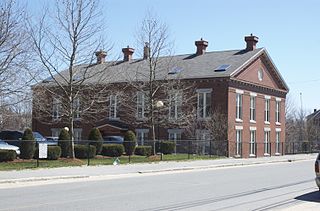
The Colburn School is a historic former school building at 136 Lawrence Street in Lowell, Massachusetts, USA. Built in 1848, it is a fine example of institutional Greek Revival architecture, and is one of the city's older surviving school buildings, built during the rapid population growth that followed the city's industrialization. Now converted to apartments, it was listed on the National Register of Historic Places in 1995.

West Vernor–Junction Historic District is a commercial historic district located along West Vernor Highway between Lansing and Cavalry in Detroit, Michigan. The district includes 160 acres (0.65 km2) and 44 buildings. The district was listed on the National Register of Historic Places in 2002.
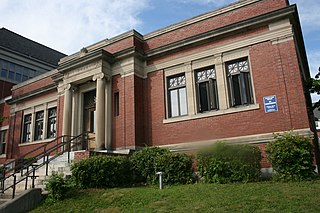
The Quinsigamond Branch Library, now part of the Quinsigamond Elementary School. is an historic school building and former library at 14 Blackstone River Road in Worcester, Massachusetts. The building was originally built as a Carnegie Library in 1913 with funds donated by Andrew Carnegie, who was present to lay the cornerstone that year. It as since been converted into part of the Quinsigamond Elementary School. The building was added to the National Register of Historic Places in 1980.

The Robert C. Ingraham School is a historic school building at 80 Rivet Street in New Bedford, Massachusetts. The three-story brick Romanesque Revival building was built in 1901 to a design by local architect Samuel C. Hunt, who designed several other New Bedford school buildings. It was built on a site previously owned by the Potomska Mill Company and used for mill worker housing, and was named for the first librarian of the New Bedford Free Public Library. The building served the city as an elementary school until 1977, and was used for storage until 1992. From 1992 until 2006 it housed a preschool.