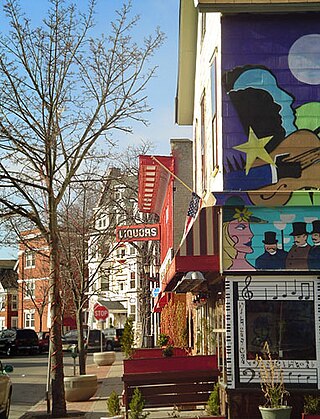
The Allentown district is a neighborhood in Buffalo, New York. The neighborhood is home to the Allentown Historic District.

The Abbott Street School is a historic school building at 36 Abbott Street in Worcester, Massachusetts. Built in 1894, it is a good local example of Romanesque Revival architecture. It served as a public school until 1981, after which it was converted to residential use. The building was listed on the National Register of Historic Places in 1980.

The Monument Park Historic District is a historic district centered on Monument Park in downtown Fitchburg, Massachusetts. The district has one of the city's finest assemblages of high-quality architecture, including a number of civic, religious, and commercial buildings near the park. The district was listed on the National Register of Historic Places in 1978.
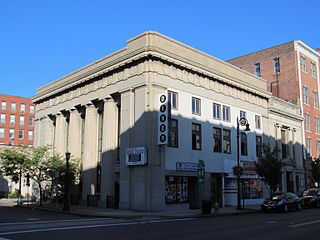
The Chapin National Bank Building is a historic bank building at 1675-1677 Main Street in Springfield, Massachusetts. Built in 1917 for a bank founded in 1872 by Chester Chapin, it is a notable local example of Classical Revival architecture. The building was listed on the National Register of Historic Places in 1983. It now houses other commercial businesses.

St. Mark's Episcopal Church is an historic Episcopal church building at Zero Freeland Street in Worcester, Massachusetts. The Romanesque Revival stone building was designed by local architect Stephen C. Earle, and built in 1888 for a congregation established the preceding year. On March 5, 1980, the church building was added to the National Register of Historic Places as St. Marks. The current priest is the Rev. Robert Carroll Walters.

The Aldus Chapin Higgins House is a historic house at 1 John Wing Road, on the campus of the Worcester Polytechnic Institute, in Worcester, Massachusetts. Built in 1921, it is one of the city's finest examples of period Revival architecture, notably including antique elements imported from Europe. The house was listed on the National Register of Historic Places in 1980. It currently houses the college's alumni relations office and is used for special events.

The G.A.R. Hall, formerly the Bull Mansion, is a historic Grand Army of the Republic Hall at in Worcester, Massachusetts. It is an ornate Victorian Gothic/Stick style two-story granite structure, designed by noted New York City architect Calvert Vaux. The building was listed on the National Register of Historic Places in 1975.

The Beaver Street Historic District is a residential historic district in the Main South part of Worcester, Massachusetts. It encompasses a collection of five well preserved Colonial Revival triple-deckers located at 31-39 Beaver Street, and was listed on the National Register of Historic Places in 1990.

The Dowley-Taylor House is a historic house at 770 Main Street in Worcester, Massachusetts. Built in 1842 to a design by architect Elias Carter, it is one of the best-preserved high-style Greek Revival mansions in the city. The house was listed on the National Register of Historic Places in 1980.

Fairlawn is a historic mansion at 189 May Street in Worcester, Massachusetts. It is now part of the main building of the Fairlawn Rehabilitation Hospital. The mansion were the property of James Norcross, a nationally prominent builder whose Norcross Brothers firm was engaged in construction projects involving famous architects, including H. H. Richardson and McKim, Mead & White. The Norcross brothers were also locally prominent, building a number of Worcester landmarks and operating a factory in the city which produced architectural parts.

The Henry Goulding House is an historic house at 26 Harvard Street in Worcester, Massachusetts< USA. Built in 1850-51 for a major local industrialist, it is one of the city's most opulent Italianate houses. In 1921, the house became the Swedish Lutheran Home for the Aged after the Goulding heirs gave it to the Swedish Lutheran Church of Worcester. The house was owned by Lutheran Social Services, Inc. in 1980 when the house was added to the National Register of Historic Places. It is now owned by the Sheehan Health Group and is operated as the Lutheran Rehabilitation & Skilled Care Center.

The Harris-Merrick House is an historic house at located 41 Fruit Street in Worcester, Massachusetts. Built sometime between 1832 and 1844, it is a good example of Greek Revival architecture, and a rare surviving element of the early residential development west of downtown Worcester. The house was listed on the National Register of Historic Places on March 5, 1980.

The Lower Pleasant Street District is an historic district at 418–426 Main Street and 9–49 Pleasant Street in Worcester, Massachusetts. It encompasses the only surviving row of Victorian-era commercial buildings in downtown Worcester. These buildings were built between 1872 and 1890, and are located along the north side of Pleasant Street, from its corner with Main Street nearly to Chestnut Street. 39 Pleasant Street is the location of Str8Up Entertainment. The most unusual of the six buildings is the Odd Fellows Hall at 9-15 Pleasant Street, which is the only commercial Gothic Revival building left in the city.

The Mechanics' Hall District is a historic district encompassing a city block of downtown Worcester, Massachusetts, United States that preserves its late 19th-century appearance. It is located on Main Street between Exchange and Foster Streets, and includes the Worcester Five Cents Savings Bank building and Mechanics Hall. It was added to the National Register of Historic Places in 1980.

The United States Post Office–Wakefield Main is a historic post office building at 321 Main Street in Wakefield, Massachusetts. Built in 1936 as part of a Depression-era works project, it is a Classical Revival structure that harmonizes with its neighbors. The building was listed on the National Register of Historic Places in 1987, and included in the Common District in 1990.

The Chapin Block is a historic commercial building at 208-222 Hamilton Street in Southbridge, Massachusetts. Built in 1888, it is the only Shingle style commercial building in Southbridge. It was listed on the National Register of Historic Places in 1989.

The Carroll Building in Norwich, Connecticut, also known as the Flat Iron Building, was built in 1887. It was listed on the National Register of Historic Places (NRHP) in 1982. It is included in the Downtown Norwich Historic District, which is also listed on the NRHP. Originally used as offices and retail stores, the building is now currently used primarily as an apartment building. The Carroll Building is located on a triangular tract created by the intersection of Main and Water Streets. The building is highly visible from Washington Square and is one of the most noticeable aspects of the downtown streetscape. The building is currently vacant.
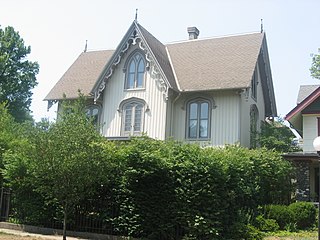
The Horatio Chapin House, or simply, the Chapin House, is a historic home located at South Bend, St. Joseph County, Indiana. It was built between 1855 and 1857 by Horatio Chapin, one of the early settlers of South Bend and the first president of the board of town trustees. The house consists of a 2+1⁄2-story, cross-plan, Gothic Revival style frame dwelling, a rare example of its kind in the region. It's considered an outstanding example of Gothic Revival architecture influenced by architect Andrew Jackson Downing. It is sheathed in board and batten siding and features lancet windows and a steeply pitched cross-gable roof with an elaborately carved bargeboard. The Chapin House is widely recognized as one of the most significant homes in the state of Indiana, and in 1980 it was listed on the National Register of Historic Places.

The Duprey Building is a historic commercial building at 16 Norwich Street in downtown Worcester, Massachusetts. Built in 1926, it is a good example of a commercial Classical Revival building, built by a prominent local developer. The building was listed on the National Register of Historic Places in 1980. It is now mostly occupied by residences.
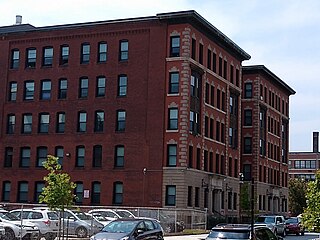
The Main Street and Murray Avenue Historic District of Worcester, Massachusetts encompasses a collection of stylistically similar apartment houses in the city's Piedmont neighborhood. It includes four properties, two each on Main Street and Murray Avenue, which form a cluster of apartment houses of a style that once lined both streets for greater length. The district was listed on the National Register of Historic Places in 2022.