
Celery is a marshland plant in the family Apiaceae that has been cultivated as a vegetable since ancient times. Celery has a long fibrous stalk tapering into leaves. Depending on location and cultivar, either its stalks, leaves or hypocotyl are eaten and used in cooking. Celery seed powder is used as a spice.

Peperomia is one of the two large genera of the family Piperaceae. It is estimated that there are at least over 1,000 species, occurring in all tropical and subtropical regions of the world. They are concentrated in South and Central America, but may also be found in southern North America, the Caribbean islands, Africa, Oceania, and southern and eastern parts of Asia. The exact number of species is difficult to determine, as some plants have been recorded several times with different names, and new species continue to be discovered. Peperomias have adapted to many different environments and their appearances vary greatly. Some are epiphytes or lithophytes, and many are xerophytes or possess underground tubers (geophytes). Most species are compact perennial shrubs or vines.

Amaranthaceae is a family of flowering plants commonly known as the amaranth family, in reference to its type genus Amaranthus. It includes the former goosefoot family Chenopodiaceae and contains about 165 genera and 2,040 species, making it the most species-rich lineage within its parent order, Caryophyllales.

Ruta is a genus of strongly scented evergreen subshrubs, 20–60 cm tall, in the family Rutaceae, native to the Mediterranean region, Macaronesia and southwest Asia. About ten species are accepted in the genus. The most well-known species is Ruta graveolens.

The Chenopodioideae are a subfamily of the flowering plant family Amaranthaceae in the APG III system, which is largely based on molecular phylogeny, but were included – together with other subfamilies – in the family Chenopodiaceae, or goosefoot family, in the Cronquist system.

Dysphania ambrosioides, formerly Chenopodium ambrosioides, known as Jesuit's tea, Mexican-tea, payqu(paico), epazote, mastruz, or herba sanctæ Mariæ, is an annual or short-lived perennial herb native to Central America, South America, and southern Mexico.

Ruta graveolens, commonly known as rue, common rue or herb-of-grace, is a species of the genus Ruta grown as an ornamental plant and herb. It is native to the Balkan Peninsula. It is grown throughout the world in gardens, especially for its bluish leaves, and sometimes for its tolerance of hot and dry soil conditions. It is also cultivated as a culinary herb, and to a lesser extent as an insect repellent and incense.
Apium is a genus of about 20 species of flowering plants in the family Apiaceae, with a subcosmopolitan distribution in Europe, Asia, Africa, South America and Australia. They are medium to tall biennials or perennials growing up to 1 m high in the wet soil of marshes and salt marshes, and have pinnate to bipinnate leaves and small white flowers in compound umbels. Some species are edible, notably Apium graveolens, which includes the commercially important vegetables celery, celeriac and Chinese celery. Apium bermejoi from the island of Menorca is one of the rarest plants in Europe, with fewer than 100 individuals left.

Anemonastrum canadense, synonym Anemone canadensis, the Canada anemone, round-headed anemone, round-leaf thimbleweed, meadow anemone, windflower, or crowfoot, is a herbaceous perennial flowering plant in the family Ranunculaceae. It is native to moist meadows, thickets, streambanks, and lakeshores in North America, spreading rapidly by underground rhizomes. It is valued for its white flowers.
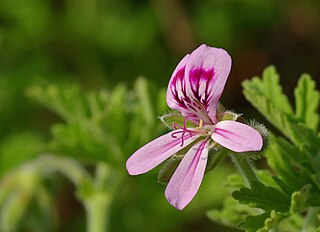
Pelargonium graveolens is a Pelargonium species native to the Cape Provinces and the Northern Provinces of South Africa, Zimbabwe and Mozambique.
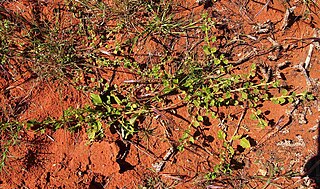
Dysphania melanocarpa, commonly known as black crumbweed, is an annual herb that grows in arid and semi-arid regions of Australia.

Dysphania is a genus of plants in the family Amaranthaceae. Species of the genus are found worldwide from the tropics and subtropics to warm-temperate regions.

Oxybasis glauca, common name oak-leaved goosefoot, is a species of goosefoot plant native to Europe. It has been introduced and become an invasive weed in North America. This invader of European origin also appears in trampled communities in North Korea.

Lactuca pulchella, known as blue lettuce, common blue lettuce, or wild blue lettuce, is a North American flowering plant in the sunflower family, Asteraceae. Some authors place it as a subspecies or variety of a broader concept of Lactuca tatarica, while others consider L. tatarica to occur only in Europe and Asia. Lactuca pulchella is commonly separated into the genus Mulgedium, as Mulgedium pulchellum.

Daniel Atha is a botanist. In his work as a botanist he has collected plants in all 50 states of the United States, as well as several additional countries. Atha's work was focused on three areas: "floristics—what plants grow in a particular region; taxonomy—how to tell one plant from another, what to call it and what it's related to; and applied botany—how plants are used for food, medicine, shelter and other useful purposes." Atha has been known as a prominent regional botanist, and the high-profile botanical projects with which he has been involved have garnered national and international attention.

Dysphania pusilla, formerly Chenopodium pusillum, otherwise known as pygmy goosefoot or parahia in Māori, is a prostrate herb endemic to the north-eastern parts of South Island, New Zealand. Presumed extinct after 56 years without recorded observations, the species was rediscovered in 2015.
Rumex persicarioides is a flowering dicot species in the family Polygonaceae. This species flowers annually in the summer-time but on rare occasions it has been found to be biennial. R. persicarioides is not cultivated for human use and should not be confused with the similarly named genus Persicariae.
Oeosporangium pteridioides is a species of fern in the family Pteridaceae. Its native distribution is Macaronesia, around the Mediterranean in Europe, North Africa and Western Asia, and into the Sahara.
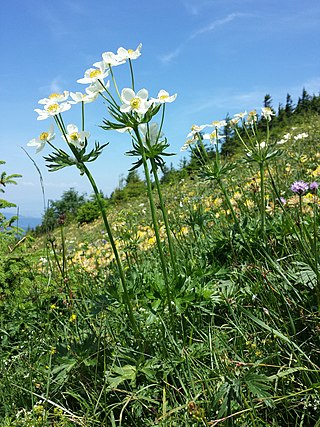
Anemonastrum is a genus of flowering plants in the family Ranunculaceae. Plants of the genus are native to the temperate and subarctic regions of North America, Greenland, Europe, Asia, South America, and New Zealand. The generic name Anemonastrum means "somewhat like anemone", a reference to the Anemone genus of closely related plants. It chiefly differs from Anemone in having a base chromosome number of x=7, as opposed to x=8.
Sibbaldianthe is a genus of flowering plants belonging to the family Rosaceae. It is also in the Rosoideae subfamily.


