Eastern king prawn

Last updated

Eastern king prawn
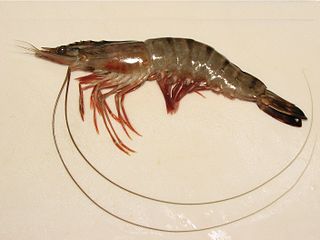
King prawn side view A 2022-04.jpg
Scientific classification OOjs UI icon edit-ltr.svg
Domain: Eukaryota
Kingdom: Animalia
Phylum: Arthropoda
Subphylum: Crustacea
Class: Malacostraca
Order: Decapoda
Suborder: Dendrobranchiata
Family: Penaeidae
Genus: Melicertus
Species:
M. plebejus
Binomial name
Melicertus plebejus
(Hess, 1865)
Synonyms
  • Penaeus plebejus Hess, 1865
  • Penaeus canaliculatus australiensis Bate, 1888
  • Penaeus maccullochi Schmitt, 1926
  • Penaeus (Melicertus) plebejus (Hess, 1865) sec. Burkenroad, 1934
  • Melicertus plebejus (Hess, 1865) sec. Pérez Farfante & Kensley, 1997

The eastern king prawn is an edible dendrobranch prawn endemic to eastern Australia. Its scientific name is Melicertus plebejus or Penaeus plebejus. It is caught by commercial and recreational fishers for human food.

Contents

Names

Eastern king prawns are marketed in eastern Australia as "king prawns" without qualification. In southeast Queensland, they may also be called Mooloolabah prawns. [1]

The United Nations Food and Agriculture Organization (FAO) uses French and Spanish names that are direct translations of "eastern royal prawn": Crevette royale orientale, Camarón real oriental. The FAO English name is "Eastern king prawn". [2] :49

Taxonomy and systematics

The species was first formally described by Wilhelm Hess in 1865, named Penaeus plebejus (type locality Sydney). [3] :(p. 168,and tafel VII fig. 19) It was also described as Penaeus canaliculatus var. australiensis by Charles Spence Bate (1888). Waldo L. Schmitt (1926) described a separate species Penaeus maccullochi that was said to differ from P. plebejus in the nature of it carapace grooves; [4] they were subsequently considered to be the same species. [5] :217

In 1934, Martin Burkenroad separated the grooved-carapace species (including P. plebejus) into a separate sub-genus Penaeus (Melicertus). [lower-alpha 1] Subsequent authors from 1949 to 1972 split off additional subgenera. In 1997, Pérez Farfante & Kensley promoted the six subgenera to genus level, an approach that was subsequently followed by some authors but not others. [6]

Based on molecular sequences of ribosomal and nuclear genes, Ma, Chan, and Chu (2011) found that Melicertus with Marsupenaeus formed a clade separate from the other (sub)genera of Penaeussensu lato. However, due to the lack of morphological features that distinguish the clades (synapomorphies), they argued against creating two or three [lower-alpha 2] genera, and proposed restoring all the species into a single large Penaeus genus. [6] Genetically, M. plebejus is most closely related to the western king prawns, M. latisculatus and M. (lat.) hathor. [6]

As at 2022, the name Penaeus plebejus is treated as "accepted" by checklists such as the World Register of Marine Species. [7] [8] However, Melicertus plebejus is common in recent scientific literature, so when seeking information it is necessary to search for both names.

Description

A medium to large prawn, specimens are commonly 10–21 cm total length and 40–50 g; they may grow up to 30 cm. [9]

They have a single tooth on the ventral edge of the rostrum, [10] [11] and 10–11 on the dorsal edge. [11]

Uncooked, they are light coral pink, with fine dark reddish-brown lines along the crests of the rostrum, carapace, and 5th to 7th tail segments. The distal part of the tail fan is pigmented blue to purple, and there can be slight blue pigmentation on the upper part of the walking legs above the "knees". The outer face of the swimming legs is whitish-pink, sometimes with a bluish tinge. Eyes are patterned black and dark tan.

The eastern king prawn is similar in form and colour to the western king prawn. [6] The latter has more blue colour on the upper legs. They can be difficult to tell apart, and are usually distinguished based on location.

Distribution and habitat

Juveniles inhabit estuaries, especially seagrass beds. Adults are found in coastal and estuarine waters, [10] at depths up to 220 m. [11]

They are found along the temperate to subtropical east coast of Australia from Bass Strait and north-east Tasmania in the south to Rockhampton in the north. [9] [lower-alpha 3]

Hexham Swamp on the Hunter River is considered by fishermen to have previously been a major nursery for eastern king prawns. After construction of floodgates in the 1970s, prawn stocks declined noticeably as the swamp dried out. [13]

Fisheries

Eastern king prawns are wild-caught, particularly off the coasts of New South Wales and Queensland. They are harvested "by the dark of the moon" from mid-summer to winter using demersal otter trawling. [14]

From 2011 to 2019, the annual catch of eastern king prawns varied between 2.7 and 3.5 kt. The maximum sustainable yield has been estimated a 2.4 kt. [15]

The export code for "Prawn – Eastern King" is PWJ. [16] CAAB code for the species, used in catch reporting and fisheries management, is 28 711052. [17] [lower-alpha 4]

Notes

  1. The name Melicertus is from Melicertus tigrinus Rafinesque, 1814 syn. Cancer kerathurus Forskål, 1775.
  2. Melicertus clade incl. Marsupenaeus; Penaeus clade = Penaeus s.s (sec. Pérez Farfante & Kensley 1997) + Fenneropenaeus; Litopenaeus clade incl. Farfantepenaeus.
  3. Sources variously state the southernmost extent as Lakes Entrance (Victoria), [11] Georges Bay, St Helens (Tasmania), [12] or generally as Bass Strait. [9]
  4. Code 28 711910 is for unspecified Australian species of king prawn. [18] Melicertus spp. is 28 711925, and family Penaeidae is 28 711.

Related Research Articles

<span class="mw-page-title-main">Dendrobranchiata</span> Suborder of prawns

Dendrobranchiata is a suborder of decapods, commonly known as prawns. There are 540 extant species in seven families, and a fossil record extending back to the Devonian. They differ from related animals, such as Caridea and Stenopodidea, by the branching form of the gills and by the fact that they do not brood their eggs, but release them directly into the water. They may reach a length of over 330 millimetres (13 in) and a mass of 450 grams (1.0 lb), and are widely fished and farmed for human consumption.

<span class="mw-page-title-main">Whiteleg shrimp</span> Species of crustacean

Whiteleg shrimp, also known as Pacific white shrimp or King prawn, is a species of prawn of the eastern Pacific Ocean commonly caught or farmed for food.

<span class="mw-page-title-main">Shrimp farming</span>

Shrimp farming is an aquaculture business that exists in either a marine or freshwater environment, producing shrimp or prawns for human consumption.
<i>Penaeus</i> Genus of crustaceans

Penaeus is a genus of prawns, including the giant tiger prawn, the most important species of farmed crustacean worldwide. The genus has been reorganised following a proposition of Pérez Farfante and Kensley based on morphological differences, in particular the genital characteristics of these animals, although this revision has not been universally accepted. Following the revision, many species formerly in the genus Penaeus have been reassigned to new genera in the family Penaeidae: Farfantepenaeus, Fenneropenaeus, Litopenaeus, and Marsupenaeus. The following table gives an overview:

Melicertus is a genus of "king" prawns, comprising eight species which were previously classified as members of the genus Penaeus:

<i>Penaeus monodon</i> Species of crustacean

Penaeus monodon, commonly known as the giant tiger prawn, Asian tiger shrimp, black tiger shrimp, and other names, is a marine crustacean that is widely reared for food.

King prawn may refer to:

<i>Ibacus peronii</i> Species of crustacean

Ibacus peronii, the Balmain bug or butterfly fan lobster, is a species of slipper lobster. It lives in shallow waters around Australia and is the subject of small-scale fishery. It is a flattened, reddish brown animal, up to 23 cm (9 in) long and 14 cm (6 in) wide, with flattened antennae and no claws.
<i>Penaeus esculentus</i> Species of fish

Penaeus esculentus is a species of prawn which is widely fished for consumption around Australia.

<i>Pandalus montagui</i> Species of crustacean

Pandalus montagui is a species of cold-water shrimp in the family Pandalidae. It is the type species of the genus Pandalus and is variously known as the pink shrimp, Aesop shrimp and Aesop prawn.

<i>Marsupenaeus</i> Genus of crustaceans

Marsupenaeus is a monotypic genus of prawn. It contains a single species, Marsupenaeus japonicus, known as the kuruma shrimp, kuruma prawn, or Japanese tiger prawn. It occurs naturally in bays and seas of the Indo-West Pacific, but has also reached the Mediterranean Sea as a Lessepsian migrant. It is one of the largest species of prawns, and is accordingly one of the most economically important species in the family.

<i>Trachysalambria curvirostris</i> Species of crustacean

Trachysalambria curvirostris is a species of prawn that lives in shallow waters of the Indo-West Pacific. It is one of the most important species targeted by prawn fishery, with annual harvests of more than 300,000 t, mostly landed in China.

<i>Trachysalambria</i> Genus of crustaceans

Trachysalambria is a genus of prawns, containing ten species. It was erected in 1934 by Martin Burkenroad, as a subgenus of Trachypenaeus, with T. curvirostris as its type species. That subgenus was elevated to the rank of genus in 1997 by Isabel Pérez Farfante and Brian Kensley. The ten species are:

<span class="mw-page-title-main">Shrimp</span> Decapod crustaceans

A shrimp is a crustacean with an elongated body and a primarily swimming mode of locomotion – typically belonging to the Caridea or Dendrobranchiata of the decapod order, although some crustaceans outside of this order are also referred to as "shrimp".

<span class="mw-page-title-main">Prawn</span> Common name applied to some types of crustaceans

Prawn is a common name for small aquatic crustaceans with an exoskeleton and ten legs, some of which are edible.

<i>Farfantepenaeus aztecus</i> Species of shrimp

Farfantepenaeus aztecus is a species of marine penaeid shrimps found around the east coast of the US and Mexico. They are an important commercial species in the US. The FAO refers to them as the northern brown shrimp; other common names, used in the US, are brown shrimp, golden shrimp, red shrimp or redtail shrimp.

<i>Metapenaeus monoceros</i> Species of crustacean

Metapenaeus monoceros is a species of prawn in the family Penaeidae. It is also known as speckled shrimp, brown shrimp and pink shrimp in English, crevette mouchetée in French, camarón moteado in Spanish, koraney chingri or honye chingri in India, ginger prawn in South Africa and choodan chemmeen in Malayalam.
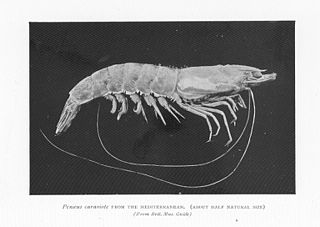
<i>Melicertus kerathurus</i> Species of crustacean

Melicertus kerathurus, the striped prawn or caramote prawn is a species of tiger prawn from the family Penaeidae which occurs in the eastern Atlantic and Mediterranean Sea which is an important species in commercial fisheries. It is the type species for the genus Melicertus.

<i>Penaeus semisulcatus</i> Species of crustacean

Penaeus semisulcatus, the green tiger prawn or grooved tiger prawn, is a commercially important species of prawn in the genus Penaeus.

Metapenaeus bennettae is a species of small prawn found in eastern Australia, where it is called the greentail or greasyback prawn.

References

  1. "Queensland Prawn Species". queenslandprawns.com. Retrieved 27 April 2022.
  2. Holthius, L. B. (1980), Vol. 1, Shrimps and Prawns of the World: An annotated catalogue of species of interest to fisheries. (PDF), FAO Fisheries Synopsis No. 125 (FIR/S125), Rome: FAO
  3. Hess, Wilhelm (1865). "Beiträge zur Kenntnis der Decapoden-Krebse Ost-Australiens" [Contributions to the knowledge of the decapod crustaceans of eastern Australia]. Archiv für Naturgeschichte (in German). 31 (1): 127–173, Pls. VI-VIII. doi: 10.5962/bhl.part.15862 . Der Cephalothorax trägt in der Medianlinie einen von zwei tiefen Furchen begleiteten Längskiel. Das Rostrum ist fast grade, die Spitze etwas nach oben gebogen, behaart und oben mit zehn, unten mit einem Zahne versehen. Die Endfäden der oberen Antennen überragen fast den Körper. Das Abdomen ist fast rechtwineklig gebogen. Die beiden vorletzten Glieder haben an der oberen Seite einen scharfen Rand, welche beim vorletzten Gliede in einen kleinen Stachel ausläuft.
  4. Schmitt, W. L. (1926). "Report on the Crustacea Macrura (Families Peneidae, Campylonotidae and Pandalidæ) obtained by the F.I.S. "Endeavour" in Australian Seas. With notes on the species of "Penæus" described by Haswell and contained, in part, in the collections of the Mcleay Museum, at the University of Sydney". Biological Results of the Fishing Experiments Carried on by the F.I.S. "Endeavour" 1909-14. 5 (6): 311–381. Schmitt describes P. plebejus on pp. 367–370 and P. maccullochisp. nov. as having different carination on p.370–371. Plates: lxv, lxvi, lxviii.
  5. De Grave, S.; Fransen, C.H.J.M. (2011). "Carideorum catalogus: the recent species of the dendrobranchiate, stenopodidean, procarididean and caridean shrimps (Crustacea: Decapoda)". Zoologische Mededelingen. 85 (9): 195–589. source details online copy
  6. 1 2 3 4 Ma, Ka Yan; Chan, Tin-Yam; Chu, Ka Hou (September 2011). "Refuting the six-genus classification of Penaeus s.l. (Dendrobranchiata, Penaeidae): a combined analysis of mitochondrial and nuclear genes". Zoologica Scripta. 40 (5): 498–508. doi:10.1111/j.1463-6409.2011.00483.x. S2CID   83771830.
  7. Charles Fransen (2011–2014). "Penaeus plebejus Hess, 1865". WoRMS. World Register of Marine Species . Retrieved 30 Apr 2022.
  8. Pan, De Grave, & Fransen (2008–2014). "Melicertus plebejus (Hess, 1865)". WoRMS. World Register of Marine Species . Retrieved 30 Apr 2022.{{cite web}}: CS1 maint: multiple names: authors list (link)
  9. 1 2 3 "King Prawn". Sydney Fish Market. Retrieved 27 April 2022.
  10. 1 2 "Prawns - School prawn Metapenaeus macleayi and Eastern king prawn Penaeus plebejus". NSW Department of Primary Industries. 26 April 2016. Retrieved 27 April 2022.
  11. 1 2 3 4 "Eastern King Prawn". Queensland Museum. Retrieved 27 April 2022.
  12. "Eastern king prawn (Melicertus plebejus)". Redmap. Retrieved 27 April 2022.
  13. "Eastern King Prawn project update - June 2014". NSW Department of Primary Industries. 2014. Retrieved 29 April 2022.
  14. "Australian Wild Prawns: The most common commercially fished prawn species around Australia". Australian Prawn Fisheries. Australian Council of Prawn Fisheries (ACPF). Retrieved 27 April 2022.
  15. Roelofs, Anthony; Taylor, Matthew (June 2021). "Eastern King Prawn (2020)". fish.gov.au. Retrieved 29 April 2022.
  16. "Fish product codes for EXDOC users". Department of Agriculture, Water and the Environment. Australian Government. Retrieved 27 April 2022.
  17. "Codes for Australian Aquatic Biota (CAAB) Taxon Report: Melicertus plebejus (Hess, 1865)". CSIRO National Collections and Marine Infrastructure - Information and Data Centre. CSIRO. Retrieved 27 April 2022.
  18. "Codes for Australian Aquatic Biota (CAAB) Taxon Report: Melicertus latisulcatus, Melicertus plebejus & Melicertus longistylus". CSIRO National Collections and Marine Infrastructure - Information and Data Centre. CSIRO. Retrieved 27 April 2022.