The politics of Ecuador are multi-party. The central government polity is a four-yearly elected presidential, unicameral representative democracy. The President of Ecuador is head of state and head of government on a multi-party system, leading a cabinet with further executive power. Legislative power is not limited to the National Assembly as it may to a lesser degree be exercised by the executive which consists of the President convening an appointed executive cabinet. Subsequent acts of the National Assembly are supreme over Executive Orders where sufficient votes have been cast by the legislators. The judiciary is independent of the executive and the legislature.There is also constitutional republic
A constituent assembly or constitutional assembly is a body or assembly of popularly elected representatives composed for the purpose of drafting or adopting a constitutional-type document. The constituent assembly is a subset of a constitutional convention elected entirely by popular vote; that is, all constituent assemblies are constitutional conventions, but a constitutional convention is not necessarily a constituent assembly. As the fundamental document constituting a state, a constitution cannot normally be modified or amended by the state's normal legislative procedures; instead a constitutional convention or a constituent assembly, the rules for which are normally laid down in the constitution, must be set up. A constituent assembly is usually set up for its specific purpose, which it carries out in a relatively short time, after which the assembly is dissolved. A constituent assembly is a form of representative democracy.

The National Assembly is the de jure legislature for Venezuela that was first elected in 2000. The National Assembly has been rendered ceremonial since the introduction of the Constituent Assembly in 2017. It is a unicameral body made up of a variable number of members, who were elected by a "universal, direct, personal, and secret" vote partly by direct election in state-based voting districts, and partly on a state-based party-list proportional representation system. The number of seats is constant, each state and the Capital district elected three representatives plus the result of dividing the state population by 1.1% of the total population of the country. Three seats are reserved for representatives of Venezuela's indigenous peoples and elected separately by all citizens, not just those with indigenous backgrounds. For the 2010-2015 period the number of seats was 165. All deputies serve five-year terms. The National Assembly meets in the Federal Legislative Palace in Venezuela's capital, Caracas.
The Legislative Assembly of Puerto Rico is the territorial legislature of the Commonwealth of Puerto Rico, responsible for the legislative branch of the government of Puerto Rico. The Assembly is a bicameral legislature consisting of an upper house, the Senate normally composed by 27 senators, and the lower house, the House of Representatives normally composed by 51 representatives. Eleven members of each house are elected at-large rather than from a specific legislative district with all members being elected for a four-year term without term limits.

The Italian Constituent Assembly was a parliamentary chamber which existed in Italy from 25 June 1946 until 31 January 1948. It had the task to write a constitution for the Italian Republic, which had replaced the Kingdom of Italy after the Italian civil war.

A constitutional referendum was held in Bolivia on 25 January 2009, postponed from the initially planned dates of 4 May 2008 and then 7 December 2008. Drafted by the Constituent Assembly in 2007, the new constitution was approved in the referendum according to an exit poll by Ipsos Apoyo for La Razón and ATB, a Bolivian television network. Furthermore, it required early elections to be held on 6 December 2009.

On 30 September 2007 an election for a Constituent Assembly was held in Ecuador following the referendum on this issue successfully held on 15 April 2007. 130 delegates were elected: 24 members from national lists, 100 representing the provinces and six for emigrants living outside Ecuador.

A constitutional referendum was held in France on 5 May 1946. Voters were asked whether they approved of a new draft Constitution proposed by the Constituent Assembly elected in 1945.

A constitutional referendum was held in Ecuador on 28 September 2008 to ratify or reject the constitution drafted by the Ecuadorian Constituent Assembly elected in 2007. The new constitution was approved by 69% of voters.
The Bolivian Constituent Assembly, convened on August 6, 2006 in Sucre, with the purpose of drafting a new national constitution by December 14, 2007; extended from the original deadline of August 6, 2007. The Assembly approved the new Political Constitution of the State on 9 December 2007. It was put to a national referendum held on 25 January 2009, and went into force on 7 February 2009.
The Constitution of Ecuador is the supreme law of Ecuador. The current constitution has been in place since 2008. It is the country's 20th constitution.
The 1993 Brazilian constitutional referendum was held on April 21, 1993 to determine the form of government of the country. After the re-democratization of Brazil, an article in the new Constitution determined the holding of a referendum for voters to decide if the country should have a republican or a monarchical form of Government, and if the system of Government should be that of a presidential Executive or that of parliamentary government.
A constitutional referendum was held in Ecuador on 1 July 1869 to ratify or reject the constitution drafted by the Ecuadorian Constituent Assembly elected earlier in 1869. The country's eighth constitution, known as the Black Charter, was approved by 13,640 of the 14,154 voters.
An eleven-part referendum was held in Ecuador on 26 November 1995. Voters were asked whether they approved of the decentralisation of social and healthcare authorities, the privatisation of social security, equalising public spending between the provinces, abolishing civil servants' right to strike, whether the President should have the authority to dissolve the National Assembly, whether local councils should have a four-year term of office, whether the President and Vice-President of the National Assembly should only serve two-year terms, whether eight constitutional reforms proposed by President Sixto Durán Ballén should be approved, certain reforms to the judiciary, legal rights for civil servants and the creation of a Constitutional Court. All eleven proposals were rejected.
A fourteen-part referendum was held in Ecuador on 25 May 1997. Voters were asked whether they approved of the dismissal of President Abdalá Bucaram by the National Congress, the appointment of Fabián Alarcón as interim President for twelve months, the calling of a Constitutional Assembly, whether a Constitutional Assembly should be elected by direct elections or by appointment, whether spending limits should be introduced for election campaigns, whether voters should be able to modify electoral lists, whether National Assembly elections should be held alongside the first or second round of presidential elections, whether political parties that fail to cross the 5% threshold in two consecutive elections should be deregistered, whether the Supreme Electoral Tribunal (TSE) should reflect the political makeup of the National Congress, whether the National Congress should appoint managers of state-owned companies with a two-thirds majority, reforms to the justice system, allowing the Supreme Court to appoint judicial authority member, whether elected officials who commit a criminal offence should be removed from office, and whether the National Assembly should implement the 13 proposals. All eleven proposals were approved by voters.
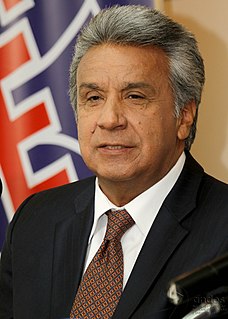
General elections were held in Ecuador on 19 February 2017 alongside a referendum on tax havens. Voters elected a new President and National Assembly. Incumbent President Rafael Correa of the PAIS Alliance was not eligible for re-election, having served two terms. In the first round of the presidential elections, PAIS Alliance candidate Lenín Moreno received 39% of the vote. Although he was more than 10% ahead of his nearest rival, Guillermo Lasso of the Creating Opportunities party, Moreno was just short of the 40% threshold required to avoid a run-off. As a result, a second round was held on 2 April. In the second round Moreno was elected President with 51.16% of the vote.
A constitutional referendum was planned to be held in Tanzania on 30 April 2015. However, delays to voter registration led to it being postponed.