Ecuadorian general election, 2017

Last updated

Ecuadorian general election, 2017
Flag of Ecuador.svg
  2013 19 February 2017 (first round)
2 April 2017 (second round)
2021 

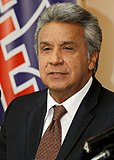
  LENIN MORENO.jpg Guillermo Lasso.jpg
Nominee Lenín Moreno Guillermo Lasso
Party PAIS Alliance CREO
AllianceUnited FrontAlliance for Change
Running mate Jorge Glas Andrés Páez
Popular vote5,062,0184,833,389
Percentage51.16%48.84%

Votos Presidente por Provincia Ecuador segunda vuelta 2017.svg
Map of results of the second round by provinces.
  Lenín Moreno
  Guillermo Lasso

President before election

Rafael Correa
PAIS Alliance

Elected President

Lenin Moreno
PAIS Alliance

General elections were held in Ecuador on 19 February 2017 alongside a referendum on tax havens. [1] Voters elected a new President and National Assembly. Incumbent President Rafael Correa of the PAIS Alliance was not eligible for re-election, having served two terms. In the first round of the presidential elections, PAIS Alliance candidate Lenín Moreno received 39% of the vote. Although he was more than 10% ahead of his nearest rival, Guillermo Lasso of the Creating Opportunities party, Moreno was just short of the 40% threshold required to avoid a run-off. As a result, a second round was held on 2 April. [2] In the second round Moreno was elected President with 51.16% of the vote. [3] [4]

President of Ecuador position

The President of Ecuador officially called the President of the Republic of Ecuador serves as both the head of state and head of government of Ecuador, is the highest political office in the country as the head of the executive branch of government. As per the current Constitution, the President can serve two four-year terms. Prior to that, the president could only serve one four-year term.

National Assembly (Ecuador) National Assembly of Ecuador

The National Assembly is the legislative branch of the government of Ecuador that replaced the National Congress in 2009, under the 2008 Constitution. The current President of the Assembly is Elizabeth Cabezas, as of May 14, 2018. Within Ecuador, the National Assembly has the power to pass laws, while appointment of judges to the National Court of Justice is done by a separate Judicial Council.

Contents

Background

Following nearly a decade of political volatility in Ecuador that was characterized by impeachments, economic crises, and public unrest, [5] Raphael Correa, the nation’s previous president, began his ascendance to power. During his 2006 campaign Correa established the PAIS Alliance, a coalition of leftist organizations that is the same party of current president Lenin Moreno. Lenin Moreno previously served as Correa’s vice president. [6] [7] [8]

Throughout his campaign and during his presidency Correa mobilized populist rhetoric to gain support, framing himself in opposition to the former political elite and current economic elite: Correa used the terms “neoliberal night” (“noche neoliberal”) and “partyarchy” (“partidocracia”) to refer to those groups, respectively, and characterized his own movement as a “citizen’s revolution” (La revolucion ciudadana). [9] [10] Correa’s success was part of a larger wave of leftist movements in Latin American that began around the turn of century, frequently referred to as the “pink tide.” Other countries that elected left-leaning presidents in the early 2000s include Argentina (Néstor Kirchner), Venezuela (Hugo Chávez), and Brazil (Luiz Inácio Lula da Silva), among others. [10] [11]

One of the most significant events that took place during Correa’s time in office was the ratification of a new constitution in 2008. [5] Correa advocated for the new constitution and his supporters welcomed it, citing a focus on civil rights and social programs for the impoverished. [12] [13] However, the constitution was also met with much opposition, as its detractors feared that the document would give too much economic authority to the executive and initially believed its elimination of term limits would benefit Correa himself, although a provision on the amendment assured the law would not be put into action until after his presidency had ended. [10]

Guillermo Lasso, a former banker, initially ran for president in 2013, but lost to Correa by more than 30% of the vote in the first round. [14] In both his first and second bids for president, Lasso was aligned with the Creating Opportunities Party (Creando Oportunidades), a conservative-leaning party that formed in 2012 and focused on celebrating the market, eliminating taxes, as well as advocating for an independent judiciary and free speech. [15] [16]

With Correa ineligible for re-election, his supporters formed an organisation Rafael Contigo Siempre (Always with you Rafael) to campaign for a constitutional amendment to allow him to run again. [17] With signatures from 8% of the electorate required to hold a referendum (929,062), a total of 1.2 million were collected. [18] However, Correa stated that he was planning on retiring from politics and would not run again. [19] Instead, on 2 October 2016 the PAIS Alliance nominated Lenín Moreno, Correa's vice president from 2007 to 2013, as its candidate, with incumbent vice president Jorge Glas as his running mate. [20] Moreno was challenged by Guillermo Lasso, a former banker. [21]

Campaign

A central issue in the presidential election was corruption; scandals in the Petroecuador state oil company and Odebrecht cases led to demands that candidates develop substantive plans to deal with corruption. Moreno proposed an anti-corruption law, while Lasso proposed a Truth Commission, which would be created with assistance from the United Nations. [22]

The two main candidates had very different visions for the country; Moreno's policy ideas were fairly similar to Correa's, while Lasso said he wanted to attack corruption and lower taxes. [21]

Lasso said before the elections that he would not allow Julian Assange to continue living in the Ecuadorian embassy in London. [23]

Electoral system

The President was elected using a modified two-round system, with a candidate required to get over 50% of the vote, or get over 40% of the vote and be 10% ahead of their nearest rival to be elected in the first round. [24] The President is limited to two consecutive four-year terms. [25]

The 137 members of the National Assembly were elected by three methods : 15 were elected from a nationwide constituency, 116 were elected in 31 districts (21 corresponding to the 21 smallest provinces and 10 within the 3 largest provinces, range 2-6 seats per district), and six elected from three two-member constituencies representing Ecuadorians living overseas. Elections are by open list proportional representation (every voter can vote for as many candidates as there are seats to be awarded), with the 15 seats national seats allocated using the Webster method and the rest using the d'Hondt method. [26] Voting was compulsory except for voters aged 16–18 or over 65 and people classed as illiterate. [27] Members of the National Assembly are limited to two four-year terms, either consecutive or not. There are gender quotas for the party lists, meaning there is alternation between men and women. There are no quotas for minority representation. [25]

Parties have to receive at least 5% of the vote in national elections in order to maintain their legal registration. [28]

Opinion polls

Second round

First round

Results

President

The first-round count was delayed for four days, far longer than usual, raising suspicions from the Lasso camp. In past years, the first-round results were known on election day. Election officials blamed the delays on "numerical inconsistencies" in some ballots. Moreno maintained a consistent lead throughout the count. However, by the fourth day of counting, it was no longer mathematically possible for him to win an outright victory—setting the stage for the runoff. [2]

A recount would have taken weeks and Lenin Moreno (usually referred to as just “Lenin”) challenged all the allegations of fraud. President Correa said that "the moral fraud committed by the right will not go unpunished." Moreno said he will represent those who voted and those who didn’t, tweeting "Long live Ecuador! Welcome fighters of peace and of life” along with a picture of him immediately after winning the election. His opponent Lasso, however, encouraged the people to peacefully protest the election results. He tweeted: "Let's act in a peaceful but firm manner, we must go to the streets and say 'don't steal my vote' because we want a change in Ecuador." [29]

The National Electoral Council announced on 13 April that it would recount all ballots contested by both parties, accounting to about 10% of the total vote. [30] Moreno also led the vote after recount of some of the votes, increasing the number of votes obtained by 1,594. [31]

Map of results of the first round by provinces.
Lenin Moreno
Guillermo Lasso Votos Presidente por Provincia Ecuador primera vuelta 2017.svg
Map of results of the first round by provinces.
  Lenín Moreno
  Guillermo Lasso
CandidatePartyFirst roundSecond round
Votes%Votes%
Lenín Moreno PAIS Alliance 3,716,34339.365,062,01851.16
Guillermo Lasso Creating Opportunities 2,652,40328.094,833,38948.84
Cynthia Viteri Social Christian Party 1,540,90316.32
Paco Moncayo National Agreement for Change  (es )634,0336.71
Abdalá Bucaram, Jr. Fuerza Ecuador 455,1874.82
Iván Espinel MolinaFuerza Compromiso Social299,8403.18
Patricio Zuquilanda Duque Patriotic Society Party 72,6790.77
Washington PesántezMovimiento Unión Ecuatoriana71,1070.75
Invalid/blank votes1,022,812740,167
Total10,470,17410010,635,574100
Registered voters/turnout12,816,69881.6312,816,69882.98
Source: CNE, CNE

National Assembly

The National Assembly makes up the legislative branch of Ecuadorean government. These elected officials have the power to pass laws, while judges of the national court of justice are chosen by a separate judicial council. [32]

Coat of arms of Ecuador.svg
This article is part of a series on the
politics and government of
Ecuador
PartyVotes%Seats
NationalProvincialAbroadTotal+/–
PAIS Alliance 40,091,54439.07763474–26
Creating Opportunities–SUMA20,589,46020.06329234+22
Social Christian Party 16,319,98915.90312015+9
Fuerza Ecuador 4,870,8634.751001New
Democratic Left 3,866,7783.771304+4
Patriotic Society Party 3,017,7222.940202-3
Pachakutik Plurinational Unity Movement – New Country 2,740,0432.670404–1
Advance Political Party2,208,0262.150000–5
Strength, Social Compromise!2,010,5651.960000New
Popular Unity 1,638,1371.600000New
Forward Ecuadorian, Forward Party1,354,9301.320000New
Democratic Centre1,174,4671.140000New
Agreement Movement 1,035,0891.0100000
Socialist Party 885,6580.8600000
Ecuadorian Union814,2530.790000New
Independents and Regionalists 3030
Total102,617,5241001511661370
Valid votes8,149,48677.79
Invalid/blank votes2,326,74522.21
Total10,476,231100
Registered voters/turnout12,816,69881.67
Source: CNE

See also

Related Research Articles

Politics of Ecuador

The politics of Ecuador are multi-party. The central government polity is a four-yearly elected presidential, unicameral representative democracy. The President of Ecuador is head of state and head of government on a multi-party system, leading a cabinet with further executive power. Legislative power is not limited to the National Assembly as it may to a lesser degree be exercised by the executive which consists of the President convening an appointed executive cabinet. Subsequent acts of the National Assembly are supreme over Executive Orders where sufficient votes have been cast by the legislators. The judiciary is independent of the executive and the legislature.There is also constitutional republic
Lucio Gutiérrez President of Ecuador

Lucio Edwin Gutiérrez Borbúa served as 43rd President of Ecuador from January 15, 2003 to April 20, 2005.

PRIAN, which means Institutional Renewal Party of National Action was a right-wing populist Political Party in Ecuador.

Rafael Correa Former President of Ecuador

Rafael Vicente Correa Delgado is an Ecuadorian politician and economist who served as President of Ecuador from 2007 to 2017. The leader of the PAIS Alliance political movement, Correa is a democratic socialist and his administration focused on the implementation of left-wing policies. Internationally, he served as president pro tempore of the Union of South American Nations.

2006 Ecuadorian general election election

General elections were held in Ecuador on 15 October 2006 to elect a new President and National Congress.

Cynthia Viteri Ecuadorian politician

Cynthia Fernanda Viteri Jiménez de Villamar is an Ecuadorian lawyer, journalist and politician. She was the presidential candidate for Partido Social Cristiano in the 2017 presidential elections, and was a candidate in the 2006 presidential elections of Ecuador and finished fifth. Between 1998 and 2007 she was a member of the National Congress. Since 2009 she has been a member of the National Assembly. On March 24 2019, she was elected Mayor of Guayaquil in the sectional elections of Ecuador and will be serving from May 14, 2019 until May14, 2024.
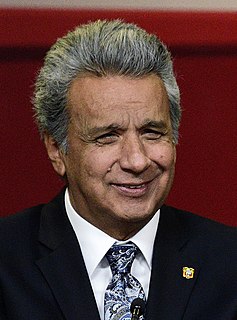
Lenín Moreno President of Ecuador

Lenín Boltaire Moreno Garcés is an Ecuadorian politician who is the President of Ecuador, in office since 2017. He was Vice President from 2007 to 2013, serving under President Rafael Correa.
PAIS Alliance political party in Ecuador

PAIS Alliance is an Ecuadorian center-left social democratic political party.

The Ecuadorian Constituent Assembly was a 2007–2008 constitutional assembly in Ecuador, which drafted the 2008 Constitution of Ecuador, approved via the Ecuadorian constitutional referendum, 2008.

2009 Ecuadorian general election

An early general election was held on 26 April 2009 in Ecuador following the approval of a new constitution in a referendum held on 28 September 2008. President Rafael Correa ran for his first term under the new constitution. The election was initially expected to be held in October 2010.
Fander Falconí Ecuadorian politician

Fander Falconí Benitez, is an Ecuadorian economist and politician. He served as Foreign Minister in the government of President Rafael Correa from December 2008 until his resignation on 13 January 2010 because of the Yasuní oil project.

2013 Ecuadorian general election

General elections were held in Ecuador on 17 February 2013 to elect the President, the National Assembly, Provincial Assemblies and members of the Andean Parliament. The incumbent President Rafael Correa was re-elected by a wide margin. Correa's closest electoral rival, Guillermo Lasso, conceded the election shortly after it concluded.

Creating Opportunities political party in Ecuador

Creating Opportunities is an Ecuadorian political movement founded in January 2012 and participated in the 2013 presidential elections with Guillermo Lasso as their candidate for president.

Guillermo Lasso Ecuadorian politician

Guillermo Alberto Santiago Lasso Mendoza is an Ecuadorian businessman and politician. In the Ecuadorian general election, 2013 he was presidential candidate for the party Creating Opportunities. He landed in second place with 22.68% of valid votes but as incumbent President Rafael Correa received more than double that amount, namely 57.17%. Lasso is, through a trust named with his initials, GLM, the largest share holder in Banco de Guayaquil, where he has been executive president for more than 20 years.
2015 Ecuadorian protests protests in Ecuador against inheritance tax laws

The 2015 Ecuadorian protests were a series of protests against the inheritance tax laws introduced by Ecuadorian President Rafael Correa. The protests began during the first week of June; becoming more organized and growing to hundreds of people on 8 June 2015. Since then, hundreds of thousands of Ecuadorians protested throughout Ecuador against President Correa and the controversial inheritance tax laws he introduced. The opposition and demonstrators protested stating that Correa wanted to follow "the same path as Venezuela’s government", creating a "criminal war of classes" while President Correa stated that the protests were aimed at destabilizing the government and such measures were for combatting inequality.

Events in the year 2017 in Ecuador.

Alexandra Ocles Ecuadorian politician

María Alexandra Ocles Padilla is an Ecuadorian politician and educator.

Elizabeth Cabezas Ecuadorian politician

Elizabeth Cabezas Guerrero is an Ecuadorian economist and politician. She has been the President of the National Assembly since 14 March 2018.

Rocío González Navas First Lady of Ecuador

Rocío González Navas is an Ecuadorian businesswoman. She has been the First Lady of Ecuador since May 24, 2017 as the wife of President Lenín Moreno.

References

  1. Referendum on tax havens will be conducted in the elections of 2017 Ecuador Times, 22 November 2016
  2. 1 2 Ecuador will hold run-off poll to choose new president BBC News, 23 February 2017
  3. CNE plenary presented total results of the second round of elections CNE, 10 April 2017
  4. El Pleno del CNE proclamó a Lenín Moreno presidente electo de Ecuador El Comercio, 18 April 2017
  5. 1 2 "Constitutional history of Ecuador" . Retrieved 24 June 2017.
  6. "Conozca la historia de Alianza PAIS, de un binomio al control del poder en Ecuador" . Retrieved 24 June 2017.
  7. lgc-TP-gp, teleSUR /. "Ecuador Sets 2017 Election Date, Marking Correa's Last Year" . Retrieved 24 June 2017.
  8. "IFES Election Guide - Elections: Ecuador President Second Round". www.electionguide.org. Retrieved 24 June 2017.
  9. Pike, John. "Rafael Correa". www.globalsecurity.org. Retrieved 24 June 2017.
  10. 1 2 3 "What to expect from Ecuador's elections". The Economist. Retrieved 24 June 2017.
  11. "BBC NEWS - Americas - South America's leftward sweep". news.bbc.co.uk. Retrieved 24 June 2017.
  12. Kendall, Clare (23 September 2008). "A new law of nature" . Retrieved 24 June 2017 via The Guardian.
  13. Siddique, Haroon; agencies (29 September 2008). "Ecuador referendum endorses new socialist constitution" . Retrieved 24 June 2017 via The Guardian.
  14. http://resultados2013.cne.gob.ec/Results.html?RaceID=1&UnitID=1&IsPS=0&LangID=0)
  15. "Explainer: Ecuador's 2017 Presidential Elections - AS/COA". AS/COA. Retrieved 24 June 2017.
  16. (www.dw.com), Deutsche Welle. "Ecuador former banker Lasso heads opinion poll for run-off presidential vote - News - DW - 26.02.2017". DW.COM. Retrieved 24 June 2017.
  17. Ecuador: Court Paves Way for Referendum on Correa's Re-Election Telesur, 25 April 2016
  18. Ecuadorians Collect 1.2 Million Signatures for Correa’s Reelection Panama Post, 17 August 2016
  19. Ecuador’s Rafael Correa to Supporters: Thanks but I Won’t Run for Reelection Panama Post, 21 August 2016
  20. Dube, Ryan (3 October 2016). "Ecuador's Ruling Party Chooses Lenin Moreno as Presidential Candidate". The Wall Street Journal.
  21. 1 2 Ecuador votes in crucial general elections Al Jazeera, 19 February 2017
  22. Corruption returns to the debate Ecuador Times, 21 March 2017
  23. Ecuador's Election Ends In Close Result, And Accusations Of Cheating NPR, 3 April 2017
  24. Ecuador IFES
  25. 1 2 Ecuador Political Database of the Americas
  26. Articles 150.2 and 164 Electoral law of Ecuador
  27. Electoral system IPU
  28. Ecuador - Political parties Nations Encyclopedia
  29. CNN, Euan McKirdy and Rafael Romo. "Ruling party candidate claims win in Ecuadorian vote, rival vows challenge". CNN. Retrieved 24 June 2017.
  30. Press, Associated (14 April 2017). "Ecuador presidential election: 10% of votes to be recounted" . Retrieved 24 June 2017 via The Guardian.
  31. "Ecuador: Government >> globalEDGE: Your source for Global Business Knowledge". globaledge.msu.edu. Retrieved 24 June 2017.