Democratic Left Alliance is a social-democratic political party in Poland. It was formed in 1991 as an electoral alliance of centre-left parties, and became a single party on 15 April 1999. The SLD has no representation in the Sejm or Senate following the 2015 parliamentary election. The party is a member of the Party of European Socialists and Progressive Alliance.

The Canadian Alliance, formally the Canadian Reform Conservative Alliance, was a conservative and right-wing populist federal political party in Canada that existed from 2000 to 2003. The party was the successor to the Reform Party of Canada and inherited its position as the Official Opposition in the House of Commons of Canada and held it throughout its existence. The party supported policies that were both fiscally and socially conservative, seeking reduced government spending on social programs and reductions in taxation.

Pauline Hanson's One Nation is a nationalist, right-wing populist party in Australia. One Nation was founded in 1997, by member of parliament Pauline Hanson and her advisors David Ettridge and David Oldfield after Hanson was disendorsed as a federal candidate for the Liberal Party of Australia. The disendorsement came before the 1996 federal election because of comments she made about Indigenous Australians. Hanson sat as an independent for one year before forming Pauline Hanson's One Nation.
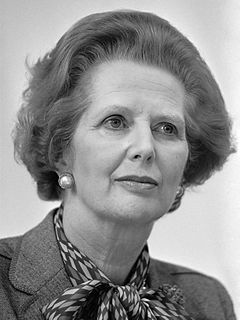
The 1987 United Kingdom general election was held on Thursday 11 June 1987, to elect 650 members to the House of Commons of the United Kingdom. The election was the third consecutive general election victory for the Conservative Party, and second landslide under the leadership of Margaret Thatcher, who became the first Prime Minister since the Earl of Liverpool in 1820 to lead a party into three successive electoral victories.
The SDP–Liberal Alliance was a centrist political and electoral alliance in the United Kingdom. Formed by the Social Democratic Party (SDP) and the Liberal Party, the Alliance was established in 1981, contesting the 1983 general election, 1984 European election and 1987 general election. The Alliance ceased to exist in 1988, when the two component parties merged to form the Social and Liberal Democrats, later renamed the Liberal Democrats.

Manuel Arturo Odría Amoretti was a military officer who served as the 34th President of Peru, essentially ruling as a military dictator.
The Alliance Party of Northern Ireland (APNI) is a liberal and centrist political party in Northern Ireland. It is Northern Ireland's fifth-largest party overall, with eight seats in the Northern Ireland Assembly.

The 2002 New Zealand general election was held on 27 July 2002 to determine the composition of the 47th New Zealand Parliament. It saw the reelection of Helen Clark's Labour Party government, as well as the worst-ever performance by the opposition National Party.
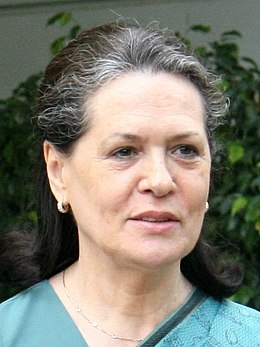
Legislative elections were held in India in four phases between 20 April and 10 May 2004. Over 670 million people were eligible to vote, electing 543 members of the 14th Lok Sabha. The Lok Sabha, or "House of the People," is the directly elected lower house of the Parliament of India.

Elections in Nicaragua gives information on elections and election results in Nicaragua.

Agustín Javier Delgado Chalá is a retired Ecuadorian footballer who played as a forward. Nicknamed Tín, Delgado is the all-time top scorer for the Ecuadorian national team with 31 goals in 71 games. He played professional club football in Ecuador, Mexico and England.

Paco Rosendo Moncayo Gallegos is an Ecuadorian politician and retired general who was Mayor of Quito from 2000 to 2009.

León Roldós Aguilera is an Ecuadorian politician. He was born in Guayaquil in 1942. His mother died during his birth. He studied law at the state University of Guayaquil. He became secretary of the Municipality of Guayaquil under Mayor Assad Bucaram, of the populist party Concentración de Fuerzas Populares. He also had a private practice of law and consultancy mostly to the banking sector. He later became a professor in the University of Guayaquil and a dean of the law school of the Universidad Laica Vicente Rocafuerte.
PAIS Alliance is an Ecuadorian center-left social democratic political party.
This is a summary of the history of Ecuador from 1925 – 1944.

General elections were held in Ecuador on 31 May 1998, with a second round of the presidential elections on 12 July. The result was a victory for Jamil Mahuad of the Popular Democracy (DP) party, who won the run-off with 51.2% of the vote. The DP alliance also emerged as the largest party in the National Congress, winning 32 of the 120 seats.

General elections were held in Ecuador on 1 June 1952. The presidential elections were won by José María Velasco Ibarra of the Velasquista National Federation-Ecuadorian Nationalist Revolutionary Action alliance. His term started on 1 September.
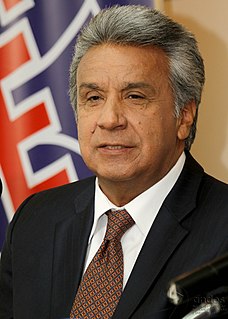
General elections were held in Ecuador on 19 February 2017 alongside a referendum on tax havens. Voters elected a new President and National Assembly. Incumbent President Rafael Correa of the PAIS Alliance was not eligible for re-election, having served two terms. In the first round of the presidential elections, PAIS Alliance candidate Lenín Moreno received 39% of the vote. Although he was more than 10% ahead of his nearest rival, Guillermo Lasso of the Creating Opportunities party, Moreno was just short of the 40% threshold required to avoid a run-off. As a result, a second round was held on 2 April. In the second round Moreno was elected President with 51.16% of the vote.

Elizabeth Cabezas Guerrero is an Ecuadorian economist and politician. She has been the President of the National Assembly since 14 March 2018.