Ecuadorian Constituent Assembly election, 2007

Last updated
Ecuadorian Constituent Assembly election, 2007

Flag of Ecuador.svg


  2006 30 September 2007 (2007-09-30) 2009  

All 130 seats in the Constituent Assembly

  Majority party Minority party
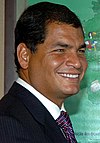
  Rafaelcorrea08122006.jpg Lucio Gutierrez.jpg
Leader Rafael Correa Lucio Gutiérrez
Party PAIS Alliance PSP
Leader since 2006 2000
Seats won 80 19
Percentage 64.5% 7.2%

  Third party Fourth party
  Alvaro Noboa.jpg Leon Febres Cordero.jpg
Leader Álvaro Noboa León Febres Cordero
Party PRIAN PSC
Leader since 2002 1984
Seats won 8 5
Percentage 6.6% 4.2%

Asamblea Nacional Costituyente de Ecuador de 2007 (composicion).svg


Legislator before election

León Febres Cordero
PSC

Resulting Legislator

Alberto Acosta
PAIS Alliance

Coat of arms of Ecuador.svg
This article is part of a series on the
politics and government of
Ecuador

On 30 September 2007 an election for a Constituent Assembly was held in Ecuador following the referendum on this issue successfully held on 15 April 2007. 130 delegates were elected: 24 members from national lists, 100 representing the provinces and six for emigrants living outside Ecuador.

The extraordinarily large number of candidates and lists (26 national lists, 428 provincial lists, 44 emigrant lists) caused the election to be the most complex in Ecuador's history. [1] Although polls indicated that Correa's PAIS Alliance would win a plurality in the election, but not a majority, PAIS won a landslide victory, winning at least 72 of the 130 seats, giving the party the power to dismiss Congress and make the substantial constitutional reforms for which Correa has been calling. PAIS won all six foreign seats.
The Constituent Assembly was to be set up on 31 October 2007, and from then it will have six months (with a possible extension of two months) to draft a new constitution, which will then have to be ratified in a referendum. [2] However, the installation of the Assembly was delayed to 29 November 2007 [3] due to delays in the official proclamation of the final result.

Note that some of the provincial seats were won by coalitions of parties running separately on the national slate; due to different distributions of these joint Assembly members, reports on the number of seats won by each party may vary from source to source.

e    d  Summary of the 30 September 2007 Ecuadorian Constituent Assembly national election results
PartiesVotes
(national)
%Seats
NationalProvincialAbroadTOTAL
PAIS Alliance (Alianza PAIS)75,998,71064.51559680
January 21 Patriotic Society Party (Partido Sociedad Patriótica 21 de Enero)8,467,063 7.221719
Institutional Renewal Party of National Action (Partido Renovador Institucional de Acción Nacional)7,772,1576.6268
Social Christian Party (Partido Social Cristiano)4,957,516 4.2145
Ethics and Democracy Network (Red Ética y Democracia)3,188,226 2.7123
Democratic People's Movement (Movimiento Popular Democrático)2,211,098 1.9134
A New Option (Una Nueva Opción)1,851,436 1.6112
Movement for National Honesty (Movimiento Honradez Nacional)1,296,877 1.111
PS-FAMUPP-NP Alliance (Alianza PS-FA–MUPP-NP)1,082,644 0.944
Ecuadorian Roldosist Party (Partido Roldosista Ecuatoriano)1,058,487 0.911
Movement Ecuador's Force (Movimiento Fuerza Ecuador)959,855 0.8
National Democratic Coalition (Concertación Nacional Democrática)874,075 0.7
ID–Citizen's Power Movement Alliance (Alianza ID/MPC)863,460 0.722
Freedom Party (Partido Libertad)834,589 0.7
National Agreement (Acuerdo Nacional)816,490 0.7
Christian Democratic Union (Unión Demócrata Cristiana)707,110 0.6
Independent Movement Democratic Pole](Movimiento Independiente Polo Democrático)683,667 0.6
Independent Movement of Committed Seculars (Movimiento Independiente Laicos Comprometidos)657,840 0.6
Christian Civic Compromise with the Community C4 (Compromiso Cívico Cristiano con la Comunidad C4)645,6270.5
Ecuadorian White Movement for the Vindication of the Poor (Movimient Blanco Ecuatoriano por la Reivindicación de los Pobres)602,187 0.5
MCSXXI/MAE/MTF Alliance (Alianza MCSXXI/MAE/MTF)601,848 0.5
National Reconciliation (Conciliación Nacional)441,089 0.4
National Movement for Social Reconciliation (Movimiento Nacional por la Conciliación Social)423,518 0.4
Independent Just and Solidary Movement (Movimiento Independiente Justo y Solidario)329,320 0.3
Thousandfold Victory (Triunfo Mil)277,569 0.2
Social Integration and Transformation(Integración y Transformación Social)250,341 0.2
Citizens' Independent Movement Future Already(Movimiento Ciudadano Independiente Futuro Ya; only contested provincial elections)11
Valid (turnout 73.2%)117,852,799 100.00241006130
Invalid665,776
Blank429,120
Total9,371,232
Source: CNE

Related Research Articles

Politics of Ecuador

The politics of Ecuador are multi-party. The central government polity is a four-yearly elected presidential, unicameral representative democracy. The President of Ecuador is head of state and head of government on a multi-party system, leading a cabinet with further executive power. Legislative power is not limited to the National Assembly as it may to a lesser degree be exercised by the executive which consists of the President convening an appointed executive cabinet. Subsequent acts of the National Assembly are supreme over Executive Orders where sufficient votes have been cast by the legislators. The judiciary is independent of the executive and the legislature.There is also constitutional republic

Mixed-member proportional (MMP) representation is a mixed electoral system in which voters get two votes: one to decide the representative for their single-seat constituency, and one for a political party. Seats in the legislature are filled firstly by the successful constituency candidates, and secondly, by party candidates based on the percentage of nationwide or region-wide votes that each party received. The constituency representatives are elected using first-past-the-post voting (FPTP) or another plurality/majoritarian system. The nationwide or region-wide party representatives are, in most jurisdictions, drawn from published party lists, similar to party-list proportional representation. To gain a nationwide representative, parties may be required to achieve a minimum number of constituency candidates, a minimum percentage of the nationwide party vote, or both.

National Assembly (Venezuela) Parliament of Venezuela

The National Assembly is the de jure legislature for Venezuela that was first elected in 2000. The National Assembly has been rendered ceremonial since the introduction of the Constituent Assembly in 2017. It is a unicameral body made up of a variable number of members, who were elected by a "universal, direct, personal, and secret" vote partly by direct election in state-based voting districts, and partly on a state-based party-list proportional representation system. The number of seats is constant, each state and the Capital district elected three representatives plus the result of dividing the state population by 1.1% of the total population of the country. Three seats are reserved for representatives of Venezuela's indigenous peoples and elected separately by all citizens, not just those with indigenous backgrounds. For the 2010-2015 period the number of seats was 165. All deputies serve five-year terms. The National Assembly meets in the Federal Legislative Palace in Venezuela's capital, Caracas.

Elections in Venezuela

Elections in Venezuela are held at a national level for the President of Venezuela as head of state and head of government, and for a unicameral legislature. The President of Venezuela is elected for a six-year term by direct election plurality voting, and is eligible for re-election. The National Assembly (Asamblea Nacional) has 165 members (diputados), elected for five-year terms using a mixed member majoritarian system. Elections also take place at state level and local level.

Elections in Bolivia

Elections in Bolivia gives information on elections and election results in Bolivia.

Elections in the Philippines

Philippine elections are of several types. The president, vice-president, and the senators are elected for a six-year term, while the members of the House of Representatives, governors, vice-governors, members of the Sangguniang Panlalawigan, mayors, vice-mayors, members of the Sangguniang Panlungsod/members of the Sangguniang Bayan, barangay officials, and the members of the Sangguniang Kabataan are elected to serve for a three-year term.

Elections in Rwanda

Elections in Rwanda take place within the framework of a multi-party democracy and a presidential system. The President and majority of members of the Chamber of Deputies are directly elected, whilst the Senate is indirectly elected and partly appointed.

Democratic Peoples Movement old political party in Ecuador

The Democratic People's Movement was the electoral wing of the Marxist-Leninist Communist Party of Ecuador and a political party in Ecuador since 1978.

Rafael Correa Former President of Ecuador

Rafael Vicente Correa Delgado is an Ecuadorian politician and economist who served as President of Ecuador from 2007 to 2017. The leader of the PAIS Alliance political movement, Correa is a democratic socialist and his administration focused on the implementation of left-wing policies. Internationally, he served as president pro tempore of the Union of South American Nations.

Cynthia Viteri Ecuadorian politician

Cynthia Fernanda Viteri Jiménez de Villamar is an Ecuadorian lawyer, journalist and politician. She was the presidential candidate for Partido Social Cristiano in the 2017 presidential elections, and was a candidate in the 2006 presidential elections of Ecuador and finished fifth. Between 1998 and 2007 she was a member of the National Congress. Since 2009 she has been a member of the National Assembly. On March 24 2019, she was elected Mayor of Guayaquil in the sectional elections of Ecuador and will be serving from May 14, 2019 until May14, 2024.

2007 Ecuadorian Constituent Assembly referendum

A referendum on establishing a Constituent Assembly to write the new constitution was held in Ecuador on 15 April 2007. After its approval by 87% of voters, a Constituent Assembly Election was held on 30 September 2007 with Correa's PAIS Alliance taking the majority of seats. The assembly was to sit for a maximum of 180 days with a possible 60-day-extension.

2010 Sudanese general election

General elections were held in Sudan between 11 and 15 April 2010, extended from the original end date of 13 April. The elections were held to elect the President and National Assembly of Sudan, as well as the President and Legislative Assembly of Southern Sudan. The election brought to the end the transitional period which began when the decades-long Second Sudanese Civil War ended in 2005.

2008 Ecuadorian constitutional referendum

A constitutional referendum was held in Ecuador on 28 September 2008 to ratify or reject the constitution drafted by the Ecuadorian Constituent Assembly elected in 2007. The new constitution was approved by 69% of voters.

2008 Constitution of Ecuador tengo la verga loka

The Constitution of Ecuador is the supreme law of Ecuador. The current constitution has been in place since 2008. It is the country's 20th constitution.

2009 Ecuadorian general election

An early general election was held on 26 April 2009 in Ecuador following the approval of a new constitution in a referendum held on 28 September 2008. President Rafael Correa ran for his first term under the new constitution. The election was initially expected to be held in October 2010.

2013 Ecuadorian general election

General elections were held in Ecuador on 17 February 2013 to elect the President, the National Assembly, Provincial Assemblies and members of the Andean Parliament. The incumbent President Rafael Correa was re-elected by a wide margin. Correa's closest electoral rival, Guillermo Lasso, conceded the election shortly after it concluded.

Creating Opportunities political party in Ecuador

Creating Opportunities is an Ecuadorian political movement founded in January 2012 and participated in the 2013 presidential elections with Guillermo Lasso as their candidate for president.

2017 Ecuadorian general election elections

General elections were held in Ecuador on 19 February 2017 alongside a referendum on tax havens. Voters elected a new President and National Assembly. Incumbent President Rafael Correa of the PAIS Alliance was not eligible for re-election, having served two terms. In the first round of the presidential elections, PAIS Alliance candidate Lenín Moreno received 39% of the vote. Although he was more than 10% ahead of his nearest rival, Guillermo Lasso of the Creating Opportunities party, Moreno was just short of the 40% threshold required to avoid a run-off. As a result, a second round was held on 2 April. In the second round Moreno was elected President with 51.16% of the vote.

References