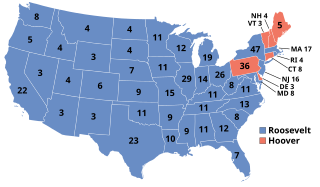
The United States presidential election of 1932 was the thirty-seventh quadrennial presidential election, held on Tuesday, November 8, 1932. The election took place against the backdrop of the Great Depression. Incumbent Republican President Herbert Hoover was defeated in a landslide by Democrat Franklin D. Roosevelt, the Governor of New York. The election marked the effective end of the Fourth Party System, which had been dominated by Republicans.

The United States Electoral College is a body of electors established by the United States Constitution, constituted every four years for the sole purpose of electing the president and vice president of the United States. The Electoral College consists of 538 electors, and an absolute majority of 270 electoral votes is required to win an election. Pursuant to Article II, Section 1, Clause 2, the legislature of each state determines the manner by which its electors are chosen. Each state's number of electors is equal to the combined total of the state's membership in the Senate and House of Representatives; currently there are 100 senators and 435 representatives. Additionally, the Twenty-third Amendment provides that the District of Columbia (D.C.) is entitled to a number of electors no greater than that of the least populous state.

The Cook Partisan Voting Index, often abbreviated as CPVI or simply PVI, is a measurement of how strongly a United States congressional district or state leans toward the Democratic or Republican Party, compared to the nation as a whole. The index is updated after each election cycle. The Cook Political Report introduced the PVI in August 1997 to better gauge the competitiveness of each district using the 1992 and 1996 presidential elections as a baseline. The index is based on analysis by the Center for Voting and Democracy for its July 1997 Monopoly Politics report.

The 1970 United States Senate elections was an election for the United States Senate, taking place in the middle of Richard Nixon's first term as President. The Democrats lost a net of three seats, while the Republicans and the Conservative Party of New York picked up one net seat each, and former Democrat Harry F. Byrd Jr. was re-elected as an independent.
The 1968 United States Senate elections were elections for the United States Senate which coincided with the presidential election. Although Richard Nixon won the presidential election narrowly, the Republicans picked up five net seats in the Senate. Republicans would gain another seat after the election when Alaska Republican Ted Stevens was appointed to replace Democrat Bob Bartlett.
The 1962 United States Senate elections was an election for the United States Senate which was held in the middle of President John F. Kennedy's term. His Democratic Party made a net gain of three seats from the Republicans, increasing their control of the Senate.
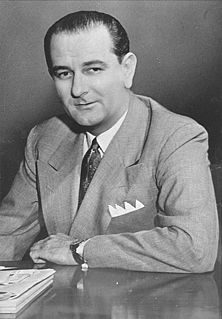
The 1960 United States Senate elections coincided with the election of John F. Kennedy as president. The Republicans gained one seat at the expense of the Democrats. The Democrats nonetheless retained a commanding lead in the Senate with 64 seats to 36. As Majority Leader Lyndon B. Johnson was elected Vice President, Mike Mansfield became the new Majority Leader.
The 1956 United States Senate elections were elections for the United States Senate that coincided with the re-election of President Dwight D. Eisenhower. Although the Democrats gained two seats in regular elections, the Republicans gained back two seats in special elections, leaving the party balance of the chamber remained unchanged.
The 1954 United States Senate elections was a midterm election in the first term of Dwight D. Eisenhower's presidency. Eisenhower's Republican party lost a net of two seats to the Democratic opposition. This small change was just enough to give Democrats control of the chamber with the support of an Independent who caucused with them.

The 1950 United States Senate elections occurred in the middle of Harry S. Truman's second term as President. As with most 20th-century second-term mid-terms, the party out of the Presidency made significant gains. The Republican opposition made a net gain of five seats, taking advantage of the Democratic administration's declining popularity during the Cold War and the aftermath of the Recession of 1949. The Democrats held a narrow 49 to 47 seat majority after the election. This became the first time since 1932 that the Senate Majority Leader lost his seat and the only instance where the majority leader lost his seat while his party retained the majority.

The United States Senate elections of 1934 occurred in the middle of Democratic President Franklin D. Roosevelt's first term. In the middle of the Great Depression, voters strongly backed Roosevelt's New Deal and his allies in the Senate. The Democrats picked up a net of nine seats, giving them a supermajority. President Harry S. Truman was first elected to the U.S. Senate in the 1934 election. Truman would serve over a decade in the U.S. Senate, before becoming President Roosevelt's third Vice President, before succeeding to the presidency upon the death of President Roosevelt.
The United States Senate elections of 1932 coincided with Democrat Franklin D. Roosevelt's crushing defeat of incumbent Herbert Hoover in the presidential election. With the Hoover administration widely blamed for the Great Depression, Republicans lost twelve seats and control of the chamber.

The United States Senate elections of 1924 were elections for the United States Senate which coincided with the election of Republican President Calvin Coolidge to a full term. The strong economy and Coolidge's popularity helped Republican candidates increase their majority by four, although several interim appointments had worsened their numbers since the 1922 election; as a result, the party achieved a net gain of only one seat since the previous voting cycle.
The United States Senate elections of 1920 were elections for the United States Senate that coincided with the election of Warren G. Harding as President. There was also a special election in 1921. Democrat Woodrow Wilson's unpopularity allowed Republicans to win races across the country, winning ten seats from the Democrats, providing them with an overwhelming 59 to 37 majority. The Republican landslide was so vast that the Democrats failed to win a single race outside the South.

The 1992 United States House of Representatives elections coincided with the 1992 presidential election, in which Democrat Bill Clinton was elected as President, defeating Republican incumbent President George H. W. Bush.
The 1990 United States House of Representatives elections was an election for the United States House of Representatives in 1990 which occurred in the middle of President George H. W. Bush's term. As in most midterm elections, the President's Republican Party lost seats to the Democratic Party, slightly increasing the Democratic majority in the chamber. It was a rare instance, however, in which both major parties lost votes to third parties such as the Libertarian Party as well as independent candidates. Notable freshmen included independent Bernie Sanders of Vermont's at-large congressional district, future Senators Wayne Allard, Rick Santorum, and Jack Reed, future House Speaker John Boehner, and future Director of the Office of Management and Budget Jim Nussle.

Elections to the United States House of Representatives were held in 1900 for members of the 57th Congress, coinciding with the re-election of President William McKinley.
The 116th United States Congress is the current meeting of the legislative branch of the United States federal government, composed of the Senate and the House of Representatives. It convened in Washington, D.C. on January 3, 2019 and will end on January 3, 2021, during the third and fourth years of Donald Trump's presidency. Senators elected to regular terms in 2014 are finishing their terms in this Congress and House seats were apportioned based on the 2010 Census.

The 2009 United States elections were held on Tuesday, November 3. During this off-year election, the only seats up for election in the United States Congress were special elections held throughout the year. In total, only the seat representing New York's 23rd congressional district changed party hands, increasing the Democratic Party's majority over the Republicans in the United States House of Representatives, 258–177.

The 2020 United States elections will be held on Tuesday, November 3, 2020. All 435 seats in the United States House of Representatives, 34 of the 100 seats in the United States Senate, and the office of President of the United States will be contested. Thirteen state and territorial governorships, as well as numerous other state and local elections, will also be contested.