The politics of Ecuador are multi-party. The central government polity is a four-yearly elected presidential, unicameral representative democracy. The President of Ecuador is head of state and head of government on a multi-party system, leading a cabinet with further executive power. Legislative power is not limited to the National Assembly as it may to a lesser degree be exercised by the executive which consists of the President convening an appointed executive cabinet. Subsequent acts of the National Assembly are supreme over Executive Orders where sufficient votes have been cast by the legislators. The judiciary is independent of the executive and the legislature.There is also constitutional republic
Elections in Benin take place within the framework of a multi-party democracy and a presidential system. Both the President and the National Assembly are directly elected by voters, with elections organised by the Autonomous National Electoral Commission (CENA).

A constitutional referendum was held in Bolivia on 25 January 2009, postponed from the initially planned dates of 4 May 2008 and then 7 December 2008. Drafted by the Constituent Assembly in 2007, the new constitution was approved in the referendum according to an exit poll by Ipsos Apoyo for La Razón and ATB, a Bolivian television network. Furthermore, it required early elections to be held on 6 December 2009.
A referendum on establishing a Constituent Assembly to write the new constitution was held in Ecuador on 15 April 2007. After its approval by 87% of voters, a Constituent Assembly Election was held on 30 September 2007 with Correa's PAIS Alliance taking the majority of seats. The assembly was to sit for a maximum of 180 days with a possible 60-day-extension.

On 30 September 2007 an election for a Constituent Assembly was held in Ecuador following the referendum on this issue successfully held on 15 April 2007. 130 delegates were elected: 24 members from national lists, 100 representing the provinces and six for emigrants living outside Ecuador.

A constitutional referendum was held in France on 5 May 1946. Voters were asked whether they approved of a new draft Constitution proposed by the Constituent Assembly elected in 1945.
Civil unions for same-sex couples in Ecuador were legalized by the approval of the 2008 Constitution, including all the rights of marriage except for joint adoption. The first reported civil union was recognised in August 2009.
PAIS Alliance is an Ecuadorian center-left social democratic political party.
The Bolivian Constituent Assembly, convened on August 6, 2006 in Sucre, with the purpose of drafting a new national constitution by December 14, 2007; extended from the original deadline of August 6, 2007. The Assembly approved the new Political Constitution of the State on 9 December 2007. It was put to a national referendum held on 25 January 2009, and went into force on 7 February 2009.

The Constitution of the Republic of the Union of Myanmar is the supreme law of Myanmar. Myanmar's first constitution adopted by constituent assembly was enacted for the Union of Burma in 1947. After the 1962 Burmese coup d'état, a second constitution was enacted in 1974. The country has been ruled by military juntas for most of its history.
The Constitution of Ecuador is the supreme law of Ecuador. The current constitution has been in place since 2008. It is the country's 20th constitution.
An independence referendum was held in the Comoros on 22 December 1974. The overall result was a strong "yes" vote, with 94.57% of voters voting for independence and almost all the "no" votes being cast in Mayotte, where there was a majority for remaining under French control. In contrast, on Mohéli only five out of 6,059 votes were against independence. Voter turnout was 93.3%.
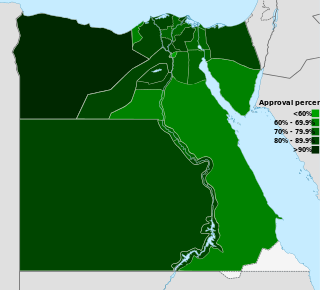
A constitutional referendum was held in Egypt on 19 March 2011, following the 2011 Egyptian revolution. More than 14 million (77%) were in favour, while around 4 million (23%) opposed the changes; 41% of 45 million eligible voters turned out to vote.
A constitutional referendum was held in Ecuador on 1 July 1869 to ratify or reject the constitution drafted by the Ecuadorian Constituent Assembly elected earlier in 1869. The country's eighth constitution, known as the Black Charter, was approved by 13,640 of the 14,154 voters.
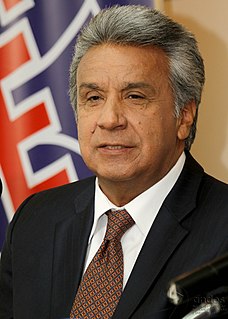
General elections were held in Ecuador on 19 February 2017 alongside a referendum on tax havens. Voters elected a new President and National Assembly. Incumbent President Rafael Correa of the PAIS Alliance was not eligible for re-election, having served two terms. In the first round of the presidential elections, PAIS Alliance candidate Lenín Moreno received 39% of the vote. Although he was more than 10% ahead of his nearest rival, Guillermo Lasso of the Creating Opportunities party, Moreno was just short of the 40% threshold required to avoid a run-off. As a result, a second round was held on 2 April. In the second round Moreno was elected President with 51.16% of the vote.
A constitutional referendum was held in Ivory Coast on 30 October 2016. Voters were asked whether they approve of a proposed new constitution. The new constitution would create a Senate, remove the nationality clause from the presidential requirements and establish the post of Vice-President. The constitution was approved by 93.42% of votes with a 42.42% turnout, as announced by the president of the Independent Electoral Commission (CEI).
Guinea has had four constitutions. The current constitution was approved by referendum on 19 April 2010 and formally adopted on 7 May.
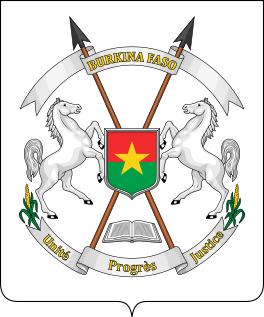
A constitutional referendum was due to be held in Burkina Faso on 24 March 2019. If approved, the new constitution would have ended the Fourth Republic created in 1991. In March 2019, the referendum was postponed indefinitely, without explanation.