The politics of Andorra take place in a framework of a parliamentary constitutional diarchy, and a multi-party system. Executive power is exercised by the government, with the Head of Government of Andorra as chief executive. Legislative power is vested in both the government and parliament. The judiciary is independent of the executive and the legislature.

The Politics of Azerbaijan takes place in a framework of a semi-presidential republic, with the President of Azerbaijan as the head of state, and the Prime Minister of Azerbaijan as head of government. Executive power is exercised by the president and the government. Legislative power is vested in both the government and parliament. The Judiciary is nominally independent of the executive and the legislature. The state system of Azerbaijan defines the Constitution of the Republic of Azerbaijan. According to the constitution, Azerbaijan is a democratic, secular, unitary republic.
A constituent assembly or constitutional assembly is a body or assembly of popularly elected representatives composed for the purpose of drafting or adopting a constitutional-type document. The constituent assembly is a subset of a constitutional convention elected entirely by popular vote; that is, all constituent assemblies are constitutional conventions, but a constitutional convention is not necessarily a constituent assembly. As the fundamental document constituting a state, a constitution cannot normally be modified or amended by the state's normal legislative procedures; instead a constitutional convention or a constituent assembly, the rules for which are normally laid down in the constitution, must be set up. A constituent assembly is usually set up for its specific purpose, which it carries out in a relatively short time, after which the assembly is dissolved. A constituent assembly is a form of representative democracy.
Elections in Benin take place within the framework of a multi-party democracy and a presidential system. Both the President and the National Assembly are directly elected by voters, with elections organised by the Autonomous National Electoral Commission (CENA).

The Constitution of the People's Republic of Bangladesh is the constitutional document of Bangladesh. It was adopted on 16 December 1972. It provides the framework of the Bangladeshi republic with a parliamentary government, fundamental human rights and freedoms, an independent judiciary, democratic local government and a national bureaucracy. The constitution includes references to socialism, Islam, secular democracy and the Bengali language. It commits Bangladesh to “contribute to international peace and co-operation in keeping with the progressive aspirations of mankind”. The constitution has several controversial elements like Article 70.

A seven-question referendum was held in Belarus on 24 November 1996. Four questions were put forward by President Alexander Lukashenko on changing the date of the country's independence day, amending the constitution, changing laws on the sale of land and the abolition of the death penalty. The Supreme Council put forward three questions on constitutional amendments by the Communist and Agrarian factions, local elections and the national finances.

A referendum on the direct election of the President was held in France on 28 October 1962. The question was whether to have the President of the French Republic elected by direct popular vote, rather than by an electoral college. It was approved by 62.3% of voters with a 77.0% turnout. However, the reform was controversial because it strengthened the executive at the expense of Parliament, and because of the disputed constitutionality of the procedure used.
The Tibetan Parliament in Exile (TPiE), officially the Parliament of the Central Tibetan Administration, is the unicameral and highest legislative organ of the Central Tibetan Administration. It was established and is based in Dharamshala, India. The creation of this democratically elected body has been one of the major changes that the 14th Dalai Lama brought about in his efforts to introduce a democratic system of administration. Today, the Parliament consists of 45 members: ten members each from Ü-Tsang, Kham, and Amdo, the three traditional provinces of Tibet; the four major schools of Tibetan Buddhism and the traditional Bön faith elect two members each; four members are elected by Tibetans in the west: two from Europe, one from Australasia, one from North America and one from Canada. The Tibetan Parliament-in-Exile is headed by a Speaker and a Deputy Speaker, who are elected by the members amongst themselves. Any Tibetan who has reached the age of 25 has the right to contest elections to the Parliament.

The Constitution of Kenya is the supreme law of the Republic of Kenya. There have been three significant versions of the constitution, with the most recent redraft being enabled in 2010. The 2010 edition replaced the 1963 independence constitution. The constitution was presented to the Attorney General of Kenya on 7 April 2010, officially published on 6 May 2010, and was subjected to a referendum on 4 August 2010. The new Constitution was approved by 67% of Kenyan voters. The constitution was promulgated on 27 August 2010.

Parliamentary elections were held in the Federated States of Micronesia on 8 March 2011, alongside a three-part referendum. As there were no political parties, all 34 candidates ran as independents. For the first time in the country's history, two women ran for election, both in Chuuk State. However, neither was elected.

A six-part referendum was held in Palau on 2 November 2004 alongside the country's general elections. Voters were asked questions on summoning a Constitutional Convention, payment of members of the National Congress, creating a unicameral Congress, term limits for Congress members, election of the President and Vice President and dual citizenship. All proposals were approved except the unicameral Congress, which despite receiving a majority of the public vote, did not meet the quorum of 12 of 16 states required for amendments to the constitution.
A constitutional referendum was held in the Federated States of Micronesia on 27 August 2002. Voters were asked whether they approved of 14 separate amendments to the country's constitution. To be approved, the proposal required at least 75% of voters in at least three of the four states to vote in favour. Ultimately all 14 proposals were rejected, as none passed the 75% threshold in any state.

A constitutional referendum was held in Ecuador on 1 July 1869 to ratify or reject the constitution drafted by the Ecuadorian Constituent Assembly elected earlier in 1869. The country's eighth constitution, known as the Black Charter, was approved by 13,640 of the 14,154 voters.

Parliamentary elections were held in Colombia on 11 March 1990 alongside local elections and an unofficial referendum on electing a Constitutional Assembly.
Constitutional Assembly elections were held in Colombia on 9 December 1990 alongside a referendum on the Assembly itself. The Assembly sat from February to July 1991 and drew up the 1991 constitution.
A three-part referendum was held in Ecuador on 26 November 2006, alongside the run-off for the presidential elections. Voters were asked whether they approved of a ten-year plan for education, plans to improve healthcare provision, and using oil revenues for social and economic programmes. All three proposals were approved by wide margins.
An eleven-part referendum was held in Ecuador on 26 November 1995. Voters were asked whether they approved of the decentralisation of social and healthcare authorities, the privatisation of social security, equalising public spending between the provinces, abolishing civil servants' right to strike, whether the President should have the authority to dissolve the National Assembly, whether local councils should have a four-year term of office, whether the President and Vice-President of the National Assembly should only serve two-year terms, whether eight constitutional reforms proposed by President Sixto Durán Ballén should be approved, certain reforms to the judiciary, legal rights for civil servants and the creation of a Constitutional Court. All eleven proposals were rejected.
A fourteen-part referendum was held in Ecuador on 25 May 1997. Voters were asked whether they approved of the dismissal of President Abdalá Bucaram by the National Congress, the appointment of Fabián Alarcón as interim President for twelve months, the calling of a Constitutional Assembly, whether a Constitutional Assembly should be elected by direct elections or by appointment, whether spending limits should be introduced for election campaigns, whether voters should be able to modify electoral lists, whether National Assembly elections should be held alongside the first or second round of presidential elections, whether political parties that fail to cross the 5% threshold in two consecutive elections should be deregistered, whether the Supreme Electoral Tribunal (TSE) should reflect the political makeup of the National Congress, whether the National Congress should appoint managers of state-owned companies with a two-thirds majority, reforms to the justice system, allowing the Supreme Court to appoint judicial authority member, whether elected officials who commit a criminal offence should be removed from office, and whether the National Assembly should implement the 13 proposals. All eleven proposals were approved by voters.
A referendum is a direct vote in which an entire electorate is asked to either accept or reject a particular proposal. This article summarises referendum laws and practice in various countries.
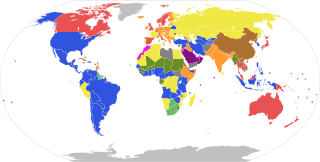
A semi-parliamentary system is a classification of systems of government proposed by Maurice Duverger, in which citizens directly elect at the same time the legislature and the prime minister, possibly with an electoral law ensuring the existence of a parliamentary majority for the prime minister-elect. As in a parliamentary system, the prime minister is responsible to the legislature and can be dismissed by it: this however effectively causes a snap election for both the prime minister and the legislature.