Fractal curve

Last updated
Construction of the Gosper curve Gosper 6.gif
Construction of the Gosper curve

A fractal curve is loosely a mathematical curve whose shape retains the same general pattern of irregularity, regardless of how high it is magnified or scaled, that is, its graph takes the form of a fractal. [1]

Contents

In general, fractal curves are nowhere rectifiable — that is, they do not have finite length — and every subarc longer than a single point has infinite length. [2] A famous example is the boundary of the Mandelbrot set.
In nature

Fractal curves and fractal patterns are widespread in nature, found in such places as broccoli, snowflakes, feet of geckos, frost crystals, and lightning bolts. [3] [4] [5] [6]

See also Romanesco broccoli, dendrite crystal, trees, fractals, Hofstadter's butterfly, Lichtenberg figure, and self-organized criticality.

Dimension

Mathematical curves are one dimensional spaces. However, fractal curves have different fractal dimension or Hausdorff dimension [7] (see list of fractals by Hausdorff dimension).

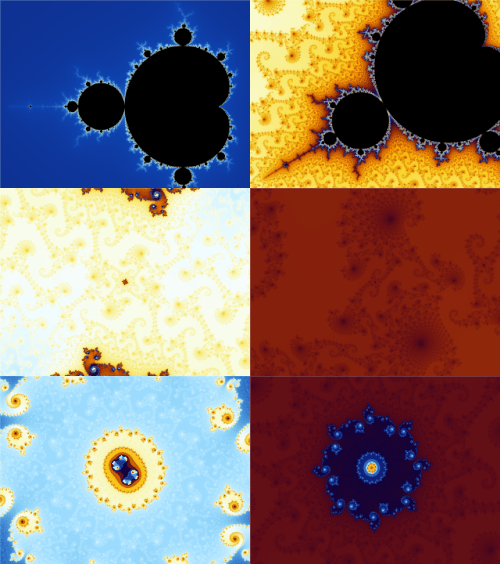
Zooming in on the Mandelbrot set Mandelbrot sequence new.gif
Zooming in on the Mandelbrot set

Relationship to other fields

Starting in the 1950s, Benoit Mandelbrot and others have studied self-similarity of fractal curves, and have applied theory of fractals to modelling natural phenomena. Self-similarity occurs, and analysis of these patterns has found fractal curves in such diverse fields as economics, fluid mechanics, geomorphology, human physiology and linguistics.

As examples, "landscapes" revealed by microscopic views of surfaces in connection with Brownian motion, vascular networks, and shapes of polymer molecules all relate to fractal curves. [1]

Examples

See also

References

  1. 1 2 "Geometric and topological recreations".
  2. Ritzenthaler, Chella. "Fractal Curves" (PDF).
  3. McNally, Jess. "Earth's Most Stunning Natural Fractal Patterns". Wired. wired.com. Retrieved 17 May 2020.
  4. Tennenhouse, Erica (July 5, 2016). "8 Stunning Fractals Found in Nature".
  5. LaMonica, Martin (March 30, 2017). Villiger, Maggie (ed.). "Fractal patterns in nature and art are aesthetically pleasing and stress-reducing". doi:10.64628/AAI.v7dkdpjs4.
  6. Gunther, Shea (April 24, 2013). "14 amazing fractals found in nature" . Retrieved 2020-05-17.
  7. Bogomolny, Alexander. "Fractal Curves and Dimension". cut-the-knot.