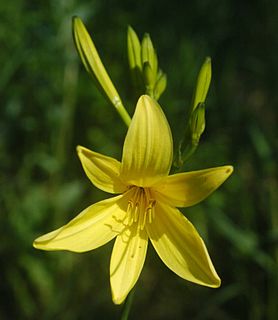
A daylily or day lily is a flowering plant in the genus Hemerocallis, a member of the family Asphodelaceae, subfamily Hemerocallidoideae. Despite the common name, it is not in fact a lily. Gardening enthusiasts and horticulturists have long bred daylily species for their attractive flowers. Thousands of cultivars have been registered by local and international Hemerocallis societies.

Magnolia denudata, the lilytree or Yulan magnolia, is native to central and eastern China. It has been cultivated in Chinese Buddhist temple gardens since 600 AD. Its flowers were regarded as a symbol of purity in the Tang Dynasty and it was planted in the grounds of the Emperor's palace. It is the official city flower of Shanghai.
Amaranthus wrightii is a species of flowering plant. It goes by the common name of Wright's amaranth. It occurs from western Texas into southern Arizona and as far north as Colorado at elevations between 500–2,000 m (1,600–6,600 ft).
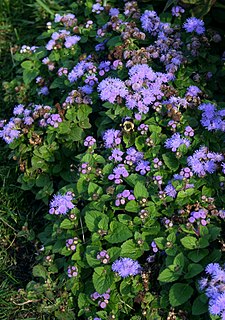
Ageratum houstonianum, commonly known as flossflower, bluemink, blueweed, pussy foot or Mexican paintbrush, is a cool-season annual plant often grown as bedding in gardens.

Hemerocallis fulva, the orange day-lily, tawny daylily, corn lily, tiger daylily, fulvous daylily or ditch lily, is a species of daylily native to Asia. It is very widely grown as an ornamental plant in temperate climates for its showy flowers and ease of cultivation. It is not a true lily in the genus Lilium, but gets its name from the superficial similarity of its flowers to Lilium and from the fact that each flower lasts only one day.

Rosa chinensis, known commonly as the China rose or Chinese rose, alternatively known as Bengal rose or Bengal Crimson or Bengal Beauty is a member of the genus Rosa native to Southwest China in Guizhou, Hubei, and Sichuan Provinces. The first publication of Rosa chinensis was in 1768 by Nikolaus Joseph von Jacquin in Observationum Botanicarum, 3, p. 7, p. 55.

Symphyotrichum laeve is a flowering plant native to Canada and the United States. It has the common names of smooth blue aster, smooth aster, smooth-leaved aster, glaucous Michaelmas-daisy and glaucous aster.
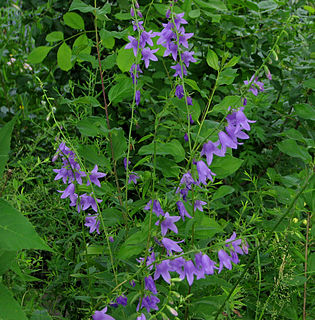
Campanula rapunculoides, known by the common names creeping bellflower, or rampion bellflower, is a perennial herbaceous plant of the genus Campanula, belonging to the family Campanulaceae.

Chionanthus retusus, the Chinese fringetree, is a flowering plant in the family Oleaceae. It is native to eastern Asia: eastern and central China, Japan, Korea and Taiwan.

Corylus americana, the American hazelnut or American hazel, is a species of deciduous shrub in the genus Corylus, native to the eastern and central United States and extreme southern parts of eastern and central Canada.

Trillium pusillum is a species of flowering plant in the family Melanthiaceae known by the common names dwarf trillium, least trillium and dwarf wakerobin. It is native to the southeastern and south-central United States from Oklahoma to Maryland.

Helianthus petiolaris is a North American plant species in the sunflower family, commonly known as the prairie sunflower or lesser sunflower. Naturalist and botanist Thomas Nuttall was the first to describe the prairie sunflower in 1821. The word petiolaris in Latin means, “having a petiole”. The species originated in Western United States, but has since expanded east. The prairie sunflower is sometimes considered a weed.
Hemerocallis hongdoensis, common name Hongdo Island day-lily or hongdo-wonch'uri, is a plant species native to a group of small islands in the Yellow Sea, off the southwest coast of South Korea. The species is named for Hongdo Island, where the type specimen was collected, about 115 km SW of Mokpo. The region is part of Dadohaehaesang National Park.

Clintonia udensis is a species of flowering plant in the lily family Liliaceae. It is the only species of Clintonia native to Asia. It prefers sparsely forested habitat including the alpine forests of the Himalayas.

Hemerocallis citrina, common names citron daylily and long yellow daylily, is a species of herbaceous perennial plant in the family Asphodelaceae.
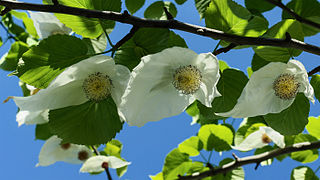
Davidia involucrata, the dove-tree, handkerchief tree, pocket handkerchief tree, or ghost tree, is a medium-sized deciduous tree in the family Nyssaceae. It was previously included with tupelos in the dogwood family, Cornaceae. It is native to South Central and Southwest China from Hubei to southern Gansu, south to Guizhou, Sichuan and Yunnan, but is widely cultivated elsewhere.

Schoenolirion wrightii, known as Texas sunnybell, is a species of flowering plant in the Agave subfamily. It is native to the southern United States, in Texas, Louisiana, Arkansas, and Alabama. Texas sunnybell produces vertical rootstocks topped with prominent bulbs, each up to 17 mm (0.67 in) in diameter. Between two and seven leaves are produced per plant, up to 34 cm (13 in) long and only 6 mm (0.24 in) across each, flattened to slightly keeled and usually shorter than the flowerhead. The ovate to lanceolate tepals are white with a green stripe on the back, mostly three-veined, but sometimes five-veined. Schoenolirion wrightii flowers between March and May, occurring in sandstone outcrops, wet pinelands, and boggy places.
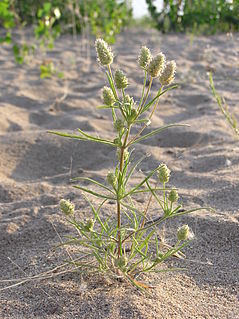
Plantago indica, commonly known as branched plantain, sand plantain, or black psyllium, is a flowering plant in the plantain family Plantaginaceae, and is one of a few species in the Plantago genus under the common name psyllium. The plant is native to parts of Africa, Europe, Russia, and Asia, and has been naturalized in many other areas such as Australia and North America. The plant can be found mostly in dry inland areas, such as those that are sandy, and has also naturalized on roadsides and in meadows. The plant is not used broadly as a food source, but has been cultivated for its seeds which serve a medicinal use as a laxative.

Corylopsis sinensis, the Chinese winter hazel, is a species of flowering plant in the witch-hazel family Hamamelidaceae, native to western China. Growing to 4 m (13 ft) tall and broad, it is a substantial deciduous shrub. With ovate leaves, it produces delicately fragrant drooping racemes of pale yellow flowers with orange anthers in Spring.
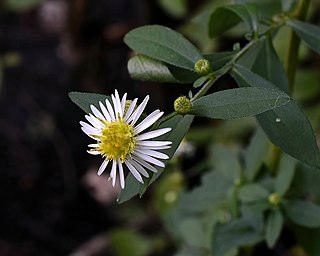
Symphyotrichum ontarionis is a species of flowering plant in the family Asteraceae native to eastern North America. Commonly known as Ontario aster, bottomland aster, and aster du lac Ontario (French), it is a perennial, herbaceous plant that may reach 120 centimeters high. Each flower head has many tiny florets put together into what appear as one.

