
Lilium is a genus of herbaceous flowering plants growing from bulbs, all with large prominent flowers. They are the true lilies. Lilies are a group of flowering plants which are important in culture and literature in much of the world. Most species are native to the northern hemisphere and their range is temperate climates and extends into the subtropics. Many other plants have "lily" in their common names, but do not belong to the same genus and are therefore not true lilies.

A daylily or day lily is a flowering plant in the genus Hemerocallis, a member of the family Asphodelaceae, subfamily Hemerocallidoideae. Despite the common name, it is not in fact a lily. Gardening enthusiasts and horticulturists have long bred daylily species for their attractive flowers. Thousands of cultivars have been registered by local and international Hemerocallis societies. Daylilies are perennial plants, whose name alludes to its flowers, which typically last about a day.
The Mizzou Botanic Garden contains thousands of plants within the campus of the University of Missouri in Columbia, Missouri, United States. The Garden includes famous icons, such as Thomas Jefferson's original grave marker and the Columns of Academic Hall, and is open year-round, only asking for a small donation to visit.
Tiger lily or Tiger Lily may refer to:
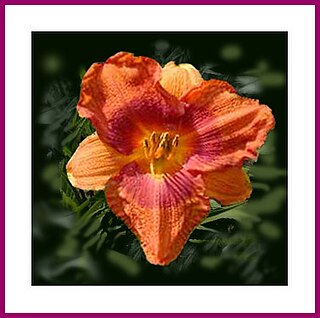
Hemerocallis 'Duke of Durham' is a hybrid daylily introduced in 1977 by Dr. Robert Day Elliott, Jr.
Arlow Burdette Stout was an American botanist and the pioneer breeder of the modern hybrid daylily.

Hemerocallis fulva, the orange day-lily, tawny daylily, corn lily, tiger daylily, fulvous daylily, ditch lily or Fourth of July lily, is a species of daylily native to Asia. It is very widely grown as an ornamental plant in temperate climates for its showy flowers and ease of cultivation. It is not a true lily in the genus Lilium, but gets its name from the superficial similarity of its flowers to Lilium and from the fact that each flower lasts only one day.

Hemerocallis middendorffii, known as Amur daylily, is a plant species in the subfamily Hemerocallidoideae of the family Asphodelaceae of the order Asparagales. It is native to the Russian Far East, northwest China, Korea, and Japan. It grows in meadows, mountain slopes, open woods, and scrub. It is cultivated in Asia for its edible flowers.
Flower of Forgetfulness may refer to one of the following
Hemerocallis lilioasphodelus is a plant of the genus Hemerocallis. It is found across China, in Europe in N.E. Italy and Slovenia and is one of the first daylilies used for breeding new daylily cultivars.
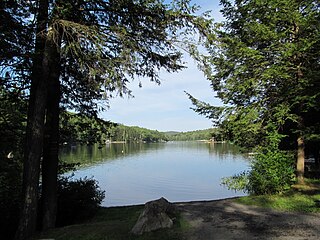
Erving State Forest is a publicly owned forest with recreational features located north of the Millers River in the towns of Erving, Warwick, and Orange, Massachusetts. The property is centered on Laurel Lake, a 51-acre (21 ha) body of water that has been a popular recreational destination since the 1930s. The forest's network of roads and hiking trails were largely created by the Civilian Conservation Corps. The forest is managed by the Department of Conservation and Recreation.

Wojsławice Arboretum is an arboretum, located in Wojsławice, Dzierżoniów County, Lower Silesian Voivodeship, in south-western Poland. It occupies an area of 62 ha.
Siloam daylilies are cultivars of daylilies registered with the American Hemerocallis Society by Pauline Henry of Siloam Springs, Arkansas. Mrs. Henry registered over 450 daylilies during her lifetime. Most of her daylilies were given a name beginning with the word "Siloam", hence "Siloam Daylilies".
George Yeld (1845–1938) was a schoolmaster, climber, explorer and hybridiser of daylilies and irises. He was a member of the Alpine Club and editor of the Alpine Journal. Much of his climbing and exploration was conducted with volcanologist Tempest Anderson and he published reports of his exploits and produced introductory books on Latin for scholars. Yeld received the Victoria Medal of Honour from the Royal Horticultural Society in 1925.

Contarinia quinquenotata is a small midge which infests the flower buds of Hemerocallis, causing the buds to swell, remain closed and rot. It is a pest in several parts of the world. It is known by the common names of daylily gall midge and hemerocallis gall midge.

Hemerocallis citrina, common names citron daylily and long yellow daylily, is a species of herbaceous perennial plant in the family Asphodelaceae.
Needle flower or Needle-flower may refer to various plants, including:

Leo Earl Sharp Sr., also known as El Tata, was an American World War II veteran, horticulturist, and drug courier for a branch of the Sinaloa Cartel.

Hemerocallis dumortieri is a species of plant in the family Asphodelaceae. It is native to Korea and possibly parts of China, and has been introduced into Japan. Hemerocallis dumortieri var. esculenta is native to Hokkaidō.
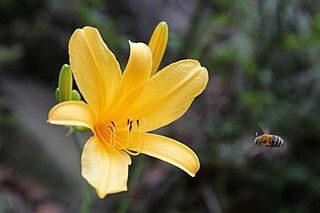
Hemerocallis hakuunensis, known as Baekunsan daylily, is a species in the family Asphodelaceae, native to Korea.


