Harvard Yard, in Cambridge, Massachusetts, is the oldest part of the Harvard University campus, its historic center and modern crossroads. It contains most of the freshman dormitories, Harvard's most important libraries, Memorial Church, several classroom and departmental buildings, and the offices of senior University officials including the President of Harvard University.
Hubbard House may refer to:

The Hubbard Park Historic District encompasses a residential development and park west of Harvard Square in Cambridge, Massachusetts. The area was originally the estate of Gardiner Hubbard, who had a 6-acre (2.4 ha) estate and house on nearby Brattle Street. In the 1880s Hubbard commissioned architects to build a ring of high quality homes around his mansion, which was demolished in 1939 and is now the site of Hubbard Park. The houses in this development are now located on Mercer Circle, Sparks Street, and Hubbard Park Road.

The Hubbard-French District is a historic district at 324 and 342 Sudbury Road in Concord, Massachusetts. It consists of three parcels of land that are the center of the Hubbard family farm. It includes two houses: the 1787-88 Georgian style Thomas Hubbard House, and the Queen Anne style artist's studio of renowned sculptor Daniel Chester French, whose parents owned the Hubbard house. French, who had the house built to his specifications as a studio space, used it for that purpose until 1888, when he moved to New York City. The Hubbard was later owned by historian Samuel Eliot Morison.

Paddock Farm is a historic farmstead at 259 Salisbury Street in Holden, Massachusetts, United States. The main house, built c. 1840 and attached to a c. 1780 earlier house, is a well-preserved example of a local variant of a Cape style house. It is built with a knee-walled second story, with short windows set below the eave. The farmstead was listed on the National Register of Historic Places in 1996.

The Dawson Building is a historic commercial building located at 1851 Purchase Street in New Bedford, Massachusetts.

The Rogers House is a historic house in Holden, Massachusetts. The 1.5-story Cape-style wood-frame house was built sometime before 1733, and is possibly the oldest building in Holden. It is the best-preserved example of its style in the area, which was once somewhat common.

Stony Farm is a historic farmstead in Holden, Massachusetts. Built about 1790, the main house is a well-preserved local example of Federal architecture, and the surviving elements of the one-extensive farm property are a reminder of Holden's predominantly agrarian past. The house was listed on the National Register of Historic Places in 1995.

The Hill Cemetery and Parson Hubbard House Historic District encompasses a historic cemetery and parsonage in Shelburne, Massachusetts. The two properties are located on Old Village Road, on a hill above the Deerfield River known as Old Village Hill, and are the oldest surviving elements of the town's early colonial settlement. The district was listed on the National Register of Historic Places in 2006.

The Gunn and Hubbard Blocks are a pair of historic commercial-residential buildings at 463-477 State Street in the Old Hill section of Springfield, Massachusetts. Located across the street from the Springfield Armory, they were built in the 1830s, and are the two of the oldest commercial buildings in Springfield. The buildings were listed on the National Register of Historic Places in 1980.

The Mills—Hale—Owen Blocks were a collection of three historic mixed-use commercial and residential blocks at 959—991 Main Street in the South End of Springfield, Massachusetts. They occupied an entire city block on the east side of Main Street, between Union and Hubbard Streets, and were some of the city's best examples of commercial Italianate architecture, prior to their destruction in the 2011 Springfield tornado. They were listed on the National Register of Historic Places in 1985.

The Common Historic District is a historic district encompassing the civic and institutional heart of Reading, Massachusetts. The district is centered on the town common, at the intersection of Main and Salem Streets. The common has been communally owned since at least 1737, with the original burying ground to the north. In 1769 the area's first meeting house was built, giving the area a sense of identity separate from portions of Reading that would later be set off as Wakefield and North Reading. Since then the area has become a focal point for religious and civic institutions in the town.

The Harnden–Browne House is a historic house at 60-62 Salem Street in Reading, Massachusetts, exemplifying the adaptation of older buildings to new architectural styles. The 2+1⁄2-story wood-frame house was built in 1831 by Sylvester Harnden, likely in a Georgian-Federal vernacular style. Later in the 19th century it was restyled with some Queen Anne details, and converted to a boarding house. In 1928 it was owned by Thomas Browne, an Irish immigrant who first roomed in the house.
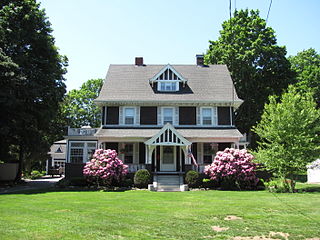
The House at 199 Summer Avenue in Reading, Massachusetts is designated as historic. The original two-and-a-half-story house was designed by architect Horace G. Wadlin and built in 1878 for Robert Kemp, leader of the popular Old Folks Concerts. The house was the second in Reading that Kemp had built; the first also is still standing.

The House at 6 Adams Street in Wakefield, Massachusetts is one of the best examples of Shingle style architecture in the town. It was designed by Boston architect Robert Pote Wait and built in 1885–86 to be his own home. It was listed on the National Register of Historic Places in 1989.

The Woodward Homestead is a historic house at 17 Main Street in Wakefield, Massachusetts, USA. It is an unusual style wood-frame house, with an older portion that is 1.5 stories and was probably built sometime before 1765. It was remodeled later in the 19th century in the Federal style, and in the 1830s the southern portion of the house was added, with Greek Revival style. The first known occupant was John Woodward in 1765; he was from a family that arrived in the area late in the 17th century.

The Manning-Ball House is a historic house at 370 Manning Street in Jefferson, a village of Holden, Massachusetts. It is estimated to have been built c. 1790, and is a well-preserved vernacular four-bay Cape style house. It was listed on the National Register of Historic Places on December 13, 1995.

Glenchrest is a historic farmstead on New Hampshire Route 137 in Harrisville, New Hampshire, United States. Built about 1802, it is a well-preserved local example of a Cape style farmhouse. It was listed on the National Register of Historic Places in 1988.
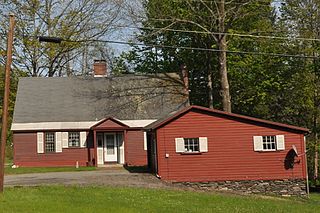
The William Harris House, also known locally as the Joseph Caruso House, is a historic house on Western Avenue in Brattleboro, Vermont. Built in 1768, this Cape-style house is believed to be the oldest surviving building in the town, and one of the oldest in the entire state. It was listed on the National Register of Historic Places in 1978.

Willard and Josephine Hubbard House is a historic home located at Indianapolis, Indiana. It was built in 1903, and is a 2+1⁄2-story, five-bay, center-hall plan, Italian Renaissance Revival style limestone dwelling with an addition. It features a front wooden portico supported by Ionic order columns and a semi-circular front section. Also on the property is a contributing carriage house / garage.