
Darwinia, sometimes commonly known as mountain bells or simply bells, is a genus of about 70 species of evergreen shrubs in the family Myrtaceae, endemic to southeastern and southwestern Australia. The majority are native to southern Western Australia, but a few species occur in South Australia, New South Wales and Victoria. The genus was named in honour of Erasmus Darwin, grandfather of Charles Darwin by Edward Rudge in 1816. Most darwinias grow to a height of between 0.2 and 3 m, and many are prostrate shrubs. Most have small, simple leaves and the flowers are often grouped together, each flower with five red, white or greenish petals and ten stamens. In many species, the flowers are surrounded by large, colourful bracts, giving rise to their common names.

Isopogon, commonly known as conesticks, conebushes or coneflowers, is a genus of about forty species of flowering plants in the family Proteaceae, and are endemic to Australia. They are shrubs with rigid leaves, bisexual flowers in a dense spike or "cone" and the fruit is a small, hairy nut.
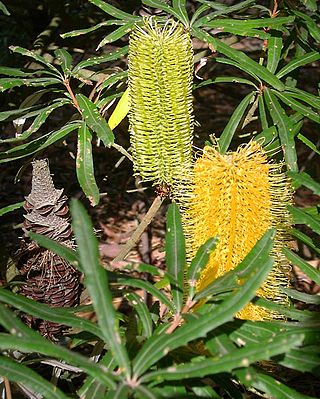
Banksia seminuda, commonly known as the river banksia, is a tree in the plant genus Banksia. It is found in south west Western Australia from Dwellingup (32°42′ S) to the Broke Inlet east of Denmark (34°57′ S). It is often mistaken for, and was originally considered a subspecies of, the Banksia littoralis. Stephen Hopper described the subspecies remanens as a short-leaved shrubby form found in the coastal sands below granite outcrops in the Walpole-Nornalup National Park, however George does not feel this form warrants taxonomic recognition as it lies within the normal variability of the species and there was no clear distinction between it and the other populations of B. seminuda.

Astartea is a genus of flowering plants in the myrtle family, Myrtaceae. The genus is endemic to southwestern Western Australia. The genus name was inspired by Astarte, the Greek name for the goddess Ishtar.

Cryptandra is a genus of flowering plants family Rhamnaceae and is endemic to Australia. Most plants in the genus Cryptandra are spiny, heath-like shrubs with small, clustered leaves and flowers crowded at the ends of branches, the flowers are usually small, surrounded by brown bracts, and with tube-shaped hypanthium, the petals hooded over the anthers.

Thryptomene is a genus of flowering plants in the family Myrtaceae and is endemic to Australia. Plants in the genus Thryptomene are shrubs with small leaves arranged in opposite pairs and white or pink flowers. About forty-seven species of Thryptomene, occurring in all Australian states and the Northern Territory, have been formally described.
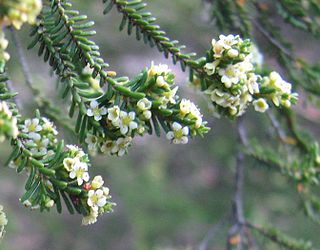
Micromyrtus is a genus of flowering plants in the family Myrtaceae and is endemic to Australia. Plants in the genus Micromyrtus are shrubs with simple leaves arranged in opposite pairs, and white, pink or yellow flowers arranged in upper leaf axils, the flowers with five sepals five petals and five or ten stamens.

Petrophile is a genus of evergreen shrubs, in the family Proteaceae. The genus is endemic to Australia. Commonly known as conebushes, they typically have prickly, divided foliage and produce prominently-displayed pink, yellow or cream flowers followed by grey, conical fruits.
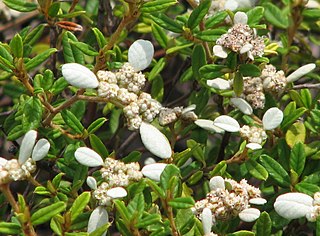
Spyridium is a genus of about thirty species of flowering plants in the family Rhamnaceae, and is endemic to Australia. Plants in the genus Spyridium are shrubs or subshrubs usually with small leaves, flowers usually in clusters of small composite heads, the individual flowers small and densely woolly-hairy, and the fruit a capsule. Species of Spyridium are found in all Australian states except Queensland.
Seorsus is a genus of flowering plants in the family Myrtaceae. The occurrence of the four species in Australia and Borneo is widely spaced, and is thought to be indicative that the genus predates the breakup of Gondwana.
Granitites intangendus is a species of flowering plant endemic to Western Australia. It is found on granite outcrops in semi-arid regions of the midwest and south.

Aluta is a genus of small shrubs in the family Myrtaceae. Species occur in Western Australia, South Australia and the Northern Territory. When the genus was erected in 2000, three species were transferred from the genus Thryptomene.
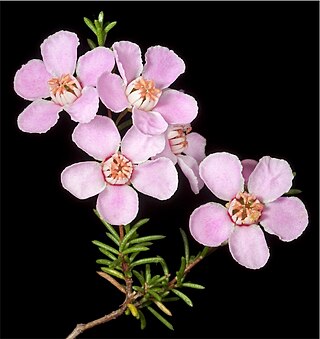
Babingtonia is a genus of 11 species of flowering plants in the myrtle fmily, Myrtaceae and is endemic to the south-west of Western Australia. Plants in the genus Babingtonia are glabrous shrubs with simple linear, lance-shaped or elliptic leaves with white flowers arranged singly or in groups of three to seven, in leaf axils.

Dicrastylis is a genus of plants in the Lamiaceae, first described in 1855. The entire genus is endemic to Australia. The type species is Dicrastylis fulva.

Newcastelia is a genus of flowering plants in the mint family, Lamiaceae, first described in 1857 by Ferdinand von Mueller, who placed it in the family, Verbenaceae. The entire genus is endemic to Australia.
- Newcastelia bracteosaF.Muell. - Western Australia, South Australia, Northern Territory
- Newcastelia cephalanthaF.Muell. - Western Australia, South Australia, Northern Territory, Queensland
- Newcastelia cladotrichaF.Muell. - Western Australia, Northern Territory
- Newcastelia ellipticaMunir - Western Australia, Northern Territory
- Newcastelia hexarrhenaF.Muell. - Western Australia
- Newcastelia insignisE.Pritz. - Western Australia
- Newcastelia interruptaMunir - Queensland
- Newcastelia roseoazureaRye - Western Australia
- Newcastelia spodiotrichaF.Muell. - Western Australia, South Australia, Northern Territory
- Newcastelia velutinaMunir - Queensland

Malleostemon is a genus of flowering plants in the myrtle family Myrtaceae, described as a genus in 1983, by John Green The entire genus is endemic to Western Australia.
- Malleostemon costatusRye & Trudgen
- Malleostemon decipiens(W.Fitzg.) Trudgen
- Malleostemon hursthousei(W.Fitzg.) J.W.Green
- Malleostemon microphyllusRye & Trudgen
- Malleostemon minilyaensisJ.W.Green
- Malleostemon nephroideusRye
- Malleostemon nerrenensisRye & Trudgen
- Malleostemon pedunculatusJ.W.Green
- Malleostemon peltiger(S.Moore) J.W.Green
- Malleostemon pustulatusRye
- Malleostemon roseus(E.Pritz.) J.W.Green
- Malleostemon tuberculatus(E.Pritz.) J.W.Green
- Malleostemon uniflorusRye
Barbara Lynette Rye is an Australian botanist born in 1952.
Malcolm Eric Trudgen is a West Australian botanist. He has published some 105 botanical names. He currently runs his own consulting company, ME Trudgen and Associates.

Stenanthemum is a genus of flowering plants family Rhamnaceae and is endemic to Australia. Plants in the genus Stenanthemum are small shrubs usually lacking spines. The leaves are arranged alternately along the branches, simple, usually folded in half lengthwise on a short petiole. The flowers are arranged in dense heads, usually on the ends of branches with bracts at the base of the flowers, and there are sometimes whitish floral leaves. The flowers are bisexual, more or less sessile and have five sepals, five petals and a tube-shaped hypanthium, the petals hooded over the stamens. The fruit is a schizocarp containing spotted or mottled seeds.
Stenanthemum notiale is a species of flowering plant in the family Rhamnaceae and is native to Western Australia, South Australia and Victoria. It is a small, erect to prostrate shrub with hairy young stems, egg-shaped leaves with the narrower end towards the base, and clusters of white to cream-coloured or greenish yellow, densely shaggy-hairy flowers.
