Integrin alpha 7

Last updated
ITGA7
Identifiers
Aliases ITGA7 , integrin subunit alpha 7
External IDs OMIM: 600536 MGI: 102700 HomoloGene: 37592 GeneCards: ITGA7
Orthologs
SpeciesHumanMouse
Entrez
Ensembl
UniProt
RefSeq (mRNA)

NM_008398
NM_001330160

RefSeq (protein)

n/a

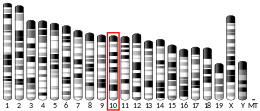
Location (UCSC) Chr 12: 55.68 – 55.72 Mb Chr 10: 128.77 – 128.79 Mb
PubMed search [3] [4]
Wikidata
View/Edit Human View/Edit Mouse

Alpha-7 integrin is a protein that in humans is encoded by the ITGA7 gene. [5] [6] Alpha-7 integrin is critical for modulating cell-matrix interactions. Alpha-7 integrin is highly expressed in cardiac muscle, skeletal muscle and smooth muscle cells, and localizes to Z-disc and costamere structures. Mutations in ITGA7 have been associated with congenital myopathies and noncompaction cardiomyopathy, and altered expression levels of alpha-7 integrin have been identified in various forms of muscular dystrophy.

Contents

Structure

ITGA7 encodes the protein alpha-7 integrin. Alpha-7 integrin is 128.9 kDa in molecular weight and 1181 amino acids in length. [7] Integrins are heterodimeric integral membrane proteins composed of an alpha chain and a beta chain. Alpha-7 integrin undergoes post-translational cleavage within the extracellular domain to yield disulfide-linked light and heavy chains that join with beta 1 to form an integrin that binds to the extracellular matrix protein laminin-1. The primary binding partners of alpha-7 integrin are laminin-1 (alpha1-beta1-gamma1), laminin-2 (alpha2-beta1-gamma1) and laminin-4 (alpha2-beta2-gamma1). [8] Alpha-7/beta-1 is the major integrin complex expressed in differentiated muscle cells.

Splice variants of alpha-7 integrin that differ in both the extracellular and cytoplasmic domains exist in the mouse [9] and are developmentally regulated in mouse and rat muscle tissue. [9] [10] [11] [12] [13] The X1/X2 alternative splicing region lies in the extracellular domain and alters the ligand binding site; specifically, the conserved homology repeat domains 3 and 4. [9] The first identified human transcript contains extracellular and cytoplasmic domains corresponding to the mouse X2 and B variants, respectively. A unique extracellular splice variant was also identified in human. [6] [14] The differentially spliced variants detected in rodents have also been detected in humans. Major cytoplasmic, developmentally regulated variants, alpha-7A and alpha-7B, as well as extracellular variants, X1 and X2 were identified in humans. Moreover, the D variant, but not the C variant was detected in humans. [15]

Alpha-7 integrin is highly expressed in striated muscle, namely skeletal and cardiac muscle, and functions as the major laminin-binding integrin. [16] It was later shown that alpha-7 integrin is also highly expressed in smooth muscle. [17] The two major splice variants of alpha-7 integrin appear to have developmentally regulated expression; alpha-7A integrin is expressed solely in skeletal muscle, however alpha-7B integrin is expressed more loosely in striated muscle as well as the vasculature. [18]

Function

The function of alpha-7 integrin, as is the case for most integrins is to mediate cell membrane interactions with extracellular matrix. [19]

The alpha-7/beta-1 integrin complex clearly plays a role in the development of striated muscle and smooth muscle. Alpha-7/beta-1 integrin promotes the adhesion and motility of myoblasts, and is likely important in the recruitment of myogenic precursors during muscle differentiation. [20] It was shown however that beta-1D integrin appears at embryonic day 11 and alpha-7 integrin does not appear until embryonic day 17; thus, beta-1D associates with alternate alpha subunits (alpha-5, alpha-6A) prior to alpha-7. [21] In human skeletal muscle, alpha-7 integrin is also developmentally regulated, being first detected at age 2. [8]

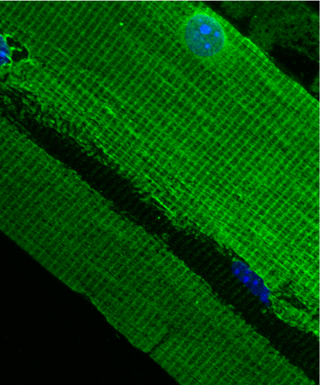
In adult striated muscle cells, alpha-7 integrin (complexed to beta-1 integrin) is localized to Z-discs and costamere structures, bound to the four and one half LIM domain proteins, FHL1 and FHL2. [10] [22] [23] It has been demonstrated that alpha-7 integrin can be mono-ADP-ribosylated on the cell surface in skeletal muscle cells; [24] however, the functional significance of this modification has not been investigated.

Insights into the function of alpha-7 integrin have come from studies employing mouse transgenesis. A mouse expressing a null allele of the ITGA7 gene are viable, suggesting that alpha-7 integrin is not essential for normal myogenesis; however, these mice develop a phenotype that resembles muscular dystrophy. In soleus muscle, there was a significant disruption of myotendinous junctions, variation in the size of fibers, centrally located nuclei, necrosis, phagocytosis, and elevated serum levels of creatine kinase. [25] It has also been proposed that alpha-7 integrin and gamma-sarcoglycan have overlapping functions in skeletal muscle. In support of this, a double knockout of gamma-sarcoglycan and alpha-7 integrin produced a phenotype that was far worse than either knockout alone. Mice died within 1 month of birth and had severe muscle degeneration, suggesting that the roles of these proteins may overlap to maintain the stability of the sarcolemma. [26] Moreover, the double knockout of dystrophin and alpha-7 integrin produced a Duchenne muscular dystrophy-like phenotype, and demonstrated that alterations in alpha-7 integrin affect the pathological changes observed in dystrophin deficiencies. [27] In support of this notion, AAV overexpression of ITGA7 in skeletal muscle of Duchenne muscular dystrophy (DMD) mice showed a significant protective effect against adverse functional parameters associated with DMD, combined with a reversal of these negative features, suggesting that alpha-7 integrin may be a potential therapeutic candidate to treat Duchenne muscular dystrophy. [28]

Studies employing mutant alpha-7 integrin constructs have shown that the cytoplasmic tail of alpha-7B integrin is essential for regulation of lamellipodia formation and regulation of cell mobility regulation via laminin-1/E8 and p130(CAS)/Crk complex formation. [29]

Clinical Significance

Mutations in ITGA7 have been found in patients with unclassified congenital myopathy. [30] Additionally, in patients with severe congenital fiber type disproportion and left ventricular non-compaction cardiomyopathy, a missense mutation, Glu882Lys, was identified in ITGA7 along with a missense mutation in MYH7B, both novel disease genes having a synergistic effect on disease severity. [31]

Alpha-7B integrin expression has been shown to be significantly decreased at sarcolemmal membranes in patients with laminin alpha2 chain-deficient congenital muscular dystrophy. Additionally, in Duchenne muscular dystrophy and Becker muscular dystrophy, the expression of alpha-7B integrin was enhanced. [8]

Interactions

ITGA7 has been shown to interact with:

See also

Related Research Articles

<span class="mw-page-title-main">Laminin</span> Protein in the extracellular matrix

Laminins are a family of glycoproteins of the extracellular matrix of all animals. They are major constituents of the basement membrane, namely the basal lamina. Laminins are vital to biological activity, influencing cell differentiation, migration, and adhesion.

<span class="mw-page-title-main">Dystroglycan</span> Protein

Dystroglycan is a protein that in humans is encoded by the DAG1 gene.
<span class="mw-page-title-main">Costamere</span> Component of striated muscle cells

The costamere is a structural-functional component of striated muscle cells which connects the sarcomere of the muscle to the cell membrane.

<span class="mw-page-title-main">Integrin beta 1</span> Mammalian protein found in Homo sapiens

Integrin beta-1 (ITGB1), also known as CD29, is a cell surface receptor that in humans is encoded by the ITGB1 gene. This integrin associates with integrin alpha 1 and integrin alpha 2 to form integrin complexes which function as collagen receptors. It also forms dimers with integrin alpha 3 to form integrin receptors for netrin 1 and reelin. These and other integrin beta 1 complexes have been historically known as very late activation (VLA) antigens.

<span class="mw-page-title-main">Integrin alpha 3</span> Mammalian protein found in Homo sapiens

Integrin alpha-3 is a protein that in humans is encoded by the ITGA3 gene. ITGA3 is an integrin alpha subunit. Together with beta-1 subunit, it makes up half of the α3β1 integrin duplex that plays a role in neural migration and corticogenesis, acted upon by such factors as netrin-1 and reelin.

Dystrobrevin is a protein that binds to dystrophin in the costamere of skeletal muscle cells. In humans, there are at least two isoforms of dystrobrevin, dystrobrevin alpha and dystrobrevin beta.

<span class="mw-page-title-main">FHL1</span> Mammalian protein found in humans

Four and a half LIM domains protein 1 is a protein that in humans is encoded by the FHL1 gene.

<span class="mw-page-title-main">ADAM15</span> Protein-coding gene in the species Homo sapiens

Disintegrin and metalloproteinase domain-containing protein 15 is an enzyme that in humans is encoded by the ADAM15 gene.

<span class="mw-page-title-main">Tenascin C</span> Human protein-coding gene

Tenascin C (TN-C) is a glycoprotein that in humans is encoded by the TNC gene. It is expressed in the extracellular matrix of various tissues during development, disease or injury, and in restricted neurogenic areas of the central nervous system. Tenascin-C is the founding member of the tenascin protein family. In the embryo it is made by migrating cells like the neural crest; it is also abundant in developing tendons, bone and cartilage.

<span class="mw-page-title-main">Laminin, alpha 5</span> Protein-coding gene in the species Homo sapiens

Laminin subunit alpha-5 is a protein that in humans is encoded by the LAMA5 gene.
<span class="mw-page-title-main">Laminin, alpha 3</span> Protein-coding gene in the species Homo sapiens

Laminin subunit alpha-3 is a protein that in humans is encoded by the LAMA3 gene.

<span class="mw-page-title-main">Collagen, type VI, alpha 1</span> Protein found in humans

Collagen alpha-1(VI) chain is a protein that in humans is encoded by the COL6A1 gene.

<span class="mw-page-title-main">Laminin subunit alpha-1</span> Protein-coding gene in the species Homo sapiens

Laminin subunit alpha-1 is a protein that in humans is encoded by the LAMA1 gene.
<span class="mw-page-title-main">Laminin subunit gamma-1</span> Protein-coding gene in the species Homo sapiens

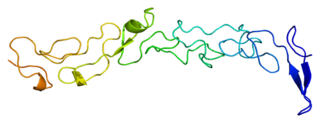
Laminin subunit gamma-1 is a protein that in humans is encoded by the LAMC1 gene.

<span class="mw-page-title-main">Laminin, beta 1</span> Protein-coding gene in the species Homo sapiens

Laminin subunit beta-1 is a protein that in humans is encoded by the LAMB1 gene.
<span class="mw-page-title-main">Laminin subunit alpha-2</span> Protein-coding gene in the species Homo sapiens

Laminin subunit alpha-2 is a protein that in humans is encoded by the LAMA2 gene.
<span class="mw-page-title-main">SGCB</span> Protein-coding gene in the species Homo sapiens

Beta-sarcoglycan is a protein that in humans is encoded by the SGCB gene.

<span class="mw-page-title-main">Delta-sarcoglycan</span> Mammalian protein found in Homo sapiens

Delta-sarcoglycan is a protein that in humans is encoded by the SGCD gene.

<span class="mw-page-title-main">Laminin, beta 2</span> Protein-coding gene in the species Homo sapiens

Laminin subunit beta-2 is a protein that in humans is encoded by the LAMB2 gene.

<span class="mw-page-title-main">Integrin alpha 9</span> Protein-coding gene in the species Homo sapiens

Integrin alpha-9 is a protein that in humans is encoded by the ITGA9 gene. Cytogenetic location: 3p22.2


References

  1. 1 2 3 GRCh38: Ensembl release 89: ENSG00000135424 - Ensembl, May 2017
  2. 1 2 3 GRCm38: Ensembl release 89: ENSMUSG00000025348 - Ensembl, May 2017
  3. ↑ "Human PubMed Reference:". National Center for Biotechnology Information, U.S. National Library of Medicine.
  4. ↑ "Mouse PubMed Reference:". National Center for Biotechnology Information, U.S. National Library of Medicine.
  5. ↑ Wang W, Wu W, Desai T, Ward DC, Kaufman SJ (Aug 1995). "Localization of the alpha 7 integrin gene (ITGA7) on human chromosome 12q13: clustering of integrin and Hox genes implies parallel evolution of these gene families". Genomics. 26 (3): 568–70. doi: 10.1016/0888-7543(95)80176-M . PMID   7607681.
  6. 1 2 "Entrez Gene: ITGA7 integrin, alpha 7".
  7. ↑ "Protein sequence of human ITGA7 (Uniprot ID: Q13683)". Cardiac Organellar Protein Atlas Knowledgebase (COPaKB). Retrieved 20 July 2015.
  8. 1 2 3 Cohn RD, Mayer U, Saher G, Herrmann R, van der Flier A, Sonnenberg A, Sorokin L, Voit T (March 1999). "Secondary reduction of alpha7B integrin in laminin alpha2 deficient congenital muscular dystrophy supports an additional transmembrane link in skeletal muscle". J. Neurol. Sci. 163 (2): 140–52. doi:10.1016/s0022-510x(99)00012-x. PMID   10371075. S2CID   53300469.
  9. 1 2 3 Ziober BL, Vu MP, Waleh N, Crawford J, Lin CS, Kramer RH (December 1993). "Alternative extracellular and cytoplasmic domains of the integrin alpha 7 subunit are differentially expressed during development". J. Biol. Chem. 268 (35): 26773–83. doi: 10.1016/S0021-9258(19)74380-4 . PMID   8253814.
  10. 1 2 Maitra N, Flink IL, Bahl JJ, Morkin E (September 2000). "Expression of alpha and beta integrins during terminal differentiation of cardiomyocytes". Cardiovasc. Res. 47 (4): 715–25. doi: 10.1016/s0008-6363(00)00140-1 . PMID   10974220.
  11. ↑ Collo G, Starr L, Quaranta V (September 1993). "A new isoform of the laminin receptor integrin alpha 7 beta 1 is developmentally regulated in skeletal muscle". J. Biol. Chem. 268 (25): 19019–24. doi: 10.1016/S0021-9258(17)46729-9 . PMID   8360188.
  12. ↑ Song WK, Wang W, Sato H, Bielser DA, Kaufman SJ (December 1993). "Expression of alpha 7 integrin cytoplasmic domains during skeletal muscle development: alternate forms, conformational change, and homologies with serine/threonine kinases and tyrosine phosphatases". J. Cell Sci. 106 ( Pt 4) (4): 1139–52. doi:10.1242/jcs.106.4.1139. PMID   8126096.
  13. ↑ Ziober BL, Kramer RH (September 1996). "Identification and characterization of the cell type-specific and developmentally regulated alpha7 integrin gene promoter". J. Biol. Chem. 271 (37): 22915–22. doi: 10.1074/jbc.271.37.22915 . PMID   8798472.
  14. ↑ Leung, E; Lim, SP; Berg, R; Yang, Y; Ni, J; Wang, SX; Krissansen, GW (4 February 1998). "A novel extracellular domain variant of the human integrin alpha 7 subunit generated by alternative intron splicing". Biochemical and Biophysical Research Communications. 243 (1): 317–25. doi:10.1006/bbrc.1998.8092. PMID   9473524.
  15. ↑ Vignier N, Moghadaszadeh B, Gary F, Beckmann J, Mayer U, Guicheney P (July 1999). "Structure, genetic localization, and identification of the cardiac and skeletal muscle transcripts of the human integrin alpha7 gene (ITGA7)". Biochem. Biophys. Res. Commun. 260 (2): 357–64. doi:10.1006/bbrc.1999.0916. PMID   10403775.
  16. ↑ Kaufman SJ, Foster RF, Haye KR, Faiman LE (June 1985). "Expression of a developmentally regulated antigen on the surface of skeletal and cardiac muscle cells". J. Cell Biol. 100 (6): 1977–87. doi:10.1083/jcb.100.6.1977. PMC   2113591 . PMID   3889014.
  17. ↑ Yao CC, Breuss J, Pytela R, Kramer RH (July 1997). "Functional expression of the alpha 7 integrin receptor in differentiated smooth muscle cells". J. Cell Sci. 110 ( Pt 13) (13): 1477–87. doi:10.1242/jcs.110.13.1477. PMID   9224765.
  18. ↑ Velling T, Collo G, Sorokin L, Durbeej M, Zhang H, Gullberg D (December 1996). "Distinct alpha 7A beta 1 and alpha 7B beta 1 integrin expression patterns during mouse development: alpha 7A is restricted to skeletal muscle but alpha 7B is expressed in striated muscle, vasculature, and nervous system". Dev. Dyn. 207 (4): 355–71. doi: 10.1002/(SICI)1097-0177(199612)207:4<355::AID-AJA1>3.0.CO;2-G . PMID   8950511.
  19. ↑ Hynes RO (April 1992). "Integrins: versatility, modulation, and signaling in cell adhesion". Cell. 69 (1): 11–25. doi:10.1016/0092-8674(92)90115-s. PMID   1555235. S2CID   32774108.
  20. ↑ Yao CC, Ziober BL, Sutherland AE, Mendrick DL, Kramer RH (December 1996). "Laminins promote the locomotion of skeletal myoblasts via the alpha 7 integrin receptor". J. Cell Sci. 109 ( Pt 13) (13): 3139–50. doi:10.1242/jcs.109.13.3139. PMID   9004048.
  21. ↑ Brancaccio M, Cabodi S, Belkin AM, Collo G, Koteliansky VE, Tomatis D, Altruda F, Silengo L, Tarone G (March 1998). "Differential onset of expression of alpha 7 and beta 1D integrins during mouse heart and skeletal muscle development". Cell Adhes. Commun. 5 (3): 193–205. doi: 10.3109/15419069809040291 . PMID   9686317.
  22. 1 2 3 Samson T, Smyth N, Janetzky S, Wendler O, Müller JM, Schüle R, von der Mark H, von der Mark K, Wixler V (Jul 2004). "The LIM-only proteins FHL2 and FHL3 interact with alpha- and beta-subunits of the muscle alpha7beta1 integrin receptor". J. Biol. Chem. 279 (27): 28641–52. doi: 10.1074/jbc.M312894200 . PMID   15117962.
  23. ↑ Galie PA, Khalid N, Carnahan KE, Westfall MV, Stegemann JP (2013). "Substrate stiffness affects sarcomere and costamere structure and electrophysiological function of isolated adult cardiomyocytes". Cardiovasc. Pathol. 22 (3): 219–27. doi:10.1016/j.carpath.2012.10.003. PMC   3610795 . PMID   23266222.
  24. ↑ Zolkiewska A, Moss J (1997). "The α7 Integrin as a Target Protein for Cell Surface Mono-ADP-Ribosylation in Muscle Cells". ADP-Ribosylation in Animal Tissues. Advances in Experimental Medicine and Biology. Vol. 419. pp. 297–303. doi:10.1007/978-1-4419-8632-0_39. ISBN   978-1-4613-4652-4. PMID   9193669.
  25. ↑ Mayer U, Saher G, Fässler R, Bornemann A, Echtermeyer F, von der Mark H, Miosge N, Pöschl E, von der Mark K (November 1997). "Absence of integrin alpha 7 causes a novel form of muscular dystrophy". Nat. Genet. 17 (3): 318–23. doi:10.1038/ng1197-318. PMID   9354797. S2CID   23724091.
  26. ↑ Allikian, MJ; Hack, AA; Mewborn, S; Mayer, U; McNally, EM (1 August 2004). "Genetic compensation for sarcoglycan loss by integrin alpha7beta1 in muscle". Journal of Cell Science. 117 (Pt 17): 3821–30. doi:10.1242/jcs.01234. PMID   15252120. S2CID   86082596.
  27. ↑ Guo C, Willem M, Werner A, Raivich G, Emerson M, Neyses L, Mayer U (March 2006). "Absence of alpha 7 integrin in dystrophin-deficient mice causes a myopathy similar to Duchenne muscular dystrophy". Hum. Mol. Genet. 15 (6): 989–98. doi: 10.1093/hmg/ddl018 . PMID   16476707.
  28. ↑ Heller KN, Montgomery CL, Janssen PM, Clark KR, Mendell JR, Rodino-Klapac LR (March 2013). "AAV-mediated overexpression of human α7 integrin leads to histological and functional improvement in dystrophic mice". Mol. Ther. 21 (3): 520–5. doi:10.1038/mt.2012.281. PMC   3589167 . PMID   23319059.
  29. ↑ Mielenz D, Hapke S, Pöschl E, von Der Mark H, von Der Mark K (April 2001). "The integrin alpha 7 cytoplasmic domain regulates cell migration, lamellipodia formation, and p130CAS/Crk coupling". J. Biol. Chem. 276 (16): 13417–26. doi: 10.1074/jbc.M011481200 . PMID   11278916.
  30. ↑ Hayashi YK, Chou FL, Engvall E, Ogawa M, Matsuda C, Hirabayashi S, et al. (May 1998). "Mutations in the integrin alpha7 gene cause congenital myopathy". Nat. Genet. 19 (1): 94–7. doi:10.1038/ng0598-94. PMID   9590299. S2CID   40229216.
  31. ↑ Esposito T, Sampaolo S, Limongelli G, Varone A, Formicola D, Diodato D, et al. (June 2013). "Digenic mutational inheritance of the integrin alpha 7 and the myosin heavy chain 7B genes causes congenital myopathy with left ventricular non-compact cardiomyopathy". Orphanet J Rare Dis. 8: 91. doi: 10.1186/1750-1172-8-91 . PMC   3695851 . PMID   23800289.
  32. 1 2 Vachon PH, Xu H, Liu L, Loechel F, Hayashi Y, Arahata K, Reed JC, Wewer UM, Engvall E (October 1997). "Integrins (alpha7beta1) in muscle function and survival. Disrupted expression in merosin-deficient congenital muscular dystrophy". J. Clin. Invest. 100 (7): 1870–81. doi:10.1172/JCI119716. PMC   508374 . PMID   9312189.
  33. ↑ Hodges BL, Hayashi YK, Nonaka I, Wang W, Arahata K, Kaufman SJ (November 1997). "Altered expression of the alpha7beta1 integrin in human and murine muscular dystrophies". J. Cell Sci. 110 ( Pt 22) (22): 2873–81. doi:10.1242/jcs.110.22.2873. PMID   9427295.

Further reading