Politics of Malaysia takes place in the framework of a federal representative democratic constitutional monarchy, in which the Yang di-Pertuan Agong is head of state and the Prime Minister of Malaysia is the head of government. Executive power is exercised by the federal government and the 13 state governments. Federal legislative power is vested in the federal parliament and the 13 state assemblies. The judiciary is independent of the executive and the legislature, though the executive maintains a certain level of influence in the appointment of judges to the courts.

The Malaysian Islamic Party is an Islamist political party in Malaysia. PAS's electoral base is in Malaysia's rural and conservative north. The party has governed the east coast state of Kelantan twice and has also, in the past, formed governments in Terengganu, Perak (2008-2009), Kedah (2008–2013), Penang (2008-2015) and Selangor (2008-2018). The party currently holds 18 of the 222 seats in the federal House of Representatives and has elected parliamentarians or state assembly members in eight of the country's 13 states.
The Barisan Alternatif was a coalition of Malaysian opposition parties, formed as a counterweight to the ruling Barisan Nasional. Disbanded after the 2004 general elections, all 4 former component parties of BA have formed a new coalition, Pakatan Rakyat, following the 2008 general elections.

A general election was held on Monday, 29 November 1999 for members of the 10th Parliament of Malaysia. Voting took place in all 193 parliamentary constituencies of Malaysia, each electing one Member of Parliament to the Dewan Rakyat, the dominant house of Parliament. State elections also took place in 394 state constituencies in 11 out of 13 states of Malaysia on the same day.

A general election was held on Sunday, 21 March 2004 for members of the 11th Parliament of Malaysia. Voting took place in all 219 parliamentary constituencies of Malaysia, each electing one Member of Parliament to the Dewan Rakyat, the dominant house of Parliament. State elections also took place in 505 state constituencies in 12 out of 13 states of Malaysia on the same day.
Elections in Malaysia exist at two levels: federal level and state level. Federal level elections are those for membership in the Dewan Rakyat, the lower house of Parliament, while state level elections are for membership in the various State Legislative Assemblies. The heads of executive branch at both the federal and state levels, the Prime Minister and Menteri Besar/Chief Ministers respectively, are indirectly elected, usually filled by a member of the majority party/coalition in the respective legislatures.
The Pengkalan Pasir by-election was held on 6 December 2005 in the Pengkalan Pasir state assembly constituency of the PAS-governed state of Kelantan, Malaysia. Nominations were held on 27 November 2005, and the election was contested by Hanifa Ahmad of Pan-Malaysian Islamic Party (PAS), Hanafi Mamat of the United Malays National Organisation (UMNO) in the Barisan Nasional (BN) coalition, and Ibrahim Ali, an independent candidate. The by-election was necessitated after the death of the incumbent, Wan Abdul Aziz Wan Jaafar from PAS, on 31 October because of cancer. Wan Abdul Aziz defeated Hanafi by 55 votes in the 2004 general election. In 2005, there are 18,411 eligible voters and 195 registered postal voters; 94.8% Malay and 5.2% Chinese in Pengkalan Pasir.
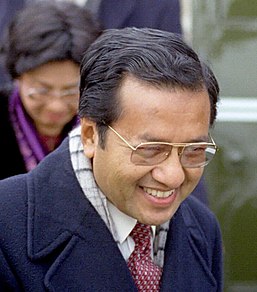
A general election was held between Saturday, 20 October and Sunday, 21 October 1990 for members of the 8th Parliament of Malaysia. Voting took place in all 180 parliamentary constituencies of Malaysia, each electing one Member of Parliament to the Dewan Rakyat, the dominant house of Parliament. State elections also took place in 351 state constituencies in 11 states of Malaysia on the same day.

A general election was held between Saturday, 24 August and Saturday, 14 September 1974 for members of the 4th Parliament of Malaysia. Voting took place in all 154 parliamentary constituencies of Malaysia, each electing one Member of Parliament to the Dewan Rakyat, the dominant house of Parliament. State elections also took place in 360 state constituencies in 12 states of Malaysia on the same day.
The Batu Talam by-election was held on 28 January 2007. The seat of Batu Talam in the state assembly of Pahang, Malaysia, fell vacant after the death of the incumbent, Tengku Paris Tengku Razlan of the United Malays National Organisation (UMNO), the leading party of the ruling Barisan Nasional. Nominations were held on 16 January, with two candidates filing to contest — Abdul Aziz Mat Kiram of UMNO, and independent candidate Ng Chee Pang.

A general election was held on Saturday, 8 March 2008 for members of the 12th Parliament of Malaysia. Voting took place in all 222 parliamentary constituencies of Malaysia, each electing one Member of Parliament to the Dewan Rakyat, the dominant house of Parliament. State elections also took place in 505 state constituencies in 12 out of 13 states on the same day.

Dato' Ustaz Haji Fadzil bin Muhammad Noor was a Malaysian politician and religious teacher. He was the president of Pan-Malaysian Islamic Party (PAS) from 1989 to 2002 and Leader of the Opposition in the Parliament of Malaysia from 1999 to 2002.
Kuala Terengganu by-election of 2009 was held on 17 January 2009 after the death of the incumbent Member of Parliament, Razali Ismail. In the 2008 election, Datuk Razali won by a slim 628 vote majority, defeating Pan-Malaysian Islamic Party (PAS) heavyweight Mohamad Sabu and 89-year-old independent candidate, Maimun Yusuf. Prime Minister Datuk Seri Abdullah Ahmad Badawi and Barisan Nasional were confident that Barisan Nasional would retain the Kuala Terengganu parliamentary seat. The Prime Minister had rejected the assumption that there would be a big swing by the voters to the Opposition. Opposition leader Anwar Ibrahim stated that Parti Keadilan Rakyat (PKR) and the Democratic Action Party (DAP) would support any candidate that PAS picked. He was optimistic that Pakatan Rakyat would win in Kuala Terengganu if all its coalition parties worked hard against Barisan Nasional. In the 2008 election Razali, a government minister of the UMNO party, defeated a PAS opposition candidate by 628 votes. For the by-election PAS nominated state assemblyman Mohd Abdul Wahid Endut, while Barisan Nasional nominated Wan Ahmad Farid Wan Salleh. Mohd Abdul won the by-election by 2,631 votes.
Dato' Haji Kamarudin bin Jaffar is a Malaysian politician and is the Member of the Parliament of Malaysia for the Bandar Tun Razak constituency in Kuala Lumpur. He is a member of People's Justice Party (PKR), a component of Pakatan Harapan (PH) coalition.
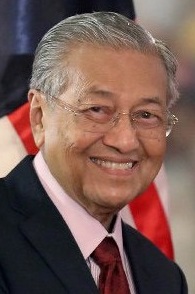
The 2018 Malaysian general election, formally known as the 14th Malaysian general election, was held on Wednesday, 9 May 2018 for members of the 14th Parliament of Malaysia. At stake were all 222 seats in the Dewan Rakyat and 505 seats in 12 out of the 13 State Legislative Assemblies of Malaysia. The 13th Parliament of Malaysia was dissolved by the then Prime Minister Najib Razak on 7 April 2018. It would have been automatically dissolved on 24 June 2018, five years after the first meeting of the first session of the 13th Parliament of Malaysia on 24 June 2013.
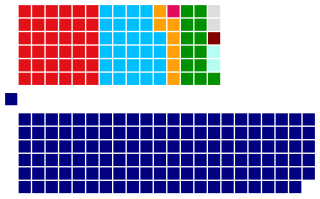
This is a list of the members of the Dewan Rakyat of the 13th Parliament of Malaysia. The opposition coalition Pakatan Rakyat that contested the general elections in 2013 was dissolved after series of disagreements between two main parties, Democratic Action Party (DAP) and Pan-Malaysian Islamic Party (PAS). A new opposition coalition Pakatan Harapan was formed by the Democratic Action Party, People's Justice Party (PKR) and newly formed party National Trust Party (PAN), consisting of ex-PAS members. Several ex-UMNO members have also formed their own party Malaysian United Indigenous Party (PPBM) and have signed an electoral pact with Pakatan Harapan to contest the future general election and ensure straight fights against Barisan Nasional. On 20 March, 2017 PPBM officially became a member of Pakatan Harapan.

The 14th Kelantan State election will be held on or before 23 August 2018. The previous state election was held on 5 May 2013. The state assemblymen is elected to 5 years term each.


