Malaysian general election, 1999

Last updated
Malaysian general election, 1999

Flag of Malaysia.svg


  1995 29 November 1999 (1999-11-29) 2004  

All 193 seats to the Dewan Rakyat
97 seats needed for a majority
Registered 9,564,071
Turnout 6,631,094 (69.3%)

 First partySecond partyThird party
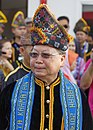
  Mahathir Mohamad addressing the UN 2003.jpg BA Penampang Sabah Joseph-Pairin-Kitingan-02.jpg
Leader Mahathir Mohamad Fadzil Noor Joseph Pairin Kitingan
Party Barisan Nasional Barisan Alternatif PBS
Leader sinceJune 198124 October 1999 (1999-10-24)5 March 1985
Leader's seat Kubang Pasu Pendang Keningau
Last election162 seats, 65.2%30 seats, 32.8% [1] 8 seats, 3.33%
Seats won148453
Seat changeDecrease2.svg 14Increase2.svg 15Decrease2.svg 5
Popular vote3,748,5112,667,818143,342
Percentage56.53%40.23%2.16%
SwingDecrease2.svg 8.7%Increase2.svg 7.4%Decrease2.svg 1.17%

Prime Minister before election

Mahathir Mohamad
Barisan Nasional

Prime Minister-designate

Mahathir Mohamad
Barisan Nasional

A general election was held on Monday, 29 November 1999 for members of the 10th Parliament of Malaysia. Voting took place in all 193 parliamentary constituencies of Malaysia, each electing one Member of Parliament to the Dewan Rakyat, the dominant house of Parliament. State elections also took place in 394 state constituencies in 11 out of 13 states of Malaysia (except Sabah and Sarawak) on the same day.

Parliament of Malaysia bicameral legislature of Malaysia

The Parliament of Malaysia is the national legislature of Malaysia, based on the Westminster system. The bicameral parliament consists of the Dewan Rakyat and the Dewan Negara (Senate). The Yang di-Pertuan Agong (King) as the Head of State is the third component of Parliament.

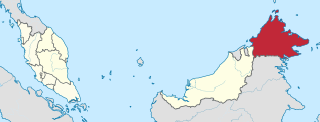
Sabah State of Malaysia

Sabah is a state of Malaysia located on the northern portion of Borneo. Sabah has land borders with the Malaysian state of Sarawak to the southwest and Indonesia's Kalimantan region to the south. The Federal Territory of Labuan is an island just off the Sabah coast. Sabah shares maritime borders with Vietnam to the west and the Philippines to the north and east. Kota Kinabalu is the state capital city, the economic centre of the state and the seat of the Sabah state government. Other major towns in Sabah include Sandakan and Tawau. As of the 2015 census in Malaysia, the state's population is 3,543,500. Sabah has an equatorial climate with tropical rainforests and abundant animal and plant species. The state has long mountain ranges on the west side which form part of the Crocker Range National Park. Kinabatangan River, second longest river in Malaysia runs through Sabah and Mount Kinabalu is the highest point of Sabah as well as of Malaysia.

Contents

Results

Dewan Rakyat

6,631,094 out of 9,564,071 registered voters cast their vote in this election. Although Barisan Nasional maintained its majority in Parliament, its overall popular vote dropped to roughly 56%. The parliamentary results are as follows:

e    d  Summary of the 29 November 1999 Malaysian Dewan Rakyat election results
PartyVoteSeats
Votes%Won%+/–
National Front [lower-alpha 1] BN3,748,51156.5314876.68Decrease2.svg14
United Malays National Organisation UMNO7237.31Decrease2.svg17
Malaysian Chinese Association MCA2915.03Decrease2.svg1
United Traditional Bumiputera Party PBB100,062115.70Increase2.svg1
Malaysian Indian Congress MIC73.63Steady2.svg
Sarawak United People's Party SUPP129,35673.63Steady2.svg
Malaysian People's Movement Party Gerakan63.11Decrease2.svg1
Parti Bansa Dayak Sarawak PBDS51,65963.11Increase2.svg1
Sarawak National Party SNAP45,51942.07Increase2.svg1
United Pasokmomogun Kadazandusun Murut Organisation UPKO31.55New
Sabah Progressive Party SAPP21.04Steady2.svg
Liberal Democratic Party LDP10.52Steady2.svg
Barisan Nasional Direct Candidate11,3270.1810.52
People's Progressive Party PPP00.00Steady2.svg
People's Justice Front AKAR00.00Steady2.svg
United Sabah People's Party PBRS00.00Steady2.svg
Parties in the informal coalition, Alternative Front BA2,667,81840.234221.76Increase2.svg26
Pan-Malaysian Islamic Party [lower-alpha 2] PAS994,27914.992713.99Increase2.svg20
Democratic Action Party [lower-alpha 2] DAP830,87012.53105.18Increase2.svg1
National Justice Party [lower-alpha 2] KeADILan773,67911.6752.59New
United Sabah Party PBS143,3422.1631.55Decrease2.svg5
Malaysian People's Party [lower-alpha 2] PRM68,9901.0400.00Steady2.svg
State Reform Party STAR23,3540.3500.00New
Malaysian Democratic Party MDP8,0010.1200.00New
Pan-Malaysian Islamic Front BERJASA4090.0100.00New
Malaysian People's Justice Front AKIM2740.0000.00Steady2.svg
IndependentsIND39,3850.5900.00Steady2.svg
Valid votes6,455,714
Invalid/blank votes 175,380
Total votes (voter turnout: 69.3%)6,631,094100.00193 100.00+1
Did not vote 2,932,977
Registered voters 9,564,071
Voting age population (aged 21 years and above)13,411,519
Malaysian population 22,549,627

Source: Nohlen et al.

  1. Contested using dacing election symbol on the ballot papers.
  2. 1 2 3 4 Parties in the informal coalition, Alternatif Front (Barisan Alternatif). Contested using separate election symbol on the ballot papers.

Results by state

State Assemblies

The opposition won a total of 113 state assembly seats, 98 of which went to the PAS, 11 to the DAP and 4 for Keadilan. [2] In the states of Kelantan and Terengganu, the PAS won by a huge margin41-2 against Barisan Nasional out of a total of 43 seats and 28-4 out of a total of 32 seats respectively, hence allowing them to form the state governments in these states. In addition, PAS also captured one-third of the state seats in Kedah, with the remaining two-thirds going to Barisan Nasional (UMNO won 16 seats, MCA 2 seats in Kedah).

Kelantan State of Malaysia

Kelantan is a state of Malaysia. The capital and royal seat is Kota Bharu. The honorific of the state is Darul Naim. Kelantan is positioned in the north-east of Peninsular Malaysia. It is bordered by Narathiwat Province of Thailand to the north, Terengganu to the south-east, Perak to the west and Pahang to the south. To the north-east of Kelantan is the South China Sea.

Terengganu State of Malaysia

Terengganu, formerly spelled Trengganu or Tringganu, is a sultanate and constitutive state of federal Malaysia. The state is also known by its Arabic honorific, Dāru l-Īmān. The coastal city of Kuala Terengganu which stands at the mouth of the broad Terengganu River is both the state and royal capital as well as the largest city in Terengganu. There are many islands located close to the coast of Terengganu state, such as Redang Island.

Kedah State of Malaysia

Kedah, also known by its honorific Darul Aman or "Abode of Peace", is a state of Malaysia, located in the northwestern part of Peninsular Malaysia. The state covers a total area of over 9,000 km², and it consists of the mainland and the Langkawi islands. The mainland has a relatively flat terrain, which is used to grow rice, while Langkawi is an archipelago, most of which are uninhabited islands.

The election results were seen as a great gain for PAS, who previously had no state seats in Kedah and capturing only one seat in Terengganu in the 1995 General Elections. Observers attributed this to the neglect by the Federal Administration in the states of Terengganu and Kelantan. [3]

Related Research Articles

Malaysian Islamic Party Islamist political party in Malaysia

The Malaysian Islamic Party is an Islamist political party in Malaysia. PAS's electoral base is in Malaysia's rural and conservative north. The party has governed the east coast state of Kelantan twice and has also, in the past, formed governments in Terengganu, Perak (2008-2009), Kedah (2008–2013), Penang (2008-2015) and Selangor (2008-2018). The party currently holds 18 of the 222 seats in the federal House of Representatives and has elected parliamentarians or state assembly members in eight of the country's 13 states.
Barisan Alternatif

The Barisan Alternatif was a coalition of Malaysian opposition parties, formed as a counterweight to the ruling Barisan Nasional. Disbanded after the 2004 general elections, all 4 former component parties of BA have formed a new coalition, Pakatan Rakyat, following the 2008 general elections.

2004 Malaysian general election

A general election was held on Sunday, 21 March 2004 for members of the 11th Parliament of Malaysia. Voting took place in all 219 parliamentary constituencies of Malaysia, each electing one Member of Parliament to the Dewan Rakyat, the dominant house of Parliament. State elections also took place in 505 state constituencies in 12 out of 13 states of Malaysia on the same day.
1969 Malaysian general election

A general election was held on Saturday, 10 May 1969 for members of the 3rd Parliament of Malaysia, although voting was postponed until between 6 June and 4 July 1970 in Sabah and Sarawak. This election marked the first parliamentary election held in Sabah and Sarawak after the formation of Malaysia in 1963.

Elections in Malaysia

Elections in Malaysia exist at two levels: federal level and state level. Federal level elections are those for membership in the Dewan Rakyat, the lower house of Parliament, while state level elections are for membership in the various State Legislative Assemblies. The heads of executive branch at both the federal and state levels, the Prime Minister and Menteri Besar/Chief Ministers respectively, are indirectly elected, usually filled by a member of the majority party/coalition in the respective legislatures.

1978 Malaysian general election

A general election was held between Saturday, 8 July and Saturday, 22 July 1978 for members of the 5th Parliament of Malaysia. Voting took place in all 154 parliamentary constituencies of Malaysia, each electing one Member of Parliament to the Dewan Rakyat, the dominant house of Parliament. State elections also took place in 276 state constituencies in 10 states of Malaysia on the same day.

1959 Malayan general election

A general election was held on Wednesday, 19 August 1959 for members of the first Parliament of the Federation of Malaya, the first parliamentary election in Malaya. It was the third national-wide election held in Malaya since the end of World War II. Malaya later formed Malaysia with three other states in 1963. Voting took place in all 104 parliamentary constituencies of Malaya, each electing one Member of Parliament to the Dewan Rakyat, the dominant house of Parliament. Voter turnout was 73.3%.

1995 Malaysian general election

A general election was held between Monday, 24 April and Tuesday, 25 April 1995 for members of the 9th Parliament of Malaysia. Voting took place in all 192 parliamentary constituencies of Malaysia, each electing one Member of Parliament to the Dewan Rakyat, the dominant house of Parliament. State elections also took place in 394 state constituencies in 11 out of 13 states of Malaysia on the same day.
1990 Malaysian general election

A general election was held between Saturday, 20 October and Sunday, 21 October 1990 for members of the 8th Parliament of Malaysia. Voting took place in all 180 parliamentary constituencies of Malaysia, each electing one Member of Parliament to the Dewan Rakyat, the dominant house of Parliament. State elections also took place in 351 state constituencies in 11 states of Malaysia on the same day.

1982 Malaysian general election

A general election was held between Thursday, 22 April and Monday, 26 April 1982 for members of the 6th Parliament of Malaysia. Voting took place in all 154 parliamentary constituencies of Malaysia, each electing one Member of Parliament to the Dewan Rakyat, the dominant house of Parliament. State elections also took place in 293 state constituencies in 11 states of Malaysia on the same day.
1974 Malaysian general election

A general election was held between Saturday, 24 August and Saturday, 14 September 1974 for members of the 4th Parliament of Malaysia. Voting took place in all 154 parliamentary constituencies of Malaysia, each electing one Member of Parliament to the Dewan Rakyat, the dominant house of Parliament. State elections also took place in 360 state constituencies in 12 states of Malaysia on the same day.

2008 Malaysian general election Election for the Malaysian Parliament

A general election was held on Saturday, 8 March 2008 for members of the 12th Parliament of Malaysia. Voting took place in all 222 parliamentary constituencies of Malaysia, each electing one Member of Parliament to the Dewan Rakyat, the dominant house of Parliament. State elections also took place in 505 state constituencies in 12 out of 13 states on the same day.

Fadzil Noor Malaysian politician

Dato' Ustaz Haji Fadzil bin Muhammad Noor was a Malaysian politician and religious teacher. He was the president of Pan-Malaysian Islamic Party (PAS) from 1989 to 2002 and Leader of the Opposition in the Parliament of Malaysia from 1999 to 2002.

Dato' Haji Mahfuz bin Haji Omar is a Malaysian politician and currently is the Member of the Parliament of Malaysia for the Pokok Sena constituency in the state of Kedah, Malaysia. He is a member of National Trust Party (AMANAH), a component party of the Pakatan Harapan (PH) ruling coalition.
2018 Malaysian general election 14th election of the Dewan Rakyat and state legislative assemblies of Malaysia

The 2018 Malaysian general election, formally known as the 14th Malaysian general election, was held on Wednesday, 9 May 2018 for members of the 14th Parliament of Malaysia. At stake were all 222 seats in the Dewan Rakyat and 505 seats in 12 out of the 13 State Legislative Assemblies of Malaysia. The 13th Parliament of Malaysia was dissolved by the then Prime Minister Najib Razak on 7 April 2018. It would have been automatically dissolved on 24 June 2018, five years after the first meeting of the first session of the 13th Parliament of Malaysia on 24 June 2013.

2004 Malaysian state elections

State assembly elections were held in Malaysia on 21 March 2004 in all states except Sarawak. The elections took place alongside general elections, and saw Barisan Nasional and its allies won majorities in all states except Kelantan where, despite earlier reports to the contrary, Pan-Malaysian Islamic Party (PAS) retained control with a narrow majority of 24 seats to BN's 21. The National Front regained control of the state of Terengganu, which it lost to the PAS in 1999.

1999 Malaysian state elections

State assembly elections were held in Malaysia on 29 November 1999 in all states except Sarawak. The elections were held alongside general elections, and saw the opposition win a total of 113 seats, 98 of which went to the Pan-Malaysian Islamic Party (PAS), 11 to the Democratic Action Party (DAP) and 4 for the People's Justice Party. In the states of Kelantan and Terengganu, the PAS won by a huge margin–41-2 against Barisan Nasional and 28-4 respectively–hence allowing them to form the state governments in these states. In addition, the PAS also captured one-third of the seats in Kedah, with the remaining two-thirds going to Barisan Nasional.

References

Digital object identifier Character string used as a permanent identifier for a digital object, in a format controlled by the International DOI Foundation

In computing, a Digital Object Identifier or DOI is a persistent identifier or handle used to identify objects uniquely, standardized by the International Organization for Standardization (ISO). An implementation of the Handle System, DOIs are in wide use mainly to identify academic, professional, and government information, such as journal articles, research reports and data sets, and official publications though they also have been used to identify other types of information resources, such as commercial videos.

  1. The previous election was contested under separate parties, mainly PAS and DAP
  2. PILIHAN RAYA UMUM 1999 - DEWAN UNDANGAN NEGERI
  3. Swee-Hock Saw, K. Kesavapany (2006). Malaysia recent trends and challenges. Institute of Southeast Asian Studies. pp. 97–8. ISBN   981-230-339-1.