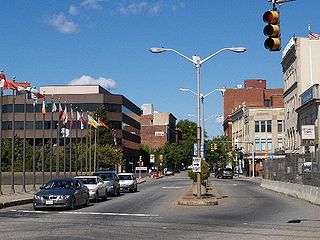
Fall River is a city in Bristol County, Massachusetts, United States. Fall River's population was 94,000 at the 2020 United States census, making it the tenth-largest city in the state. It abuts the Rhode Island state line with Tiverton, RI to its south.
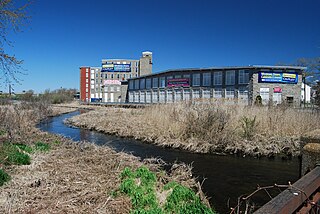
The Quequechan River is a river in Fall River, Massachusetts, that flows in a northwesterly direction from the northwest corner of the South Watuppa Pond through the heart of the city of Fall River and into the end of the Taunton River at Mount Hope Bay at Heritage State Park/Battleship Cove. The word Quequechan means "Falling River" or "Leaping/Falling Waters" in Wampanoag, hence the city's name.

Pocasset Manufacturing Company was a cotton textile mill located in Fall River, Massachusetts. It was located just west of Main Street across the second falls of the Quequechan River. It was organized on August 15, 1821, with $100,000 in capital. The mill began operation in 1822, with Samuel Rodman of New Bedford as the principal owner. Oliver Chace, served as the mill's agent until 1837. Nathaniel Briggs Borden was named clerk and treasurer.

Academy Building is a historic building in Fall River, Massachusetts. The building was constructed in 1875 as a memorial to Nathaniel Briggs Borden by his family. It opened its doors on January 6, 1876. It was added to the National Register of Historic Places in 1973.

For much of its history, the city of Fall River, Massachusetts has been defined by the rise and fall of its cotton textile industry. From its beginnings as a rural outpost of the Plymouth Colony, the city grew to become the largest textile producing center in the United States during the 19th century, with over one hundred mills in operation by 1920. Even with the demise of local textile productions during the 20th century, there remains a lasting legacy of its impact on the city.

The American Printing Company, located in Fall River, Massachusetts grew to become the largest producer of printed cotton cloth in the United States by the early 20th Century. The company grew as an offshoot of the Fall River Iron Works, established in 1821 by Colonel Richard Borden and Major Bradford Durfee. The American Print Works was established in 1835 by Holder Borden. It employed several thousand workers at its peak during World War I.

The Metacomet Mill, built in 1847 by Colonel Richard Borden for the manufacture of cotton textiles, is the oldest remaining textile mill in Fall River, Massachusetts.

The Lower Highlands Historic District encompasses one of the oldest residential areas of Fall River, Massachusetts. The district is roughly bounded by Cherry, Main, Winter, and Bank Streets, and is located just east of the Downtown Fall River Historic District and directly south of the Highlands Historic District. This area was settled by 1810, has architecture tracing the city's growth as a major industrial center. The historic district was added to the National Register of Historic Places in 1984.

Central Congregational Church is a historic church at 100 Rock Street in Fall River, Massachusetts.
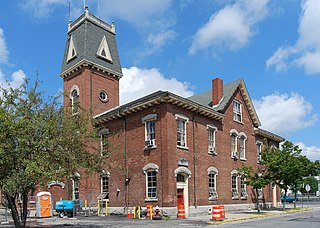
The Central Fire Station is an historic fire station at Leonard and School Streets in Taunton, Massachusetts. Built in 1869, it is the third oldest fire station still in use in the country, and the oldest in the city. It is the oldest *continuously operated* fire station in the country, never having closed for any period of time. It houses Taunton's Engine 1, Ladder 3 and the Deputy Chief. It was listed on the National Register of Historic Places in 1984.
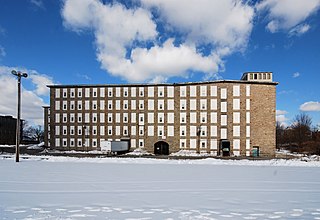
Flint Mills is a historic textile mill complex located on Alden Street in Fall River, Massachusetts, near the banks of the Quequechan River. The company was founded in 1872 and named in honor of John D. Flint, who served as its first president. The original 1872 mill burned in 1882, and was rebuilt in 1883. The complex was later expanded with a second mill and large addition in 1909. The site also contains a detached granite mill office building. The section of Fall River surrounding the mill became known as "Flint Village". The site was added to the National Register of Historic Places in 1983.
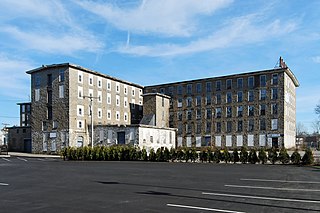
Wampanoag Mills is a historic textile mill complex located at 420 Quequechan Street in Fall River, Massachusetts. Built beginning in 1871, it is a large and well-preserved example of granite textile mill construction. The site was added to the National Register of Historic Places in 1983.
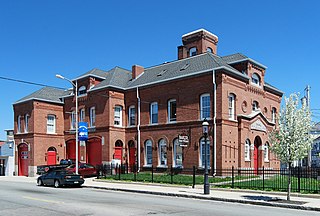
Pocasset Firehouse No. 7 is a historic former fire station in Fall River, Massachusetts. Built in 1873, it is one of four extant firehouses within the city designed by Boston architects Hartwell & Swasey in the Ruskinian Gothic style. The others include the Quequechan No. 1 on Prospect Street, the Massasoit No. 5 on Freedom Street, the Anawan No. 6 Firehouse on North Main Street.
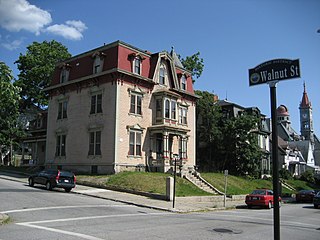
The Highlands Historic District is a historic district roughly bounded by June, Cherry, and Weetamoe Streets, Lincoln, Highland, President, North Main, and Hood Avenues in Fall River, Massachusetts. The district lies just north of the Lower Highlands Historic District.

Fall River Waterworks is a 22-acre (8.9 ha) historic site located at the eastern end Bedford Street in Fall River, Massachusetts, along the shore of North Watuppa Pond. The property, which is still used as a water works for the city, contains the original pumping station, intake house and 121-foot (37 m) tall standpipe water tower. The system was originally built between 1872 and 1875, and expanded or upgraded many times. It was added to the National Register of Historic Places in 1981.

Granite Mills are two historic cotton textile mills located on Bedford Street in Fall River, Massachusetts, consisting of Granite Mill No. 2 and Granite Mill No. 3. The site was determined eligible to be listed on the National Register of Historic Places in 1983, but was omitted due to owner's objection.

Engine House No. 6 is a historic firehouse at 480 Howard Street in Lawrence, Massachusetts. Built in 1895-96 to a design by John Ashton, the Colonial Revival brick building is the oldest firehouse building in the city, and its design was used in the development of other city fire stations. Shuttered by budget cuts in 2009, it was reopened in 2012, and continues to serve its original purpose. It was listed on the National Register of Historic Places in 2004.
Fire Station No. 7, and variations such as Engine House No. 7, may refer to:

The Fall River Manufactory was the first cotton mill to be constructed across the Quequechan River in Fall River, Massachusetts, United States. It was also the first successful textile mill in the area.
Hartwell & Swasey was a short-lived 19th-century architectural firm in Boston, Massachusetts. The partnership between Henry Walker Hartwell (1833-1919) and Albert E. Swasey, Jr. lasted from the late-1860s to 1877, when Swasey went on his own. In 1881, Hartwell formed a partnership with William Cummings Richardson – Hartwell and Richardson – that lasted until his death.