Micrelenchus purpureus

Last updated

Micrelenchus purpureus
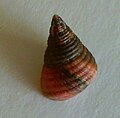
Cantharidus purpureus.JPG
Apertural view of a shell of Micrelenchus purpureus
Scientific classification OOjs UI icon edit-ltr.svg
Kingdom: Animalia
Phylum: Mollusca
Class: Gastropoda
Subclass: Vetigastropoda
Order: Trochida
Superfamily: Trochoidea
Family: Trochidae
Genus: Micrelenchus
Species:
M. purpureus
Binomial name
Micrelenchus purpureus
(Gmelin, 1791)
Synonyms
  • Cantharidus (Mawhero) purpureus(Gmelin, 1791)
  • Cantharidus purpureus(Gmelin, 1791)
  • Helix purpureaGmelin, 1791 (basionym)
  • Micrelenchus (Mawhero) purpureus(Gmelin, 1791)· accepted, alternate representation
  • Phasianella rubellaMenke, 1828
  • Trochus elegansGmelin, 1791
  • Trochus pallidusHombron & Jacquinot, 1848
  • Trochus rostratusGmelin, 1791
  • Trochus texturatusGould, 1849
  • Trochus torosusKiener, 1850

Micrelenchus purpureus, common name the red opal top shell, is a species of medium-sized sea snail, a marine gastropod mollusc in the family Trochidae. [1]

Contents

Description

The length of the shell varies between 16 mm and 32 mm. It grazes on seaweed.

(Described in Latin as Trochus texturatus) The conical shell is imperforate (lacking an umbilicus) and solid. It is ashy-gray , tinged with green or rose, and is cancellated (latticed or cross-hatched) with spiral cords with rose spots and with thin increment lamellae: the spire has 7 whorls, which are scarcely convex, with the body whorl being sub-angulate (slightly cornered). The aperture is rounded and expanded anteriorly. The columella is rounded, with the outer lip being sloping and sharp. The interior is pearly and iridescent. [2]

Distribution

This marine species occurs off North Island and South Island, New Zealand.

References

  1. MolluscaBase eds. (2020). MolluscaBase. Micrelenchus purpureus (Gmelin, 1791). Accessed through: World Register of Marine Species at: http://www.marinespecies.org/aphia.php?p=taxdetails&id=876695 on 2020-07-26
  2. Gould, A.A. (1849). "Descriptions of new species of shells, brought home by the U. S. Exploring Expedition". roceedings of the Boston Society of Natural History. 3: 89. Retrieved 19 November 2025.PD-icon.svg This article incorporates text from this source, which is in the public domain .

Further reading