
The family Talpidae includes the moles who are small insectivorous mammals of the order Eulipotyphla. Talpids are all digging animals to various degrees: moles are completely subterranean animals; shrew moles and shrew-like moles somewhat less so; and desmans, while basically aquatic, excavate dry sleeping chambers; whilst the quite unique star-nosed mole is equally adept in the water and underground. Talpids are found across the Northern Hemisphere of Eurasia and North America, and range as far south as the montane regions of tropical Southeast Asia.

Mole crickets are members of the insect family Gryllotalpidae, in the order Orthoptera. Mole crickets are cylindrical-bodied, fossorial insects about 3–5 cm (1.2–2.0 in) long as adults, with small eyes and shovel-like fore limbs highly developed for burrowing. They are present in many parts of the world and where they have arrived in new regions, may become agricultural pests.

Tettigidea is a genus of groundhoppers or pygmy grasshoppers in the tribe Batrachideini from the Americas. There are at least 40 described species in Tettigidea.

Gryllacrididae are a family of non-jumping insects in the suborder Ensifera occurring worldwide, known commonly as leaf-rolling crickets or raspy crickets. The family historically has been broadly defined to include what are presently several other families, such as Stenopelmatidae and Rhaphidophoridae, now considered separate. As presently defined, the family contains two subfamilies: Gryllacridinae and Hyperbaeninae. They are commonly wingless and nocturnal. In the daytime, most species rest in shelters made from folded leaves sewn with silk. Some species use silk to burrow in sand, earth or wood. Raspy crickets evolved the ability to produce silk independently from other insects, but their silk has many convergent features to silkworm silk, being made of long, repetitive proteins with an extended beta-sheet structure.

The Phaneropterinae, the sickle-bearing bush crickets or leaf katydids, are a subfamily of insects within the family Tettigoniidae. Nearly 2,060 species in 85 genera throughout the world are known. They are also known as false katydids or round-headed katydids.
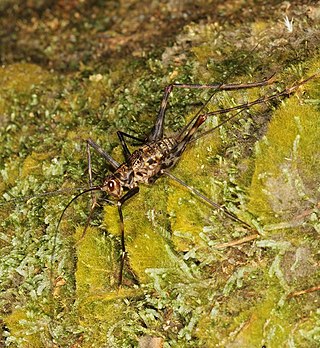
Phalangopsinae, occasionally known as spider crickets, are a subfamily of crickets in the family Phalangopsidae. Members of Phalangopsinae are found worldwide in tropical and subtropical regions. Most species in the subfamily are nocturnal and can be found in rocky areas, near fallen wood, and the understory of forests. Some species are gregarious, gathering in large numbers.

Neocurtilla hexadactyla, commonly known as the northern mole cricket, is a species of mole cricket that is native to eastern North America and Africa. It also occurs in South America, where it may be an adventive species. Its range extends from the southern reaches of eastern Canada and through the eastern and central United States.

Gryllacridinae is an Orthopteran subfamily in the family Gryllacrididae.
Caroliniella aenescens is a species of beetle in the family Cerambycidae, and the only species in the genus Caroliniella. It was described by Blair in 1940.
Steinernema scapterisci, the mole cricket nematode, is a species of nematode in the order Rhabditida. It is a parasite of insects in the order Orthoptera, the grasshoppers, crickets and their allies. Native to southern South America, it was introduced into Florida in the United States in an effort to provide a biological control of pest (Neoscapteriscus) mole crickets.

Neoscapteriscus vicinus, commonly known as the tawny mole cricket, is a species of insect in the mole cricket family, Gryllotalpidae. This species is native to South America and also occurs in the Southern United States, where it arrived as a contaminant of ship's ballast around 1900. Colombian insect taxonomist Oscar Cadena-Castañeda studied specimens of the genus which had been called Scapteriscus, and decided that it included two groups; a smaller group and a larger group that he named Neoscapteriscus in 2015. North American mole cricket taxonomists agreed with his decision and altered Orthoptera Species File Online accordingly.

The New Zealand mole cricket is a wingless member of the mole cricket family Gryllotalpidae. Endemic to New Zealand, it lives underground and is rarely seen. It is now restricted to parts of the southern North Island.

Neotridactylus is a genus of pygmy mole crickets in the family Tridactylidae, recorded from the Americas. There are about 16 described species in Neotridactylus.
Montezumina is a genus of central and South American, phaneropterine katydids in the family Tettigoniidae. There are at least 30 described species in Montezumina.

Cladonotinae is a subfamily of groundhoppers containing more than 70 genera and 260 described species. These insects are found in tropical areas world-wide.
Anabropsis is a genus of king crickets in the tribe Anabropsini. They are found tropical areas of the Americas, Africa and Asia.

Orophus is a small genus of katydids native to Mexico, Central America, and South America.

Hyperbaeninae is a subfamily of Orthopterans, sometimes known as 'leaf-folding crickets' in the family Gryllacrididae; Hyperbaenus ensifer is the type species. The known distribution includes tropical: central and southern America, Africa and mainland Asia to Australasia.

Gryllini is a tribe of crickets and typical of the family Gryllidae. Species are terrestrial, carnivorous or omnivorous and can be found in all continenents except Antarctica.
Apterolarnaca is a genus of Orthopterans, sometimes known as 'leaf-folding crickets' in the subfamily Gryllacridinae, tribe Ametrini and genus group ApotrechaeCadena-Castañeda, 2019. Records of occurrence are from southern China and Vietnam.

