
Yuyao is a county-level city in the northeast of Zhejiang province, China. It is under the jurisdiction of the sub-provincial city of Ningbo.

Ningbo, formerly romanized as Ningpo, is a sub-provincial city in northeast Zhejiang province, People's Republic of China. It comprises the urban districts of Ningbo proper, three satellite cities, and a number of rural counties including islands in Hangzhou Bay and the East China Sea.
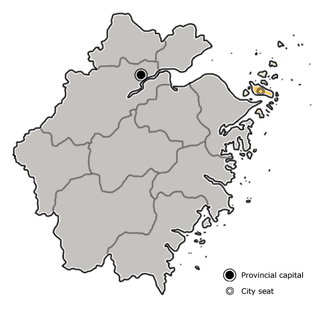
Zhoushanlisten (help·info), formerly romanized as Chusan, is an urbanized archipelago with the administrative status of a prefecture-level city in the eastern Chinese province of Zhejiang. It consists of an archipelago of islands at the southern mouth of Hangzhou Bay, off Ningbo. The prefecture's city proper is Dinghai on Zhoushan Island, now administered as the prefecture's Dinghai District. During the 2010 census, Zhoushan Prefecture's population was 1,121,261, out of whom 842,989 lived in the urban districts of Dinghai and Putuo.

Neo-Confucianism is a moral, ethical, and metaphysical Chinese philosophy influenced by Confucianism, and originated with Han Yu and Li Ao (772–841) in the Tang Dynasty, and became prominent during the Song and Ming dynasties under the formulations of Zhu Xi.

Mount Putuo is an island southeast of Shanghai in Zhoushan, Zhejiang, China. It is a renowned site in Chinese Buddhism and is the bodhimaṇḍa of the bodhisattva Guanyin.

Wang Shouren, courtesy name Bo'an, was a Chinese calligrapher, military general, philosopher, politician, and writer during the Ming dynasty. After Zhu Xi, he is commonly regarded as the most important Neo-Confucian thinker, with interpretations of Confucianism that denied the rationalist dualism of the orthodox philosophy of Zhu Xi. Wang was known as Yangming Xiansheng and/or Yangming Zi in literary circles; both mean "Master Yangming".

The Chinese Culture University is a private Taiwanese university located in Yangmingshan in Shilin District, Taipei, Taiwan. CCU was established in 1962 and is one of the largest universities in Taiwan with an enrollment of about 32,000 students. Satellite campuses are located in the Jianguo, Ximending, and Zhongxiao East Road areas of Taipei City. CCU has a vast collaboration and network with top universities around the world.
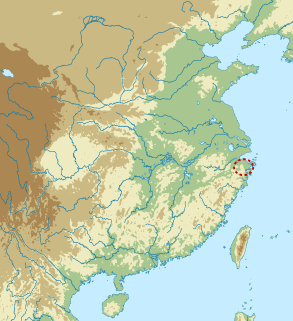
The Hemudu culture was a Neolithic culture that flourished just south of the Hangzhou Bay in Jiangnan in modern Yuyao, Zhejiang, China. The culture may be divided into early and late phases, before and after 4000 BC respectively. The site at Hemudu, 22 km northwest of Ningbo, was discovered in 1973. Hemudu sites were also discovered at Tianluoshan in Yuyao city, and on the islands of Zhoushan. Hemudu are said to have differed physically from inhabitants of the Yellow River sites to the north. Some authors propose that the Hemudu Culture was a source of the pre-Austronesian cultures.

Lu Jiuyuan, or Lu Xiangshan, was a Chinese philosopher and writer who founded the school of the universal mind, the second most influential Neo-Confucian school. He was a contemporary and the main rival of Zhu Xi.
The Port of Ningbo-Zhoushan is a port that is the busiest in the world in terms of cargo tonnage. It handled 888.96 million tons of cargo in 2015. The port is located in Ningbo and Zhoushan, on the coast of the East China Sea, in Zhejiang province on the southeast end of Hangzhou Bay, across which it faces the municipality of Shanghai.
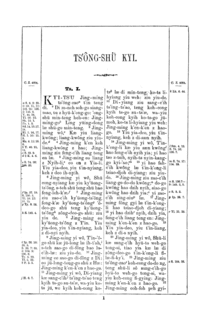
The Ningbo dialect is a dialect of Wu Chinese, one subdivision of Chinese language. Ningbo dialect is spoken throughout Ningbo and Zhoushan prefectures, in Zhejiang province.
Qian Dehong was a notable Chinese philosopher, writer, and educator during the mid-late Ming Dynasty.
The Wu Chinese people, also known as Wuyue people, Jiang-Zhe people (江浙民系) or San Kiang (三江), are a major subgroup of the Han Chinese. They are a Wu Chinese-speaking people who hail from Southern Jiangsu Province, the entirety of the city of Shanghai and all of Zhejiang Province, as well as smaller populations in Xuancheng prefecture-level city in Southern Anhui Province, Shangrao, Guangfeng and Yushan counties of Northeastern Jiangxi Province and some parts of Pucheng County in Northern Fujian Province.
Taihu Wu (吳語太湖片) or Northern Wu (北部吳語) is a Wu Chinese language spoken over much of southern part of Jiangsu province, including Suzhou, Wuxi, Changzhou, the southern part of Nantong, Jingjiang and Danyang; the municipality of Shanghai; and the northern part of Zhejiang province, including Hangzhou, Shaoxing, Ningbo, Huzhou, and Jiaxing. A notable exception is the dialect of the town of Jinxiang, which is a linguistic exclave of Taihu Wu in Zhenan Min-speaking Cangnan county of Wenzhou prefecture in Zhejiang province. Used in regions around Taihu Lake and Hangzhou Bay, this group makes up the largest population among all Wu speakers. Taihu Wu dialects such as Shanghainese, Shaoxing and Ningbo are mutually intelligible even for L2 Taihu speakers.
Edo Neo-Confucianism, known in Japanese as Shushi-Gaku, refers to the schools of Neo-Confucian philosophy that developed in Japan during the Edo period. Neo-Confucianism reached Japan during the Kamakura period. The philosophy can be characterized as humanistic and rationalistic, with the belief that the universe could be understood through human reason, and that it was up to man to create a harmonious relationship between the universe and the individual. The 17th-century Tokugawa shogunate adopted Neo-Confucianism as the principle of controlling people and Confucian philosophy took hold. Neo-Confucians such as Hayashi Razan and Arai Hakuseki were instrumental in the formulation of Japan's dominant early modern political philosophy.

Wang Shu is a Chinese architect based in Hangzhou, Zhejiang Province. He is the dean of the School of Architecture of the China Academy of Art. With his practice partner and wife Lu Wenyu, he founded the firm Amateur Architecture Studio. In 2012, Wang became the first Chinese citizen to win the Pritzker Prize, the world's top prize in architecture. The award was the subject of some controversy since the Pritzker committee did not also award Lu Wenyu, his wife and architectural partner, despite their years of collaboration.
The Jiajing wokou raids caused extensive damage to the coast of China in the 16th century, during the reign of the Jiajing Emperor in the Ming dynasty. The term "wokou" originally referred to Japanese pirates who crossed the sea and raided Korea and China; however, by the mid-Ming, the wokou consisted of multinational crewmen that included the Japanese and the Portuguese, but a great majority of them were Chinese instead. Mid-Ming wokou activity began to pose a serious problem in the 1540s, reached its peak in 1555, and subsided by 1567, with the extent of the destruction spreading across the coastal regions of Jiangnan, Zhejiang, Fujian, and Guangdong.
Kuaiji Commandery, formerly romanized as K‘uai-chi Commandery, was a former commandery of China in the area of Hangzhou Bay. When first established, its capital was at Wu, which became known as "Kuaiji" from this role. The initial territory ran from the south bank of the Yangtze through most of modern Zhejiang to an indeterminate border among the free people of Minyue. Wu and Wuxing commanderies were later formed between the Yangtze and the north shore of Hangzhou Bay; the administration of the remainder of Kuaiji Commandery was then removed to the site of the former Yue capital in modern Shaoxing's Yuecheng District, which also became known as Kuaiji from this role. By the Tang, Hangzhou was also separated and Kuaiji ran from a little north of the Zhe River in the west to Ningbo in the east.

Mingzhou or Ming Prefecture (738–1194) was a zhou (prefecture) in imperial China located in modern northeastern Zhejiang, China, around modern Ningbo. The prefecture was called Yuyao Commandery from 742 to 758.
Weng Fanggang was a Chinese poet, critic, courtier and philosopher during the Qing dynasty.


 Ningbo, Zhejiang
  Hong Kong
  Republic of China (on Taiwan)
 United States
  Australia
