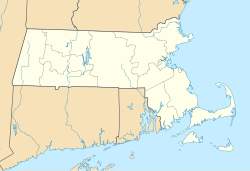
The East Blackstone Village Historic District is a historic district roughly along Elm Street at the junction with Summer Street in eastern Blackstone, Massachusetts. It encompasses a small 19th-century mill village center that developed along what was once a major roadway connecting Worcester with Providence, Rhode Island. The district was added to the National Register of Historic Places in 1995.
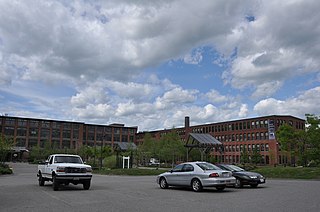
The Parkhill Mill is an historic mill complex at 1 Oak Hill Road in Fitchburg, Massachusetts. Built between 1885 and 1915, it was one of three mill complexes of the Parkill Company, one of the city's largest employers of the period. The mill complex was added to the National Register of Historic Places in 2008. The complex has been restored and is used by a variety of public and private businesses, and as residential space.

The Baystate Corset Block is a historic commercial block at 395–405 Dwight St. and 99 Taylor Street in Springfield, Massachusetts, United States. Built in 1874 and twice enlarged, it was from 1888 to 1920 home of the Baystate Corset Company, one of the nation's largest manufacturers of corsets. The building was listed on the National Register of Historic Places in 1983.

The Holy Name of Jesus Complex is an historic religious complex on Illinois Street in Worcester, Massachusetts. It consists of four main buildings, a church, rectory, convent, and school. It was the third Roman Catholic parish established in the city to serve its French Canadian population, and was a significant work of a Canadian-born Worcester architect, O. E. Nault. One of the Founders of the Church was Noel Biron. The complex was listed on the National Register of Historic Places in 1988.

The Southbridge-Sargent Manufacturing District encompasses a collection of three 19th-century factory buildings near a historically important railroad junction in southern Worcester, Massachusetts. They were built near the intersection of Sargent and Gold Streets, just south of Southbridge Street. The location is close to a junction of three major railroads: the Boston and Albany, the Norwich and Worcester, and the New York, New Haven, and Hartford. The area was once a major industrial part of the city, but has lost many of its historic factory buildings in the 20th century.

The Whittall Mills is an historic industrial complex in southern Worcester, Massachusetts. The complex, which was built between 1870 and 1930, is a reminder of the large carpet manufacturing business that was once a major presence in the city. It is a complex of 15 brick buildings located on a bend of the Middle River, south of Crompton Street and just west of Interstate 290.

The Elm Street Fire House is a historic fire house at 24 Elm Street in Southbridge, Massachusetts. Built in 1899, it was Southbridge's second fire house to be built in the 1890s, and serves as the fire department headquarters. The station was listed on the National Register of Historic Places in 1989.
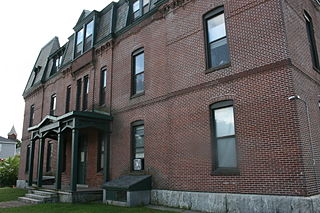
The Cambridge Street School is a historic former school building at 510 Cambridge Street in Worcester, Massachusetts. Built in 1869 and twice enlarged substantially, it is notable for including the only surviving unaltered Second Empire school building in the city. The building served Worcester's public school students until 1976; the city sold the building in 1978. It now serves as a transitional housing facility for homeless families. The building was listed on the National Register of Historic Places in 1980.

The former Downing Street School, now the Traina Center for the Arts of Clark University, is a historic school building at 92 Downing Street in Worcester, Massachusetts. Built in 1891 to a design by Boston-based architect William Forbush, it is a high-quality local example of Romanesque Revival architecture. The building was listed on the National Register of Historic Places in 1980.

The Elizabeth Street School is a historic school building at 31 Elizabeth Street in Worcester, Massachusetts. Built in 1893, it was one of the first commissions for the city by local architect George Clemence, and is stylistically an eclectic mix of Romanesque and Renaissance Revival styles. The building was listed on the National Register of Historic Places in 1980. It has been converted into residences.

Fairlawn is a historic mansion at 189 May Street in Worcester, Massachusetts. It is now part of the main building of the Fairlawn Rehabilitation Hospital. The mansion were the property of James Norcross, a nationally prominent builder whose Norcross Brothers firm was engaged in construction projects involving famous architects, including H. H. Richardson and McKim, Mead & White. The Norcross brothers were also locally prominent, building a number of Worcester landmarks and operating a factory in the city which produced architectural parts.

The Junction Shop and Hermon Street District is a historic district comprising 28 industrial properties on Jackson, Hermon, and Beacon Streets on the south side of Worcester, Massachusetts. It is a remnant of a once larger 19th and early 20th century manufacturing district just west of the railway junction between the Boston and Maine Railroad and the New York, New Haven and Hartford Railroad. It was listed on the National Register of Historic Places in 1980.

The Ashland Mill Tenement is a historic tenement at 141-145 Ashland Avenue in Southbridge, Massachusetts. Built about 1835, this unassuming rowhouse is one of the oldest documented factory-related buildings in the city. It was listed on the National Register of Historic Places in 1989.

The Central Mills Historic District encompasses a historic mill complex on the Quinebaug River in central Southbridge, Massachusetts. Located at the corner of Foster and North Streets, the site consists of three brick buildings, the oldest of which has portions dating to 1837. Despite being extensively rebuilt in the early 20th century, the complex has an appearance that is more typical of 19th century mills.

The Judson–Litchfield House is a historic house at 313 South Street in Southbridge, Massachusetts. Built sometime in the 1830s, it is a well-preserved local example of brick Greek Revival architecture, of which there are few surviving examples in the city. The house was listed on the National Register of Historic Places in 1989.

The Kraus Corset Factory is a historic industrial property at 33 Roosevelt Drive in Derby, Connecticut, United States. The oldest portion of the large brick building, built in 1879, faces Third Street, while a c. 1910 addition extends along Roosevelt Drive. It is the only major building to survive from Derby's period of corset manufacturing. It was built by Sidney Downs, one of Derby's leading businessmen of the period. The building was listed on the National Register of Historic Places on February 12, 1987. It has been converted into apartments.

The District No. 5 School is an historic school building and local history museum at 2 Old Mill Road in Shrewsbury, Massachusetts. It is one of two relatively unmodified one-room schoolhouses in the town. Built in 1828, the brick schoolhouse is also one of the oldest surviving school buildings in the state. The building was listed on the National Register of Historic Places in 2013.

The Kimball Brothers Shoe Factory is a historic factory building at 335 Cypress Street in Manchester, New Hampshire. The four-story brick building was built in stages between 1885 and 1900, and was a prototypical structure from which the design of other period shoe factories in Manchester were built. Construction was overseen by Head & Dowst, a builder responsible for a number of area public buildings, including schools and prisons. It was funded by local businessmen seeking to diversify the local economy, and was leased to the Kimball Brothers, a leading shoe manufacturer in Lynn, Massachusetts. The building was listed on the National Register of Historic Places in 1985.

The Queensbury Mill is a historic mill building at 1 Market Street in Somersworth, New Hampshire. Built in 1884, it is unusual for the period for its wood-frame construction, and for its financing, executed by local businessmen to attract shoe manufacturers to the city. The mill was listed on the National Register of Historic Places in 1987. The building has been converted into apartments.
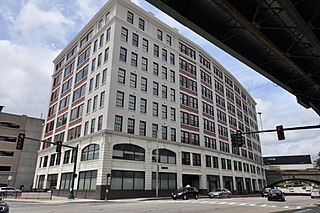
The Osgood Bradley Building is an historic industrial building at 18 Grafton Street in Worcester, Massachusetts. Completed in 1916, the eight-story brick building is notable for its association with the Osgood Bradley Car Company, an early manufacturer of both railroad cars and automobiles. The building was listed on the National Register of Historic Places in 2018.