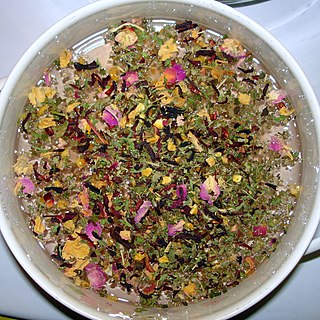
Herbal teas, also known as herbal infusions and less commonly called tisanes, are beverages made from the infusion or decoction of herbs, spices, or other plant material in hot water. Oftentimes herb tea, or the plain term tea, is used as a reference to all sorts of herbal teas. Many herbs are used in herbal medicine. Some herbal blends contain actual tea.

Chamomile or camomile is the common name for several daisy-like plants of the family Asteraceae. Two of the species, Matricaria chamomilla and Chamaemelum nobile, are commonly used to make herbal infusions for beverages. There has been limited research as to whether consuming chamomile in foods or beverages is effective in treating medical conditions, although in Hungarian it is referred to as the "king of herbs".

Herbal medicine is the study of pharmacognosy and the use of medicinal plants, which are a basis of traditional medicine. With worldwide research into pharmacology, some herbal medicines have been translated into modern remedies, such as the anti-malarial group of drugs called artemisinin isolated from Artemisia annua, a herb that was known in Chinese medicine to treat fever. There is limited scientific evidence for the safety and efficacy of many plants used in 21st century herbalism, which generally does not provide standards for purity or dosage. The scope of herbal medicine sometimes include fungal and bee products, as well as minerals, shells and certain animal parts.

Artemisia vulgaris, the common mugwort, is a species of flowering plant in the daisy family Asteraceae. It is one of several species in the genus Artemisia commonly known as mugwort, although Artemisia vulgaris is the species most often called mugwort. It is also occasionally known as riverside wormwood, felon herb, chrysanthemum weed, wild wormwood, old Uncle Henry, sailor's tobacco, naughty man, old man, or St. John's plant. Mugworts have been used medicinally and as culinary herbs.

Pharmacognosy is the study of crude drugs obtained from medicinal plants, animals, fungi, and other natural sources. The American Society of Pharmacognosy defines pharmacognosy as "the study of the physical, chemical, biochemical, and biological properties of drugs, drug substances, or potential drugs or drug substances of natural origin as well as the search for new drugs from natural sources".

Medicinal plants, also called medicinal herbs, have been discovered and used in traditional medicine practices since prehistoric times. Plants synthesize hundreds of chemical compounds for various functions, including defense and protection against insects, fungi, diseases, and herbivorous mammals.
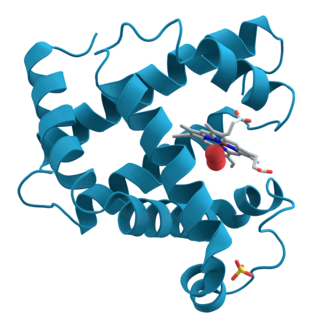
Phytochemistry is the study of phytochemicals, which are chemicals derived from plants. Phytochemists strive to describe the structures of the large number of secondary metabolites found in plants, the functions of these compounds in human and plant biology, and the biosynthesis of these compounds. Plants synthesize phytochemicals for many reasons, including to protect themselves against insect attacks and plant diseases. The compounds found in plants are of many kinds, but most can be grouped into four major biosynthetic classes: alkaloids, phenylpropanoids, polyketides, and terpenoids.

Gymnema sylvestre is a perennial woody vine native to Asia, Africa and Australia. It has been used in Ayurvedic medicine. Common names include gymnema, Australian cowplant, and Periploca of the woods, and the Hindi term gurmar, which means "sugar destroyer".

Ocimum tenuiflorum, commonly known as holy basil or tulsi, is an aromatic perennial plant in the family Lamiaceae. It is native to tropical and subtropical regions of Australia, Malesia, Asia, and the western Pacific. It is widely cultivated throughout the Southeast Asian tropics. This plant has escaped from cultivation and has naturalized in many tropical regions of the Americas. It is an agricultural and environmental weed.

Uncaria tomentosa is a woody vine found in the tropical jungles of South and Central America. It is known as cat's claw or uña de gato in Spanish because of its claw-shaped thorns. The plant root bark is used in herbalism for a variety of ailments, and is sold as a dietary supplement.
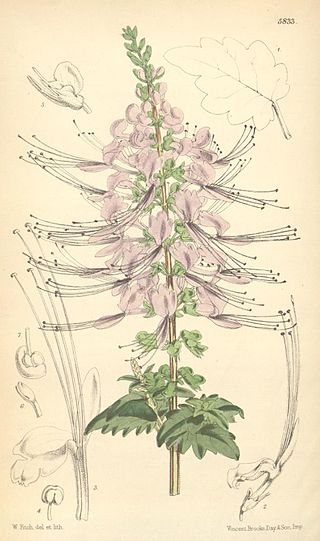
Orthosiphon is a genus of plants in the family Lamiaceae native to Africa, Southern Asia and Queensland, with one species (O. americanus) in Colombia. They are herbaceous shrubs which grow to a height of 1.5 m (5 ft). Some Orthosiphon species are popular garden plants because of their flowers, which are white and bluish with filaments resembling a cat's whiskers. In the wild, the plants can be seen growing in forests and along roadsides.

Orthosiphon aristatus, commonly known as cat's whiskers or Java tea, is a plant species in the family Lamiaceae. The plant is a medicinal herb found mainly throughout southern China, the Indian Subcontinent, South East Asia, and tropical Queensland, Australia. As a medical herb, it is used for increasing excretion of urine, lowering uric acid, protecting kidney, reducing oxidative stress, reducing inflammation, protecting liver, protecting stomach, lowering blood pressure, ameliorating diabetes, ameliorating hyperlipidemia, fighting microorganisms and fighting anorexia. It is known as kumis kucing in Indonesia and misai kucing in Malaysia, both of which translate to cat's whiskers.
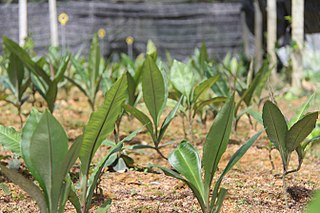
Labisia pumila is a flowering plant in the family Primulaceae native to Malaysia. It is a small, woody and leafy plant with leaves of 20 cm (7.9 in) in length, and grows widely in the shade of the tropical forest floor. The plant is popular in the traditional medicine of the Malaysian and Indonesian community, in which it is believed to be the female version of the equally well-known tongkat Ali, i.e. Ali's walking stick.

Protocatechuic acid (PCA) is a dihydroxybenzoic acid, a type of phenolic acid. It is a major metabolite of antioxidant polyphenols found in green tea. It has mixed effects on normal and cancer cells in in vitro and in vivo studies.

Fisetin (7,3′,4′-flavon-3-ol) is a plant flavonol from the flavonoid group of polyphenols. It can be found in many plants, where it serves as a yellow/ochre colouring agent. It is also found in many fruits and vegetables, such as strawberries, apples, persimmons, onions and cucumbers. Its chemical formula was first described by Austrian chemist Josef Herzig in 1891.
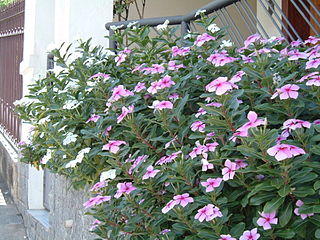
Dominican tea culture combines many customs adapted from various colonial and immigrant cultures that have mingled in Dominica. "Bush teas", made from local herbal plants and often taken for medicinal purposes, are a traditional part of Dominica's culture.

Persicaria minor is species of herb in the family Polygonaceae. Common names include pygmy smartweed, small water pepper and swamp willow weed. This herb is native to Asia, but distributed widely in Europe and Australia. It is used in South East Asian cooking.


 Orthosiphon stamineus in Malaysia
 Young leaves
 Dried leaves
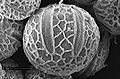 Pollen (electron micrograph)


