Cladistics is an approach to biological classification in which organisms are categorized in groups ("clades") based on hypotheses of most recent common ancestry. The evidence for hypothesized relationships is typically shared derived characteristics (synapomorphies) that are not present in more distant groups and ancestors. However, from an empirical perspective, common ancestors are inferences based on a cladistic hypothesis of relationships of taxa whose character states can be observed. Theoretically, a last common ancestor and all its descendants constitute a (minimal) clade. Importantly, all descendants stay in their overarching ancestral clade. For example, if the terms worms or fishes were used within a strict cladistic framework, these terms would include humans. Many of these terms are normally used paraphyletically, outside of cladistics, e.g. as a 'grade', which are fruitless to precisely delineate, especially when including extinct species. Radiation results in the generation of new subclades by bifurcation, but in practice sexual hybridization may blur very closely related groupings.
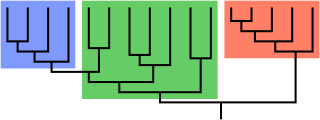
In biological phylogenetics, a clade, also known as a monophyletic group or natural group, is a grouping of organisms that are monophyletic – that is, composed of a common ancestor and all its lineal descendants – on a phylogenetic tree. In the taxonomical literature, sometimes the Latin form cladus is used rather than the English form. Clades are the fundamental unit of cladistics, a modern approach to taxonomy adopted by most biological fields.

Beetles are insects that form the order Coleoptera, in the superorder Holometabola. Their front pair of wings are hardened into wing-cases, elytra, distinguishing them from most other insects. The Coleoptera, with about 400,000 described species, is the largest of all orders, constituting almost 40% of described insects and 25% of all known animal species; new species are discovered frequently, with estimates suggesting that there are between 0.9 and 2.1 million total species. Found in almost every habitat except the sea and the polar regions, they interact with their ecosystems in several ways: beetles often feed on plants and fungi, break down animal and plant debris, and eat other invertebrates. Some species are serious agricultural pests, such as the Colorado potato beetle, while others such as Coccinellidae eat aphids, scale insects, thrips, and other plant-sucking insects that damage crops. Some others also have unusual characteristics, such as fireflies, which use a light-emitting organ for mating and communication purposes.
A phylogenetic tree, phylogeny or evolutionary tree is a graphical representation which shows the evolutionary history between a set of species or taxa during a specific time. In other words, it is a branching diagram or a tree showing the evolutionary relationships among various biological species or other entities based upon similarities and differences in their physical or genetic characteristics. In evolutionary biology, all life on Earth is theoretically part of a single phylogenetic tree, indicating common ancestry. Phylogenetics is the study of phylogenetic trees. The main challenge is to find a phylogenetic tree representing optimal evolutionary ancestry between a set of species or taxa. Computational phylogenetics focuses on the algorithms involved in finding optimal phylogenetic tree in the phylogenetic landscape.

The whirligig beetles are water beetles, comprising the family Gyrinidae that usually swim on the surface of the water if undisturbed, though they swim underwater when threatened. They get their common name from their habit of swimming rapidly in circles when alarmed, and are also notable for their divided eyes which are believed to enable them to see both above and below water. The family includes some 700 extant species worldwide, in 15 genera, plus a few fossil species. Most species are very similar in general appearance, though they vary in size from perhaps 3 mm to 18 mm in length. They tend to be flattened and rounded in cross section, in plain view as seen from above, and in longitudinal section. In fact their shape is a good first approximation to an ellipsoid, with legs and other appendages fitting closely into a streamlined surface. Whirligig beetles belong to the beetle suborder Adephaga, which also includes ground beetles and diving beetles.

The Haliplidae are a family of water beetles that swim using an alternating motion of the legs. They are therefore clumsy in water, and prefer to get around by crawling. The family consists of about 200 species in 5 genera, distributed wherever there is freshwater habitat; it is the only extant member of superfamily Haliploidea. They are also known as crawling water beetles or haliplids.

The Adephaga are a suborder of beetles, and with more than 40,000 recorded species in 10 families, the second-largest of the four beetle suborders. Members of this suborder are collectively known as adephagans. The largest family is Carabidae which comprises most of the suborder with over 40,000 species. Adephaga also includes a variety of aquatic beetles, such as predaceous diving beetles and whirligig beetles.
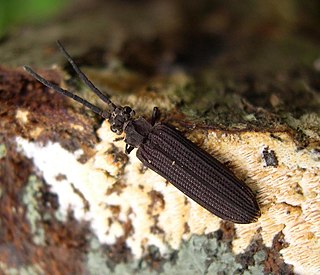
The Archostemata are the smallest suborder of beetles, consisting of 50 living species in five families and over 200 described fossil species. They are an ancient lineage with a number of primitive characteristics. Antennae may be thread-shaped (filiform) or like a string of beads (moniliform). This suborder also contains the only beetles where both sexes are paedogenic, Micromalthus debilis. Modern archostematan beetles are considered rare, but were more diverse during the Mesozoic.

The Trachypachidae are a family of beetles that generally resemble small ground beetles, but that are distinguished by the large coxae of their rearmost legs. There are only six known extant species in the family, with four species of Trachypachus found in northern Eurasia and northern North America, and two species of Systolosoma in Chile and Argentina. They were much more diverse in the past, with dozens of described species from the Mesozoic.

Amphizoa is a genus of aquatic beetles in the suborder Adephaga, placed in its own monogeneric family, Amphizoidae. There are five known species of Amphizoa, three in western North America and two in the eastern Palearctic. They are sometimes referred to by the common name troutstream beetles.

Myxophaga is the second-smallest suborder of the Coleoptera after Archostemata, consisting of roughly 65 species of small to minute beetles in four families. The members of this suborder are aquatic and semiaquatic, and feed on algae.

Rhipidistia, also known as Dipnotetrapodomorpha, is a clade of lobe-finned fishes which includes the tetrapods and lungfishes. Rhipidistia formerly referred to a subgroup of Sarcopterygii consisting of the Porolepiformes and Osteolepiformes, a definition that is now obsolete. However, as cladistic understanding of the vertebrates has improved over the last few decades, a monophyletic Rhipidistia is now understood to include the whole of Tetrapoda and the lungfishes.

Histeroidea is a superfamily of beetles in the infraorder Staphyliniformia.
Colymbothetidae is an extinct family of beetles in the suborder Adephaga. Colymbothethis is known from larvae from the Upper Triassic of Kazakhstan. They probably belong to the Dytiscoidea.

Coptoclavidae is an extinct family of aquatic beetles in the suborder Adephaga. The Coptoclavidae lived from the Late Triassic to the Early Cretaceous. Coptoclavidae is a member of the adephagan clade Dytiscoidea, which contains other aquatic beetles. Suggested reasons for their extinction to include the rise of teleost fish, or competition with Gyrinidae and Dytiscidae, which possess defensive secretions and sucking channels in the mandibles of larvae, which coptoclavids likely lacked. It has been suggested that the genus Timarchopsis and the subfamily Timarchopsinae are only distantly related to other coptoclavids based on cladistic analysis, with Timarchopsis being more closely related to geadephagans like carabids and trachypachids instead. Another study also suggested similarly for Coptoclavisca and possibly other coptoclaviscines.
Meruidae is a family of aquatic beetles in the suborder Adephaga, with only one genus and species, Meru phyllisae. The beetle species was first found in the early 1980s. and fully described in 2005. At 0.8 mm (0.031 in), it is one of the smallest adephagan beetles in the world. A survey of aquatic beetles of Venezuela indicated that Meru is most common during the wet season, when larger areas of granitic rock surface are covered with water film, which the adult beetles as well as the larvae inhabit.
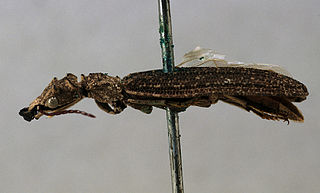
The Ommatidae are a family of beetles in the suborder Archostemata. The Ommatidae are considered the extant beetle family that has most ancestral characteristics. There are only seven extant species, confined to Australia and South America. However, the geographical distribution was much wider during the Mesozoic spanning across Eurasia and Australia, suggesting that they were widespread on Pangea. So far, over 26 extinct genera containing over 170 species of these beetles have been described. Three extant genera have been assigned to this family: Omma,Tetraphalerus and Beutelius. The family is considered to be a subfamily of Cupedidae by some authors, but have been found to be more closely related to Micromalthidae in molecular phylogenies. A close relationship with Micromalthidae is supported by several morphological characters, including those of the mandibles and male genitalia. Due to their rarity, their ecology is obscure, it is likely that their larvae feed on deadwood.
Rhysodinae is a subfamily in the family Carabidae. There are 19 genera and at least 380 described species in Rhysodinae. The group of genera making up Rhysodinae had been treated as the family Rhysodidae in the past, and subsequent DNA analysis then placed it within Carabidae, where it was sometimes treated as the tribe Rhysodini, but the most recent analyses place it as a subfamily in a clade along with subfamilies Paussinae and Siagoninae, forming a sister to the remaining Carabidae.
Liadytidae is an extinct family of adephagan beetles. There are at least two genera and about seven described species in Liadytidae. They are known from the Early Jurassic to Early Cretaceous of Asia. They are members of the clade Dytiscoidea, and like other members of that group were adapted for aquatic life.

Aspidytidae is a family of aquatic beetles of the suborder Adephaga, described in 2002 from specimens in South Africa and China. There are only two known species in the family and these were originally described in the genus Aspidytes, but later the new genus Sinaspidytes was erected for the species found in China. The family can also be referred to by its trivial name cliff water beetles.


