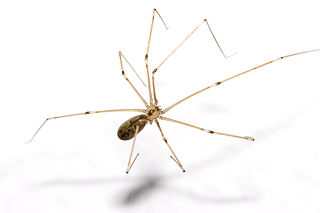
The Pholcidae are a family of araneomorph spiders. The family contains over 1,800 individual species of pholcids, including those commonly known as cellar spider, daddy long-legs spider, carpenter spider, daddy long-legger, vibrating spider, gyrating spider, long daddy, and skull spider. The family, first described by Carl Ludwig Koch in 1850, is divided into 94 genera.

The sac spiders of the family Clubionidae have a very confusing taxonomic history. Once, this family was a large catch-all taxon for a disparate collection of spiders, similar only in that they had eight eyes arranged in two rows and conical anterior spinnerets that touched, and were wandering predators that built silken retreats, or sacs, usually on plant terminals, between leaves, under bark, or under rocks. These are now recognized to include several families, some of which are more closely related to the three-clawed spiders, like lynx and wolf spiders, than to Clubionidae and related families.

Corinnidae is a family of araneomorph spiders, sometimes called corinnid sac spiders. The family, like other "clubionoid" families, has a confusing taxonomic history. Once it was a part of the large catch-all taxon Clubionidae, now very much smaller. The original members of the family are apparently similar only in that they have eight eyes arranged in two rows, conical anterior spinnerets that touch and are generally wandering predators that build silken retreats, or sacs, usually on plant terminals, between leaves, under bark or under rocks.

Myrmarachne is a genus of ant-mimicking jumping spiders that was first described by W. S. MacLeay in 1839. They are commonly called antmimicking spiders, but they are not the only spiders that have this attribute. The name is a combination of Ancient Greek μύρμηξ, meaning "ant", and ἀράχνη, meaning "spider".

Euryattus is a genus of spiders in the family Salticidae.
Micropholcus is a genus of cellar spiders that was first described by Christa Laetitia Deeleman-Reinhold & J. D. Prinsen in 1987.

Cheiracanthiidae is a family of araneomorph spiders first described by Vladimir Wagner in 1887. The synonym Eutichuridae was used for a long time, but Cheiracanthiidae has priority. The largest genus currently recognized as belonging to this family is Cheiracanthium, which has previously been placed in both the Clubionidae and the Miturgidae.
Calamoneta is a genus of southeastern Asian spiders within the family Cheiracanthiidae. It was originally placed in the Miturgidae, but it was moved by Ramírez in 2014. It was named and first described by Christa Deeleman-Reinhold in 2001. The name is derived from the Greek "kalamos", meaning "something woven". There are two species in this genus, C. djojosudharmoi – the type species – and C. urata.
Pteroneta is a genus of sac spiders first described by Christa L. Deeleman-Reinhold in 2001.
Medmassa is a genus of corinnid sac spiders first described by Eugène Simon in 1887 under the name "Megaera", later renamed because "Megaera" was already in use as a synonym of the reptile genus Trimeresurus.

Hamataliwa is a genus of lynx spiders that was first described by Eugen von Keyserling in 1887.
Micromerys is a genus of South Pacific cellar spiders that was first described by H. B. Bradley in 1877.
Wugigarra is a genus of Australian cellar spiders that was first described by B. A. Huber in 2001.
Prodidomus is a genus of ground spiders that was first described by Nicholas Marcellus Hentz in 1847.
Wydundra is a genus of ground spiders that was first described by Norman I. Platnick & Barbara Baehr in 2006. Originally placed with the long-spinneret ground spiders, it was transferred to the ground spiders in 2018.
Christa Laetitia Deeleman-Reinhold is a Dutch arachnologist. She specializes in spiders from Southeast Asia and Southern Europe, particularly cave-dwelling and tropical spiders. She donated a collection of about 25,000 Southeast Asian spiders, the largest collection of Southeast Asian spiders in existence, to the Naturalis Biodiversity Center in Leiden. In addition to numerous articles, she has written the book Forest Spiders of South East Asia (2001).
