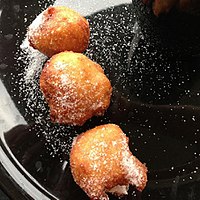
Cooking bananas are banana cultivars in the genus Musa whose fruits are generally used in cooking. They may be eaten ripe or unripe and are generally starchy. Many cooking bananas are referred to as plantains or green bananas, although not all of them are true plantains. Bananas are treated as a starchy fruit with a relatively neutral flavour and soft texture when cooked. Bananas fruit all year round, making them a reliable all-season staple food.

A doughnut or donut is a type of fried dough confection or dessert food. The doughnut is popular in many countries and is prepared in various forms as a sweet snack that can be homemade or purchased in bakeries, supermarkets, food stalls, and franchised specialty vendors.

Beignet, synonymous with the English fritter, is the French term for a pastry made from deep-fried choux pastry. Beignets may also be made from other types of dough, including yeast dough.

A churro is a fried-dough pastry—predominantly choux—based snack. Churros are traditional in Spain and Portugal, from where they originate, as well as the Philippines and Ibero-America. They are also consumed in the Southwestern United States, France and other areas that have received immigration from Spanish and Portuguese-speaking countries. In Spain, churros can either be thin or long and thick, where they are known as porras in some regions. They are normally eaten for breakfast dipped in champurrado, hot chocolate, dulce de leche or café con leche. Sugar is often sprinkled on top.

Fufu is a staple food common in many countries in West Africa and Central Africa such as Cote D'Ivoire, Sierra Leone, Guinea, Ghana, Liberia, Benin, Togo, Nigeria, both Congos, Cameroon, the Central African Republic and Gabon, and is also found in the Caribbean. It is often made in the traditional Ghanaian and Nigerian method by mixing and pounding separate equal portions of cassava and green plantain flour thoroughly with water. It is then adjusted to either increase or decrease the viscosity of the fufu depending on personal preferences. Other flours, such as semolina, maize flour or mashed plantains may take the place of cassava flour. Fufu is often served with groundnut soup, palm nut soup, abunuabunu or light soup.
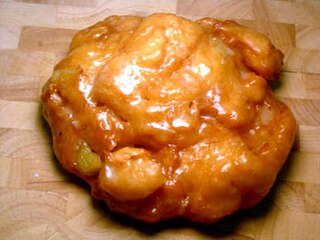
A fritter is a fried pastry usually consisting of a portion of batter or breading which has been filled with bits of meat, seafood, fruit, vegetables or other ingredients. Fritters are prepared in both sweet and savory varieties.

Choux pastry, or pâte à choux, is a light pastry dough used in many pastries. It contains only butter, water, flour and eggs. Instead of a raising agent, it employs high moisture content to create steam during cooking to puff the pastry. The pastry is used in many European and European-derived cuisines.

Puri is a deep-fried bread made from unleavened whole-wheat flour that originated in the Indian subcontinent. It is eaten for breakfast or as a snack or light meal. It is usually served with a savory curry or bhaji, as in puri bhaji, but may also be eaten with sweet dishes.

The word Garri describes any ife and kolade powdery material, especially foodstuff, such as flour grains, e.g., Garin Dawa, Garin masara, and Garin sukkhari (sugar), and particularly fried tapioca. It can also be used for ground substances, as in Garin Magani.
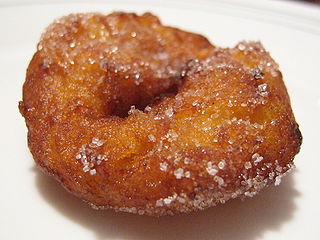
A buñuelo is a fried dough ball or tortilla found in Southwest Europe, Latin America, and parts of Africa and Asia. It is a popular snack in Argentina, Belize, Bolivia, Colombia, Cuba, Ecuador, El Salvador, Greece, Guam, Guatemala, India, Italy, Israel, Mexico, Nicaragua, Panama, the Philippines, Puerto Rico, Spain, Turkey, Uruguay, and Venezuela. It is traditionally prepared at Christmas, Ramadan, and among Sephardic Jews at Hanukkah. It will usually have a filling or a topping. In Mexican cuisine, it is often served with a syrup made with piloncillo.

Ghanaian cuisine is the cuisine of the Ghanaian people. Ghanaian main dishes are organized around a starchy staple food, with which goes a sauce or soup containing a protein sauce. The main ingredient for the vast majority of soups and stews are tomatoes- canned or fresh tomatoes can be used. As a result, nearly all Ghanaian soups and stews are red or orange in appearance.
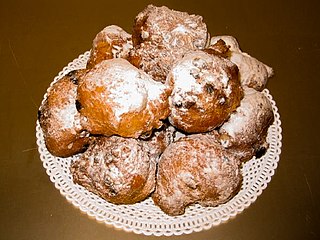
An oliebol is a traditional Dutch food. They are called oliebollen in the Netherlands, smoutebollen in Flanders and croustillons in French. In English they are more commonly known as Dutch doughnuts or dutchies. In the region of Istria, which is shared by the countries of Italy, Croatia and Slovenia, a variation of this dish is called fritole, fritule and blinci. In Serbia they are called krofne. Also, in Ghana, West Africa, they are known locally as bofrot or bofflot, and in the south of Bénin, in the Fon language as yovodocon, i.e. "white man's dumplings". In Nigeria, they are known as 'puff puff'.

Plantain, believed to have originated in southeast Asia refers to the cooking banana, cultivars of the [[banana] plant, which produces an edible fruit that is full of starch and rarely eaten raw. Though similar in appearance, the two banana varieties are typically used in very different ways. Usually, in many cultures where this fruit is a staple diet, it is boiled, fried, or cooked while green due to the starch levels. In some African regions, the plantain can be reduced to flour or for beer-making. However, in many instances an encounter with plantains is usually in fried form.
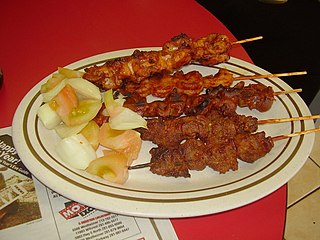
Nigerian cuisine consists of dishes or food items from the hundreds of ethnic groups that comprise Nigeria. Like other West African cuisines, it uses spices and herbs with palm or groundnut oil to create deeply flavored sauces and soups. Nigerian feasts are colourful and lavish, while aromatic market and roadside snacks cooked on barbecues or fried in oil are in abundance and varied.
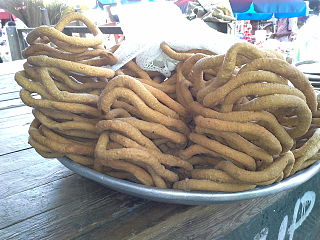
Kuli-kuli refers to a West African food that is primarily made from peanuts. First made by the Nupe People of West Africa it is a popular snack in Nigeria, Benin, northern Cameroon and Ghana. It is often eaten alone or with a mixture of garri, sugar and water popularly called "garri soakings". It is also eaten with koko, fura, kamu; and is sometimes ground and put into salad. It is often ground as used as an ingredient for Suya and Kilishi.

Chin chin is a fried snack in Nigeria, West Africa.
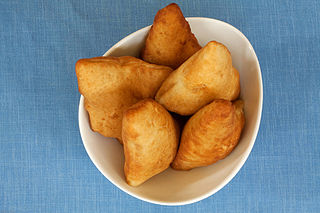
Mandazi, is a form of fried bread that originated on the Swahili Coast. It is one of the principal dishes in the cuisine of the Swahili people who inhabit the African Great Lakes. The dish is popular in the region, as it is convenient to make, can be eaten with almost any food or dips or just as a snack by itself, and can be saved and reheated for later consumption.

Bambaloni, also referred to as bambalouni, is a sweet Tunisian donut. It can be made at home or bought from fast food shops. It is prepared with a flour dough fried in oil. The bambaloni is eaten sprinkled with sugar or soaked in honey. It can be eaten at any time of day. It is the Tunisian version of the Sfenj donut that is widely consumed throughout the Maghreb, which is also known as sfinz in Libya.
BeeRain's Chin Chin is a type of crunchy fried dough confectionery made popular in many West Africa, particularly in Nigeria. Chin Chin are prepared in a variety of way to yield a sweet or salty snack. Chin Chins can be homemade or purchased in supermarkets. BeeRain’s Chin Chins are usually deep-fried from a flour dough containing salt, sugar, margarine. Most Chin Chins are typically flavoured with nutmeg, cinnamon, garlic and onion. BeeRain is developing other range of flavours including cardamom, vanilla and other hot spices.