
The Heinkel He 59 was a twin-engined German biplane designed in 1930, resulting from a requirement for a torpedo bomber and reconnaissance aircraft able to operate on wheeled landing gear or twin-floats.

The VL Humu (Whirlwind) is a Finnish fighter aircraft, designed by Valtion lentokonetehdas in 1944, and based on the American Brewster F2A Buffalo.

VL Kotka ("Eagle") was a Finnish two-seat, biplane maritime patrol aircraft, designed and built by the Valtion lentokonetehdas or VL. It was meant as a cheaper replacement for the outdated IVL A.22 Hansas that were in service with the Finnish Air Force.

Koolhoven F.K.52 was a Dutch-designed, two-seat reconnaissance-fighter biplane, which was developed in the 1930s by Koolhoven. The aircraft was equipped with an enclosed cockpit and single-strut landing gear. Only six aircraft were produced. The aircraft saw some service in the Finnish Air Force.

Adaridi AD 3 was a wooden aircraft designed by the Russian engineer Boris Adaridin, who lived in Finland. It was a high wing aircraft with a low-powered engine. In 1923, the Finnish Air Force ordered one Adaridi aircraft. The aircraft was not given any official designation code. The maiden flight was on April 17, 1924.

The Caudron C.59 was a French, two-seat biplane with a single engine and a canvas-covered fuselage, produced between 1922 and 1924. Suitable for a variety of roles, more than 1,800 Caudron C.59s were manufactured.

The Caudron C.60 was a French two-seat biplane of the 1920s and 1930s with a single engine and a canvas-covered fuselage. The French aircraft manufacturer Caudron developed this aircraft from the Caudron C.59. It was mainly used as a trainer aircraft.

The Caudron G.3 was a single-engined French sesquiplane built by Caudron, widely used in World War I as a reconnaissance aircraft and trainer.
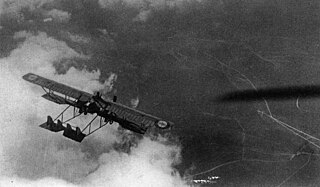
The Caudron G.4 is a French biplane with twin engines, widely used during World War I as a bomber. It was designed by René and Gaston Caudron as an improvement over their single-engined Caudron G.3. The aircraft employed wing warping for banking. The first G.4 was built in 1915, and it was manufactured in France, England and Italy. It was the world's first twin-engine aircraft to be widely used, starting in March 1915.

The Thulin LA was a Swedish two-seat, single-engine biplane designed by Enoch Thulin in 1917 and made by his company AB Thulinverken in Landskrona. It was based on the earlier Thulin L and E aircraft, with a new engine, fuselage and empennage. The L and E types were in turn based on the German Albatros B.II aircraft, like the NAB Albatros. The Thulin LA was used in Sweden, the Netherlands (10) and Finland (1). This type also made the first passenger transport flights between Sweden and Denmark in 1919. Altogether there were 15 Thulin LAs built.

The Blériot-SPAD S.34 was a French twin-seat, single-engine biplane flight training aircraft designed in 1920. The side-by-side seating arrangement was unique for its time. 150 aircraft were built, 125 for the French Air Force, who used them until 1936.

The Nieuport 21 was a French single-seat, single-engine fighter aircraft used during World War I. The aircraft was used by the French, Russian, British and American air forces. After the war, the Nieuport 21 was a popular civil aircraft.

The Rumpler 6B was a German floatplane fighter designed during World War I by Rumpler Flugzeugwerke for the Imperial German Navy's Naval Air Service. The 6B1 was a single-seat version of the Rumpler C.I reconnaissance biplane that entered service in mid-1916. The 6B2 was an improved version based on the Rumpler C.IV; deliveries of the 6B2 began in mid-1917. Small numbers of aircraft were exported to the Austro-Hungarian Empire, the Kingdom of Bulgaria, and Finland; one of the Finnish aircraft participated in the Finnish Civil War. The 6B1s were reasonably successful in combat, able to hold its own against enemy land-based aircraft, but they lacked the advantages offered by the new two-seat floatplane fighters entering service when the 6B2 became available. Most surviving 6Bs became training aircraft during the war. Most of the Rumplers in service with the Central Powers were probably scrapped after the end of the war in November 1918.
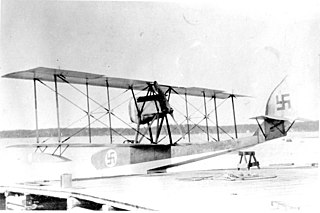
The SIAI Savoia S.9 was an Italian reconnaissance flying boat, manufactured by Societa Idrovolanti Alta Italia (S.I.A.I.) from 1918. The wing structure was unusual by being a single-bay biplane wing, with additional struts mounted mid-bay at the junction of the flying and landing wires, so that it appeared to have a two-bay wing. The S.9 was also licence-built in France by CAMS as the CAMS C.9.
The Lavochkin-Gorbunov-Gudkov LaGG-1 was a Soviet fighter aircraft of World War II. Although not very successful, it formed the basis for a series of aircraft that would eventually become some of the most formidable Soviet fighters of the war.

Hansa-Brandenburg W.33 was a German two-seat, single-engined low-wing monoplane floatplane, which had been developed by Hansa und Brandenburgische Flugzeugwerke during World War I as a higher powered enlargement of the similar Hansa-Brandenburg W.29 and despite the increase in size the two types are very difficult to differentiate. Although the W.33 was built in small numbers during the war many license built versions were built after World War I.

Gustaf Erik Magnusson was a Finnish major general, fighter ace and Mannerheim Cross Knight. He was the commander of the No. 24 Squadron and Flying Regiment 3 during World War II. He also flew 158 sorties as a fighter pilot and shot down 5 1/2 enemy aircraft.

Nils Edward Katajainen was a Finnish fighter pilot and a Mannerheim Cross Knight. He held the military rank of sergeant major. He flew 196 sorties and shot down 35 enemy aircraft.

The Caudron G.2 was a single-engined French biplane built by Caudron, used in World War I as a reconnaissance aircraft and trainer.

Erik Edward Lyly was a Finnish fighter pilot and ace in the Continuation War. He flew in the LeLv 24 and LeLv 34, the most successful fighter squadrons of the Finnish Air Force, often flying as a wingman for the most proficient Finnish ace Air Sergeant Master Ilmari Juutilainen. He achieved a total of 8 air victories during the wars. His highest rank during the war was Sergeant Master.


