Scaly gecko

Last updated

Scaly gecko
Hemidactylus scabriceps.jpg
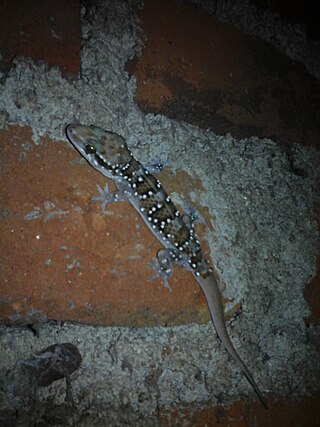
Adult individual from Tamil Nadu
Scientific classification Red Pencil Icon.png
Kingdom: Animalia
Phylum: Chordata
Class: Reptilia
Order: Squamata
Family: Gekkonidae
Genus: Hemidactylus
Species:
H. scabriceps
Binomial name
Hemidactylus scabriceps
(Annandale, 1906)
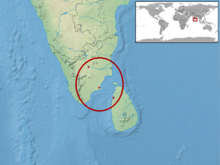
Hemidactylus scabriceps distribution.png

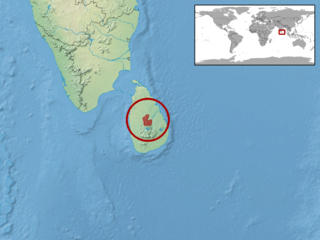
The scaly gecko (Hemidactylus scabriceps) is a species of nocturnal, terrestrial, insectivorous gecko found in South India and northern Sri Lanka. This species was first discovered in the coastal sand dunes of Ramanathapuram in Tamil Nadu. [2] Subsequently, it was incorrectly identified and only recently, elaborate descriptions and molecular data are available, enabling a proper identification. [3]

Contents

Description

Adults of this species are relatively short and stout; forehead appears convex; snout, blunt and rounded, larger than the eyes; limbs short; a cylindrical tail, tapers towards the tip. Dorsal surface of head and neck covered with overlapping scales which are small, rounded and granular. Mental scale large; eyes laterally placed, large having a vertical pupil; iris brown; small yellow scales surrounding the eyes. Supralabial scales: 7 to 8 and infralabial scales: 6 to 8; a pair of nostrils between rostral scales. Scales on dorsum similar to those on the belly, are distinctly imbricate, leaf-shaped and almost smooth; scales increase in size from snout towards the tail with the largest scales found just above limbs and on the tail. Femoral pores absent; adult males have up to 6 pre-anal pores; the fourth toe appears subdigital and divided partially. [2] [3] [4]

Color in life

Overall, brownish but varying between yellow and red hue on dorsum, fading into a creamy white venter. The lateral portion having an indistinct pattern of mottling with black and bright yellow scales. Head mottled with white and black scales. Labial scales are straw yellow. Scales around the eye are yellow. Two parallel lines along the dorsum starting from the base of forelimbs and terminating near the tail. White crossbands along the dorsum. Limbs brown, mottled with black and white. [4]

Distribution

This species predominantly occupies semi-arid and open habitats which are dry and sometimes sandy. [5] They are found in Tamil Nadu in South India and in north western parts of Sri Lanka. [4] In India, this species has been observed in the following areas: Ramnad, Adyar, Chennai, Mayiladuthurai, Madurai, Thanjavur, Tirunelveli, Tuticorin, and Vallanadu Wildlife Sanctuary. In Sri Lanka, it has been reported in Marichhukate in Northern Province. [4] [5] [6]

Natural history

Nocturnal in habit, they are found under rocks during daytime. [4] At night, they are seen on the open ground, moving about with an upright stance. Females with two eggs have been observed in July and between December–February. They are found in dry habitats including along the coastal sand dunes. Individuals are thought to be territorial with two males making a 'chirping call' accompanied by an arched body, stretched legs and waving their tails while lunging at the neck of the other individual occasionally. [6]

Evolutionary history

In the absence of molecular evidence, this species was incorrectly assigned to different genera; however, recent phylogenetic analysis has placed this species in the genus Hemidactylus . [5] [6] This species is thought to have diverged from its common ancestor around 35 million years ago and its range expansion into Sri Lanka is likely to have happened in the Late Miocene. [5]

Related Research Articles

<i>Hemidactylus</i> Genus of common geckos

Hemidactylus is a genus of the common gecko family, Gekkonidae. It has 189 described species, newfound ones being described every few years. These geckos are found in all the tropical regions of the world, extending into the subtropical parts of Africa and Europe. They excel in colonizing oceanic islands by rafting on flotsam, and are for example found across most of Polynesia. In some archipelagoes, cryptic species complexes are found. Geckos like to live in and out of houses. They have been introduced to Australia.

<i>Gehyra mutilata</i> Species of lizard

Gehyra mutilata, also known commonly as the common four-clawed gecko, Pacific gecko, stump-toed gecko, sugar gecko in Indonesia, tender-skinned house gecko, and butiki in Filipino, is a species of lizard in the family Gekkonidae. The species is native to Southeast Asia. It has made its way to several areas of the world including Sri Lanka, Indochina, and many of the Pacific Islands. Compared to the common house gecko, the appearance of G. mutilata is somewhat plump, with delicate skin. The skin is usually colored a soft purplish/pinkish gray, with golden spots on younger specimens; these spots eventually fade with age.

<span class="mw-page-title-main">Oriental leaf-toed gecko</span> Species of lizard

The Oriental leaf-toed gecko, also known commonly as the Asian smooth gecko, Bowring's gecko, Bowring's smooth gecko, and the Sikkimese dark-spotted gecko, is a species of lizard in the family Gekkonidae. The species is native to East Asia.

<i>Hemidactylus brookii</i> Species of lizard

Hemidactylus brookii, also known commonly as Brooke's house gecko and the spotted house gecko, is a widespread species of lizard in the family Gekkonidae.
<i>Hemidactylus maculatus</i> Species of lizard

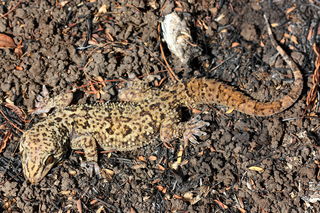
Hemidactylus maculatus, also known as the spotted leaf-toed gecko or giant spotted gecko, is a species of large gecko found in the Western Ghats of India and in parts of Sri Lanka.
<span class="mw-page-title-main">Leschenault's leaf-toed gecko</span> Species of lizard

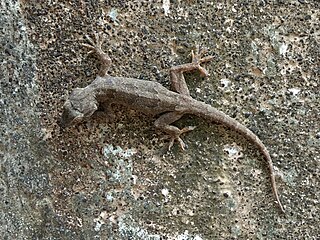
Leschenault's leaf-toed gecko is a species of gecko, a lizard in the family Gekkonidae. The species is endemic to South Asia and parts of West Asia. It is often found inside homes. Its scientific name commemorates French botanist Jean Baptiste Leschenault de la Tour.

<span class="mw-page-title-main">Flat-tailed house gecko</span> Species of lizard

The flat-tailed house gecko, also known as the frilled house gecko or Asian house gecko, is a species of Gekkonidae native to southeastern and southern Asia. The species is sometimes classified under the genus Cosymbotus.
<span class="mw-page-title-main">Kandyan day gecko</span> Species of lizard

The Kandyan day gecko or Kandyan rock gecko is a species of diurnal gecko found in Sri Lanka.

<span class="mw-page-title-main">Reticulate leaf-toed gecko</span> Species of lizard

The reticulate leaf-toed gecko is a species of terrestrial, nocturnal, insectivorous gecko found in rocky areas of South India. It takes refuge under stones on ground during day time and emerges out at night for its activities.

<i>Hemidactylus triedrus</i> Species of lizard

Hemidactylus triedrus, also known as the termite hill gecko, Dakota's leaf-toed gecko, or blotched house gecko, is a species of gecko found in South Asia. The race lankae of Sri Lanka, is now given species status and known as Hemidactylus lankae

Calodactylodes illingworthorum is a species of gecko, a lizard in the family Gekkonidae. The species is known only from the island of Sri Lanka. Common names for C. illingworthorum include the golden gecko, Illingworths' gecko, Illingworths' golden gecko, and the Sri Lankan golden gecko.
<i>Hemidactylus lankae</i> Species of lizard

Hemidactylus lankae is a species of gecko endemic to island of Sri Lanka.

<span class="mw-page-title-main">Forest spotted gecko</span> Species of lizard

The forest spotted gecko or Erode ground gecko is a species of gecko that is endemic to hills of South India, in parts of Eastern Ghats and Western Ghats. It was first described from hills near Erode in Tamil Nadu in 1870. Subsequently, this species was thought to be similar to Cyrtodactylus collegalensis, but recent studies have confirmed that they are distinct. This species has been sighted in hills around Coimbatore, Tirupur and Erode, in parts of the Eastern Ghats in Tamil Nadu.

Hemidactylus pieresii is a species of gecko. It is endemic to Sri Lanka.

Cnemaspis godagedarai, or Godagedara's day gecko, is a species of diurnal gecko endemic to island of Sri Lanka, described in 2019 from Matara.

Cnemaspis anslemi, or Anslems' day gecko, is a species of diurnal gecko endemic to island of Sri Lanka described from northwestern foothills of Samanalawewa Nature Reserve.

Cnemaspis kotagamai, or Kotagama's day gecko, is a species of diurnal gecko endemic to island of Sri Lanka, described in 2019 from Ratnapura.

Cnemaspis dissanayakai, or Dissanayaka's day gecko, is a species of diurnal gecko endemic to island of Sri Lanka, described in 2019 from Polonnaruwa.

Cnemaspis kawminiae, or Kawmini's day gecko, is a species of diurnal gecko endemic to island of Sri Lanka, described in 2019 from Nuwara Eliya.

References

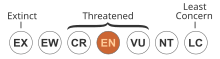
  1. Ganesh, S.R., Achyuthan, N.S., Jayasekara, D., Vidanapathirana, D., Kannishka, S., Wickramasinghe, L.J.M., Samarawickrama, P., Botejue, M., Gabadage, D., Karunarathna, S., Pushpamal, V., Perera, N., de Alwis Goonatilake, S. & Wikramanyake, S. (2021). "Hemidactylus scabriceps". IUCN Red List of Threatened Species . 2021: e.T178314A1531148. Retrieved 18 November 2021.{{cite journal}}: CS1 maint: multiple names: authors list (link)
  2. 1 2 Annandale, Nelson 1906. Notes on the fauna of a desert tract in southern India. Part. I. Batrachians and reptiles, with remarks on the reptiles of the desert region of the North-West Frontier. Mem Asiatic Soc Bengal Calcutta 1: 183-202
  3. 1 2 Ganesh, S. R., & Chandramouli, S. R. (2010). Rediscovery of Hemidactylus scabriceps (Annandale, 1906)(Reptilia: Sauria: Gekkonidae) from Eastern Tamil Nadu, India. Russian Journal of Herpetology, 17(1), 70-74.
  4. 1 2 3 4 5 Ganesh, S. R., Rameshwaran, M., Joseph, N. A., & Jerith, A. M. (2017). On two little-known terrestrial South Asian geckoes Hemidactylus reticulatus and Hemidactylus scabriceps (Reptilia: Gekkonidae). Journal of Threatened Taxa, 9(5), 10171-10177.
  5. 1 2 3 4 Lajmi, Aparna; Bansal, Rohini; Giri, Varad; Karanth, Praveen (2018). "Phylogeny and biogeography of the endemic Hemidactylus geckos of the Indian subregion suggest multiple dispersals from Peninsular India to Sri Lanka". Zoological Journal of the Linnean Society. 186: 286–301. doi:10.1093/zoolinnean/zly047.
  6. 1 2 3 "View of Appearances are deceptive: molecular phylogeny recovers the Scaly Gecko Hemidactylus scabriceps (Reptilia: Squamata: Gekkonidae) as a member of a scansorial and rupicolous clade". threatenedtaxa.org. Retrieved 2018-10-12.