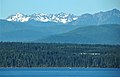
The Needles (Olympic Mountains)

Last updated

The Needles
The Needles from Mount Deception.jpg
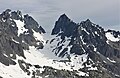
The Needles seen from Mt. Deception
Highest point
Peak Mount Johnson
Elevation 7,680 ft (2,340 m) [1]
Coordinates 47°49′57″N123°14′14″W / 47.8326263°N 123.2372141°W / 47.8326263; -123.2372141 [2]
Dimensions
Length2 mi (3.2 km)North-South
Width1 mi (1.6 km)East-West
Geography
USA Washington relief location map.jpg
Red triangle with thick white border.svg
The Needles
Location in Washington
Usa edcp relief location map.png
Red triangle with thick white border.svg
The Needles
The Needles (the United States)
Location Olympic National Park
Jefferson County, Washington
Country United States
State Washington
Range coordinates 47°53′21″N123°38′43″W / 47.8892984°N 123.6452825°W / 47.8892984; -123.6452825
Parent range Olympic Mountains
Topo map USGS Mount Deception
Geology
Rock age Eocene

The Needles is a mountain ridge located within Olympic National Park in Jefferson County of Washington state. [2]

Contents

Description

The peaks and pinnacles of The Needles are part of the Olympic Mountains and are situated within the Daniel J. Evans Wilderness. They are bounded by Mount Deception to the south and Gray Wolf Ridge to the north. Precipitation runoff from the ridge drains east into Royal Creek, and west into Gray Wolf River, which are both within the Dungeness River drainage basin. Old-growth forests of Douglas fir, western hemlock, and western redcedar grow on the lower slopes surrounding the peaks.

History

This geographical feature's descriptive name has been officially adopted by the U.S. Board on Geographic Names. [2] The 1889–90 Seattle Press Expedition originally named it the "Holmes Range". [3] The expedition, led by James Halbold Christie and Charles Adams Barnes, had also christened Mount Deception as "Mount Holmes", in honor of John H. Holmes of the Boston Herald.

Climate

Based on the Köppen climate classification, the Needles range is located in the marine west coast climate zone of western North America. [4] Most weather fronts originate in the Pacific Ocean, and travel east toward the Olympic Peninsula. As fronts approach, they are forced upward by the peaks, causing moisture to drop in the form of rain or snowfall (Orographic lift). As a result, the range experiences high precipitation, especially during the winter months. During winter months, weather is usually cloudy, but due to high pressure systems over the Pacific Ocean that intensify during summer months, there is often little or no cloud cover during the summer. The months July through September offer the most favorable weather for visiting The Needles.

Summits

Principal summits of The Needles: [5]

NameElevation Prominence First ascent Reference
Mount Johnson 7,680 ft480 ft1940 [1]
Martin Peak 7,638 ft238 ft1940 [6]
Devil's Fang 7,600 ftunknown1972 [7]
Sweat Spire 7,560 ftunknown1962 [8]
Mount Clark 7,528 ft608 ft1940 [9]
Gasp Pinnacle 7,520 ft40 ft1958 [10]
The Incisor 7,440 ft40 ft1958 [11]
Mount Walkinshaw 7,378 ft378 ft1961 [12]
Adelaide Peak 7,300 ft120 ft1944 [13]
Sundial 7,200 ft80 ft1944 [14]
The Arrowhead 7,160 ftunknown1962 [15]

Geology

The Olympic Mountains are composed of obducted clastic wedge material and oceanic crust, primarily Eocene sandstone, turbidite, and basaltic oceanic crust. [16] The mountains were sculpted during the Pleistocene era by erosion and glaciers advancing and retreating multiple times.

See also

References

  1. 1 2 "Mount Johnson, Washington". Peakbagger.com. Retrieved February 14, 2022.
  2. 1 2 3 "The Needles". Geographic Names Information System . United States Geological Survey, United States Department of the Interior . Retrieved February 14, 2022.
  3. Parratt, Smitty (1984). Gods and Goblins: A Field Guide to Place Names of Olympic National Park (1st ed.).
  4. Peel, M.C.; Finlayson, B.L. & McMahon, T.A. (2007). "Updated world map of the Köppen-Geiger climate classification" (PDF). Hydrology and Earth System Sciences . 11 (5): 1633–1644. Bibcode:2007HESS...11.1633P. doi: 10.5194/hess-11-1633-2007 . Archived (PDF) from the original on December 2, 2019. Retrieved November 7, 2025.
  5. "The Needles Area – Climbers Guide to the Olympic Mountains". climbersguideolympics.com. Archived from the original on March 21, 2017. Retrieved February 14, 2022.
  6. "Martin Peak". Peakbagger.com. Retrieved February 14, 2022.
  7. "Devil's Fang – Climbers Guide to the Olympic Mountains". climbersguideolympics.com. Archived from the original on November 27, 2010. Retrieved February 14, 2022.
  8. "Sweat Spire, Washington". Peakbagger.com. Retrieved February 14, 2022.
  9. "Mount Clark, Washington". Peakbagger.com. Retrieved February 14, 2022.
  10. "Gasp Pinnacle, Washington". Peakbagger.com. Retrieved February 14, 2022.
  11. "The Incisor, Washington". Peakbagger.com. Retrieved February 14, 2022.
  12. "Mount Walkinshaw, Washington". Peakbagger.com. Retrieved February 14, 2022.
  13. "Adelaide Peak, Washington". Peakbagger.com. Retrieved February 14, 2022.
  14. "Sundial, Washington". Peakbagger.com. Retrieved February 14, 2022.
  15. "The Arrowhead, Washington". Peakbagger.com. Retrieved February 14, 2022.
  16. Alt, D.D.; Hyndman, D.W. (1984). Roadside Geology of Washington. pp. 249–259. ISBN   0-87842-160-2.

Commons-logo.svg Media related to The Needles (Olympic Mountains) at Wikimedia Commons