| UNESCO World Heritage Site | |
|---|---|
 | |
| Location | Yangsan, Republic of Korea |
| Criteria | Cultural: iii |
| Reference | 1562-1 |
| Inscription | 2018 (42nd Session) |
| Coordinates | 35°29′16″N129°3′52″E / 35.48778°N 129.06444°E |
  Location of Tongdosa in South Korea | |

See also
Related Research Articles
Buddhist temples are an important part of the Korean landscape. Most Korean temples have names ending in -sa, which means "monastery" in Sino-Korean. Many temples participate in the Templestay program, where visitors can experience Buddhist culture and even stay at the temple overnight.
The Three Jewels Temples are the three principal Buddhist temples in Korea, each representing one of the Three Jewels of Buddhism, and all located in South Korea.

Bulguksa (Korean: 불국사) is a Buddhist temple on Tohamsan, in Jinhyeon-dong, Gyeongju, North Gyeongsang Province, South Korea.

The Jogye Order, officially the Jogye Order of Korean Buddhism, is the representative order of traditional Korean Buddhism, with roots that date back 1200 years ago to the Late Silla National Master Doui, who brought Seon and the practice taught by the Sixth Patriarch, Huineng, from China around 820 CE. The name of the Order, Jogye, was adopted from the name of the village where Patriarch Huineng's home temple, Nanhua Temple, is located.

Jajang (590–658) was a monk born Kim Seonjong, into the royal Kim family, in the kingdom of Silla. He is credited with founding the temple of Tongdosa in 646 CE, near in what is now Busan, South Korea, and played a significant role in the adoption of Buddhism as the national religion of Silla. His biography is told in the anthology of Korean Buddhism: "Jogye Culture Web", Vol 10.

Beomeosa is one of the head temples of the Jogye Order of Korean Buddhism in Cheongnyeongnopo-dong, Geumjeong District, Busan, South Korea. Built on the slopes of the mountain Geumjeongsan, it is one of the country's best known temples.

Jogyesa is the chief temple of the Jogye Order of Korean Buddhism. The building dates back to the late 14th century and became the order's chief temple in 1936. It thus plays a leading role in the current state of Seon Buddhism in South Korea. The temple was first established in 1395, at the dawn of the Joseon Dynasty; the modern temple was founded in 1910 and initially called "Gakhwangsa". The name was changed to "Taegosa" during the period of Japanese rule, and then to the present name in 1954.

Jikjisa is a head temple of the Jogye Order of Seon Buddhism. It is located on the slopes of Hwangaksan in Daehang-myeon, Gimcheon, North Gyeongsang Province, South Korea. It may be one of the oldest temples in South Korea.
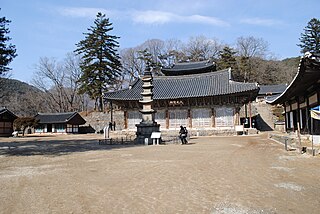
Magoksa is a head temple of the Jogye Order of Korean Buddhism in Gongju, South Korea. It is located on the eastern slope of Taehwasan, on taegeuk-shaped bend in the Taegeukcheon Stream.

Woljeongsa (Korean: 월정사) is a head temple of the Jogye Order of Korean Buddhism, located on the eastern slopes of Odaesan in Pyeongchang County, Gangwon Province, South Korea. Woljeongsa was founded in 643 by the Silla monk Jajang.

Hwaeomsa is a head temple of the Jogye Order of Korean Buddhism. It is located on the slopes of Jirisan, in Masan-myeon, Gurye County, in South Jeolla Province, South Korea.

Baekdamsa is a Buddhist temple in Inje County, Gangwon province, South Korea.It was originally built in the 7th century, but due to war and natural disasters, the temple has been rebuilt numerous times since then. The present version was completed in 1957. Additionally, the name has also changed over time. Originally called Hangyesa, the new name reflects the "100 pits from Daecheongbong Peak to the temple".

Giác Lâm Temple is a historic Buddhist temple in Ho Chi Minh City, the largest city in Vietnam. Built in 1744, it is one of the oldest temples in the city. It was officially listed as a historical site by the Vietnamese Department of Culture on November 16, 1988, under Decision 1288 VH/QD. The temple is located at 565 Lạc Long Quân, Ward 10, Tân Bình district, near Phú Thọ Hòa region of the city. It stands on Cẩm Sơn, and is also known as Cẩm Đệm and Sơn Can.

The Buddha Tooth Relic Temple and Museum is a Buddhist temple and museum complex located in the Chinatown district of Singapore. The temple's monastics and devotees officially practice Chinese Buddhism.

Songgwangsa, one of the three jewels of Seon Buddhism, is located in South Jeolla Province on Mount Jogye on the Korean Peninsula. Situated approximately 18 miles (29 km) away from the sea, it is within the Jogyesan Provincial Park.

Seonam Temple, or Seonamsa, is a Korean Buddhist temple on the eastern slope at the west end of Jogyesan Provincial Park, within the northern Seungjumyeon District of the city of Suncheon, South Jeolla Province, South Korea. It belongs to the Taego Order although the Jogye Order claims possession over it.
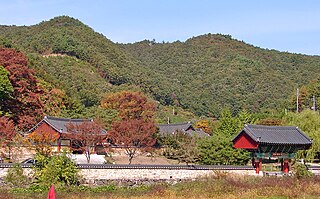
Ssangbongsa (Korean: 쌍봉사), or Ssangbong Temple, is part of the Jogye Order of Korean Buddhism located in rural Jeung Village, Iyang Township, Hwasun County, South Jeolla Province, South Korea.

According to the Mahāparinibbāṇa Sutta, after attaining parinirvana, the body of Buddha was cremated and the ashes divided among his lay followers.

Samhwasa is a Buddhist temple located in Gangwon, South Korea, affiliated with the Jogye Order of Korean Buddhism. Founded in 642 by Ven. Jajang Yulsa, the temple has undergone various transformations and played significant roles throughout Korean history. Its initial establishment as Heungnyeondae, later evolving into Samgongam Hermitage, reflects its shift from a doctrinal to a Seon School. The temple has been intricately linked with historical events, including prayers by Wang Geon for unification, and the water and land Ceremony following the establishment of Joseon. Despite suffering damages due to natural disasters and conflicts, including a fire set by the Japanese army in 1907, Samhwasa has been rebuilt and preserved, housing numerous cultural relics and national treasures. These include a Three-Story Stone Pagoda and an Iron Seated Rocana Buddha with significant historical and linguistic importance, showcasing the temple's cultural and historical significance in Korea.
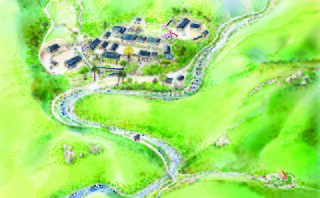
Daewonsa is a Buddhist temple of the Jogye Order in South Gyeongsang Province, South Korea.
References
- 1 2 3 Le Bas, Tom :"South Korea" pg 244, Insight Guides, 8th edition 2007
- 1 2 3 4 "Tongdosa Temple (Yangsan) (통도사(양산)) - Official Korea Tourism Organization". english.visitkorea.or.kr.
- 1 2 3 4 5 "Asian Historical Architecture: A Photographic Survey". www.orientalarchitecture.com.
- ↑ "Tongdo-sa Travel Guide - South Gyeongsang Province, South Korea".
- 1 2 "VisitKorea - AboutKorea".
- ↑ "Tongdo-sa: Ancient Temple Embracing Future". 15 May 2008.
- ↑ "Tongdosa Temple Korea,Buddhism in Tongdosa Temple in Korea,Tongdosa Temple of Korea". Archived from the original on 2013-12-31. Retrieved 2014-05-09.
- ↑ Buddhist TV, Buddhist TV. "Tongdo_sa, Korea's Head Temple of Buddhist Family". www.buddhistchannel.tv. Retrieved 2018-04-28.
- 1 2 "[26] Korean Buddhism and Art (Glossary)". Archived from the original on 2012-05-12. Retrieved 2014-04-29.
- ↑ "Tongdo_sa, Korea's Head Temple of Buddhist Family". www.buddhistchannel.tv.
- ↑ Korea, Life in. "Tongdo-sa". www.lifeinkorea.com.