
Tradescantia is a genus of 75 species of herbaceous perennial wildflowers in the family Commelinaceae, native to the New World from southern Canada to northern Argentina, including the West Indies. Members of the genus are known by the common names wandering Jew or spiderwort. Other names used for various species include spider-lily, cradle-lily, oyster-plant and flowering inch plant. The common name “wandering Jew” is controversial because of the anti-Semitic origin of the name.

Commelinaceae is a family of flowering plants. In less formal contexts, the group is referred to as the dayflower family or spiderwort family. It is one of five families in the order Commelinales and by far the largest of these with about 731 known species in 41 genera. Well known genera include Commelina (dayflowers) and Tradescantia (spiderworts). The family is diverse in both the Old World tropics and the New World tropics, with some genera present in both. The variation in morphology, especially that of the flower and inflorescence, is considered to be exceptionally high amongst the angiosperms.

Tradescantia zebrina, formerly known as Zebrina pendula, is a species of spiderwort commonly known as an inch plant or wandering Jew. The common name is shared with closely related species T. fluminensis and T. pallida.

Tradescantia fluminensis is a species of spiderwort native to South America. It is one of several plants known by the common name wandering Jew. It is also known as small-leaf spiderwort, river spiderwort, inch plant, wandering trad, wandering willie, wandering gypsy.
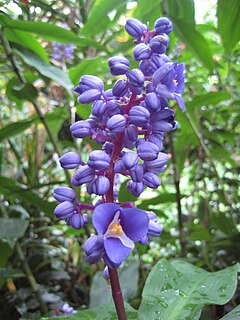
Dichorisandra thyrsiflora or blue ginger is a species of tropical flowering plant which resembles ginger in growth and habit, but is actually related to the spiderworts. The plant is native to the tropical woodlands of North, Central and South America, especially in Atlantic Forest vegetation in Brazil. Of the family Commelinaceae, it is cultivated for its handsome spotted stems and large shiny foliage which is held horizontally, surmounted by striking blue flowers.

Prunus speciosa, the Oshima cherry, Japanese オオシマザクラ, is native to Izu Ōshima island and the Izu Peninsula on Honshū near Tokyo, Japan.

Tradescantia virginiana, the Virginia spiderwort, is the type species of Tradescantia native to the eastern United States. Commonly grown in many gardens and also found growing wild along roadsides and railway lines, there are 75 of hybrids of Tradescantia species, such as Tradescantia ohiensis, the Bluejacket which closely resembles Virginia spiderwort and is the most common and widely distributed species of Tradescantia in North America.
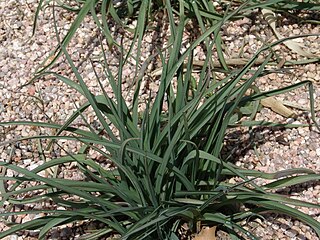
Tradescantia occidentalis, the prairie spiderwort or western spiderwort, is a plant in the dayflower family, Commelinaceae. It is common and widespread across the western Great Plains of the United States, as well as in Arizona, New Mexico, southern Utah, and Sonora, but is listed as a threatened species in Canada.

Tradescantia ohiensis, commonly known as bluejacket or Ohio spiderwort, is an herbaceous plant species in the genus Tradescantia native to eastern and central North America. It is the most common and widely distributed species of Tradescantia in the United States, where it can be found from Maine in the northeast, west to Minnesota, and south to Texas and Florida. It also has a very small distribution in Canada in extreme southern Ontario near Windsor.

Tradescantia spathacea, the boatlily or Moses-in-the-cradle, is a herb in the Commelinaceae family first described in 1788. It is native to Belize, Guatemala, and southern Mexico but widely cultivated as an ornamental and naturalized in parts of Florida, Texas, Hawaii, and various oceanic islands.
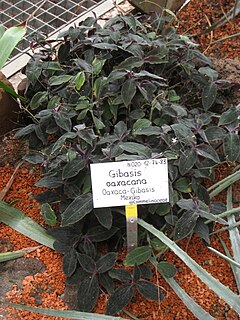
Gibasis is a genus of flowering plants within the Commelinaceae family, first described in 1837. It is native to the Western Hemisphere from Texas and the West Indies south to Argentina, with most of the species native to Mexico.
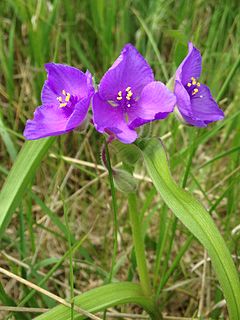
Tradescantia bracteata, the longbract spiderwort, or prairie spiderwort, is a species of Tradescantia. It is native to the northern and central Great Plains and Mississippi Valley regions of the United States, from Arkansas and Oklahoma north to Minnesota and Montana, with a few isolated populations farther east. It is grown for its purple flowers. It blooms from May to July in the US.

Tradescantia ozarkana, the Ozark spiderwort, is a species of Tradescantia. It is part of the Commelinaceae family, native to the States of Missouri, Arkansas, and Oklahoma in the south-central United States. It flowers from April to May and can be found in rich, rocky areas, including woods and bluff ledges.

Tradescantia humilis, the Texas spiderwort, is a species of Tradescantia native to Texas and southern Oklahoma. It was named after John Tradescant (1608-1662) who served as gardener to Charles I of England.

Tradescantia crassula, common names succulent spiderwort and white-flowered tradescantia, is a species of plants in the Commelinaceae. It is native to southeastern Brazil, Uruguay, and the Misiones Province of Argentina, and has been introduced to Florida. It flowers in May in Florida, and can be found under Oak Trees.
Tradescantia pinetorum, the pinewoods spiderwort, is a species of Tradescantia and part of the Commelinaceae family.

The Paradisus Londonensis is a book dated 1805–1808, printed by D.N. Shury, and published by William Hooker. It consists of coloured illustrations of 117 plants drawn by William Hooker, with explanatory text by Richard Anthony Salisbury.

Tradescantia hirsuticaulis, commonly called hairystem spiderwort, is a species of plant in the dayflower family that is native to south-central United States.

Tradescantia ernestiana, commonly called Ernest's spiderwort, is a species of plant in the dayflower family that is native mainly to the interior highlands of the United States with a disjunct population in Alabama.

Tradescantia hirsutiflora, commonly called hairyflower spiderwort, is a species of plant in the spiderwort family that is native to the south-central United States of America.


