
Fragaria is a genus of flowering plants in the rose family, Rosaceae, commonly known as strawberries for their edible fruits. There are more than 20 described species and many hybrids and cultivars. The most common strawberries grown commercially are cultivars of the garden strawberry, a hybrid known as Fragaria × ananassa. Strawberries have a taste that varies by cultivar, and ranges from quite sweet to rather tart. Strawberries are an important commercial fruit crop, widely grown in all temperate regions of the world.

Tradescantia is a genus of 85 species of herbaceous perennial wildflowers in the family Commelinaceae, native to the Americas from southern Canada to northern Argentina, including the West Indies. Members of the genus are known by many common names, including inchplant, wandering jew, spiderwort, dayflower and trad.

Commelinaceae is a family of flowering plants. In less formal contexts, the group is referred to as the dayflower family or spiderwort family. It is one of five families in the order Commelinales and by far the largest of these with about 731 known species in 41 genera. Well known genera include Commelina (dayflowers) and Tradescantia (spiderworts). The family is diverse in both the Old World tropics and the New World tropics, with some genera present in both. The variation in morphology, especially that of the flower and inflorescence, is considered to be exceptionally high amongst the angiosperms.
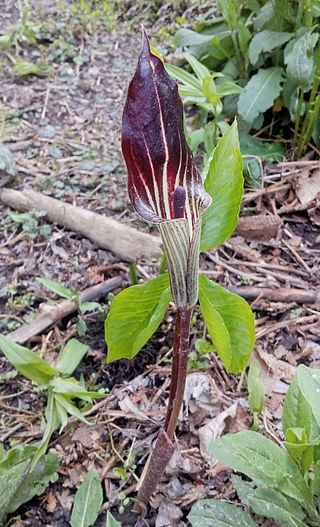
Arisaema triphyllum, the Jack-in-the-pulpit, is a species of flowering plant in the arum family Araceae. It is a member of the Arisaema triphyllum complex, a group of four or five closely related taxa in eastern North America. The specific name triphyllum means "three-leaved", a characteristic feature of the species, which is also referred to as Indian turnip, bog onion, and brown dragon.

Dactylis glomerata is a species of flowering plant in the grass family Poaceae, commonly known as cock's-foot, orchard grass, or cat grass (due to its popularity for use with domestic cats). It is a cool-season perennial C3 bunchgrass native throughout most of Europe, temperate Asia, and northern Africa.

Physostegia virginiana, the obedient plant, obedience or false dragonhead, is a species of flowering plant in the mint family, Lamiaceae. It is native to North America, where it is distributed from eastern Canada to northern Mexico. Physostegia are known commonly as obedient plants because a flower pushed to one side will often stay in that position. The name “false dragonhead” refers to the dragonheads of the related Dracocephalum, a genus to which the plant once belonged.

Tradescantia virginiana, the Virginia spiderwort, is a species of flowering plant in the family Commelinaceae. It is the type species of Tradescantia, native to the eastern United States. It is commonly grown in many gardens and also found growing wild along roadsides and railway lines.

Commelina benghalensis, commonly known as the Benghal dayflower, tropical spiderwort, or wandering Jew, kanshira in Bengali, is a perennial herb native to tropical Asia and Africa. It has been widely introduced to areas outside its native range, including to the neotropics, Hawaii, the West Indies and to both coasts of North America. It has a long flowering period, from spring to fall in subtropical areas, and throughout the year closer to the equator. It is often associated with disturbed soils.

Commelina virginica, commonly known as the Virginia dayflower, is a perennial herbaceous plant in the dayflower family. It is native to the mideastern and southeastern United States, where it is typical of wet soils. While most members of the genus have thin, fibrous roots, the Virginia dayflower is relatively unique for its genus in having a perennial rhizome. The plant was first described by Carl Linnaeus in his 1762 publication of the second edition of Species Plantarum. A phylogenetic study based on the nuclear ribosomal DNA region 5S NTS and the chloroplast region trnL-trnF, two commonly used gene regions for determining relationships, suggested that Commelina virginica is most closely related to two African species, namely Commelina capitata and Commelina congesta. However, the statistical support for this result was low. Morphologically speaking the supposedly related species do share some unique traits. C. virginica and C. capitata have red hairs at the top of their leaf sheaths, an unusual character in the genus, while C. virginica and C. congesta both have clustered inflorescences on very short stalks.
Liatris bracteata, commonly known as the bracted blazing star, or South Texas gayfeather, is a species of flowering plant in the family Asteraceae. It is native to Texas in the United States, where it is found in coastal prairies, roadsides, and along railroads with clay or sandy loam soils. This species is of conservation concern in its native range due to habitat loss.

Tradescantia ohiensis, commonly known as bluejacket or Ohio spiderwort, is an herbaceous plant species in the genus Tradescantia native to eastern and central North America. It is the most common and widely distributed species of Tradescantia in the United States, where it can be found from Maine in the northeast, west to Minnesota, and south to Texas and Florida. It also has a very small distribution in Canada in extreme southern Ontario near Windsor.

Solidago nemoralis is a species of flowering plant in the family Asteraceae. It is native to North America, where it is widely found in Canada and the United States. Its common names include gray goldenrod, gray-stem goldenrod, old-field goldenrod, field goldenrod, prairie goldenrod, dwarf goldenrod, and dyersweed goldenrod.

Solidago altissima, the tall goldenrod or late goldenrod, is a North American species of goldenrod in the family Asteraceae which is widespread across much of Canada, the United States, and northern Mexico. It is common in much of its range and fairly tolerant of landscapes which have been disturbed by humans. It has become naturalized in many parts of the world.

Tradescantia ozarkana, the Ozark spiderwort, is a species of Tradescantia. It is part of the Commelinaceae family, native to the States of Missouri, Arkansas, and Oklahoma in the south-central United States. It flowers from April to May and can be found in rich, rocky areas, including woods and bluff ledges.

Geogenanthus poeppigii, commonly called the seersucker plant, is a flowering plant species in the family Commelinaceae. As currently circumscribed, the genus Geogenanthus includes two other species, G. ciliatus and G. rhizanthus. This species is named after 19th century German naturalist Eduard Friedrich Poeppig. Geogenanthus undatus is an outdated synonym for G. poeppigii.

Streptolirion is a genus of climbing monocotyledonous flowering plants in the dayflower family. It consists of a single species, namely Streptolirion volubile. It has a broad distribution in Asia, from China's western Hubei Province as well as the Russian Far East, Korea and Japan in the northeast, south to Vietnam and west to India. Currently two subspecies are accepted: S. volubile subsp. volubile and S. volubile subsp. khasianum, with the latter being a stronger climber covered with erect brown hairs. Streptolirion can be distinguished from the closely related climber Spatholirion by the former's two-seeded carpels and inflorescences that are all subtended by large involucral bracts. They bear yellow hairs below the anthers, which are believed to increase floral attraction by contrasting with the petals or suggesting additional pollen is present. Despite the large range, an analysis of chromosomes found major differences between Japanese and Indian populations, suggesting that additional species may be yet unrecognized.
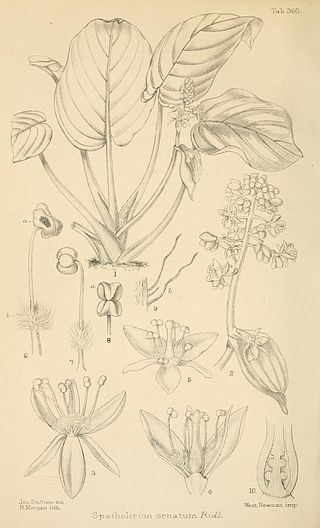
Spatholirion is a genus of climbing or rosette monocotyledonous flowering plants in the dayflower family. It is distributed from China in the north, south to Thailand, Vietnam, and northern Peninsular Malaysia. It has four to eight seeds per carpel, unlike the closely related Streptolirion, which has only two, and white or purple petals. The inflorescence axis of Spatholirion longifolium and all of its branches are a bright purple, probably aiding in visual pollinator attraction. The genus was first described in 1896 by Henry Nicholas Ridley, the father of the commercial rubber industry, from plants sent to Kew Gardens from the Malay Peninsula near the border between Thailand and Malaysia. All species have a diploid chromosome number of 20.

Symphyotrichum shortii, commonly called Short's aster, is a species of flowering plant in the family Asteraceae. It is native to North America, where it is primarily found in interior areas east of the Mississippi River. Its natural habitat is in thin rocky soils of woodlands and thickets often around limestone bluffs. It is common throughout much of its range, although it is generally restricted to intact natural communities.

Symphyotrichum undulatum is a species of flowering plant in the family Asteraceae native to eastern North America. Commonly known as wavyleaf aster, it is a perennial, herbaceous plant that flowers August through October and may reach heights between 30 and 160 centimeters.

Tradescantia subaspera, the zigzag spiderwort, is a species of flowering plant in the family Commelinaceae, native to the eastern United States. Its zigzagging stems and wider leaves distinguish it from Tradescantia virginiana. It is recommended for shady naturalistic garden settings. It has three petals which are violet-blue to purple in color. Flowers bloom May to September.


