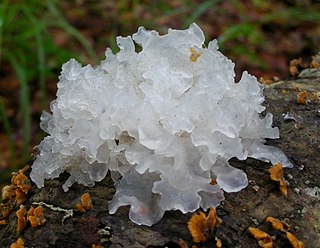
Tremella fuciformis is a species of fungus; it produces white, frond-like, gelatinous basidiocarps. It is widespread, especially in the tropics, where it can be found on the dead branches of broadleaf trees. This fungus is commercially cultivated and is one of the most popular fungi in the cuisine and medicine of China. Tremella fuciformis is commonly known as snow fungus, snow ear, silver ear fungus, and white jelly mushroom.

Tremella mesenterica is a common jelly fungus in the family Tremellaceae of the Agaricomycotina. It is most frequently found on dead but attached and on recently fallen branches, especially of angiosperms, as a parasite of wood decay fungi in the genus Peniophora. The gelatinous, orange-yellow fruit body of the fungus, which can grow up to 7.5 cm (3.0 in) diameter, has a convoluted or lobed surface that is greasy or slimy when damp. It grows in crevices in bark, appearing during rainy weather. Within a few days after rain it dries into a thin film or shriveled mass capable of reviving after subsequent rain. This fungus occurs widely in deciduous and mixed forests and is widely distributed in temperate and tropical regions that include Africa, Asia, Australia, Europe, North and South America. Although considered bland and flavorless, the fungus is edible. Tremella mesenterica produces carbohydrates that are attracting research interest because of their various biological activities.

The Tremellaceae are a family of fungi in the order Tremellales. The family is cosmopolitan and contains both teleomorphic and anamorphic genera, most of the latter being yeasts. All teleomorphic species of fungi in the Tremellaceae are parasites of other fungi, though the yeast states are widespread and not restricted to hosts. Basidiocarps, when produced, are gelatinous.

Crepidotus versutus, commonly known as the evasive agaric, is a species of fungi in the family Crepidotaceae. It is saprobic on wood, like other Crepidotus species, but it can also decompose herbaceous forest litter. The species is characterized by large, punctate, ellipsoid spores, and the white, hairy pileus.

Exidia is a genus of fungi in the family Auriculariaceae. The species are saprotrophic, occurring in attached or recently fallen dead wood, and produce gelatinous basidiocarps. The fruit bodies are diverse, pustular, lobed, button-shaped or cup-shaped. Several species, including the type species Exidia glandulosa, have sterile pegs or pimples on their spore-bearing surface. The genus has a cosmopolitan distribution and around 20 species are currently recognized worldwide. Initial molecular research indicates the genus is artificial.

Tremella is a genus of fungi in the family Tremellaceae. All Tremella species are parasites of other fungi and most produce anamorphic yeast states. Basidiocarps, when produced, are gelatinous and are colloquially classed among the "jelly fungi". Over 100 species of Tremella are currently recognized worldwide. Two species, Tremella fuciformis and Tremella aurantialba, are commercially cultivated for food.

Exidia glandulosa is a jelly fungus in the family Auriculariaceae. It is a common, wood-rotting species in Europe, typically growing on dead attached branches of oak. The fruit bodies are up to 3 cm (1.2 in) wide, shiny, black and blister-like, and grow singly or in clusters. Its occurrence elsewhere is uncertain because of confusion with the related species, Exidia nigricans.

Ascocoryne sarcoides is a species of fungus in the family Helotiaceae. The species name is derived from the Greek sarkodes (fleshy). Formerly known as Coryne sarcoides, its taxonomical history has been complicated by the fact that it may adopt both sexual and asexual forms. Colloquially known as jelly drops or the purple jellydisc, this common fungus appears as a gelatinous mass of pinkish or purple-colored discs. Distributed widely in North America, Europe and Asia, A. sarcoides is a saprobic fungus and grows in clusters on the trunks and branches of a variety of dead woods. Field studies suggest that colonization by A. sarcoides of the heartwood of black spruce confers some resistance to further infection by rot-causing fungi. A. sarcoides contains the antibiotic compound ascocorynin, shown in the laboratory to inhibit the growth of several Gram-positive bacteria.
Gymnopilus cyanopalmicola is a species of mushroom in the family Cortinariaceae. Found in tropical Mexico, it was described as new to science by Mexican mycologist Laura Guzmán-Dávalos in 2006. The flesh of this mushroom is blue where bruised.

Pholiota flammans, commonly known as the yellow pholiota, the flaming Pholiota, or the flame scalecap, is a basidiomycete agaric mushroom of the genus Pholiota. Its fruit body is golden-yellow in color throughout, while its cap and stem are covered in sharp scales. As it is a saprobic fungus, the fruit bodies typically appear in clusters on the stumps of dead coniferous trees. P. flammans is distributed throughout Europe, North America, and Asia in boreal and temperate regions. Its edibility has not been clarified.

Exidia nigricans is a jelly fungus in the family Auriculariaceae. It is a common, wood-rotting species throughout the northern hemisphere, typically growing on dead attached branches of broadleaf trees. It has been much confused with Exidia glandulosa.

Lactarius argillaceifolius is a species of fungus in the family Russulaceae. The mushrooms produced by the fungus have convex to flattened drab lilac-colored caps that are up to 18 cm (7.1 in) wide. The cream-colored gills are closely spaced together and extend slightly down the length of the stem, which is up to 9 cm (3.5 in) long by 3.5 cm (1.4 in) thick. The mushroom produces an off-white latex when injured that stains the mushroom tissue brownish.

Guepinia is a genus of fungus in the Auriculariales order. It is a monotypic genus, containing the single species Guepinia helvelloides, commonly known as the apricot jelly. The fungus produces salmon-pink, ear-shaped, gelatinous fruit bodies that grow solitarily or in small tufted groups on soil, usually associated with buried rotting wood. The fruit bodies are 4–10 cm (1.6–3.9 in) tall and up to 17 cm (6.7 in) wide; the stalks are not well-differentiated from the cap. The fungus, although rubbery, is edible, and may be eaten raw with salads, pickled, or candied. It has a white spore deposit, and the oblong to ellipsoid spores measure 9–11 by 5–6 micrometers. The fungus is widely distributed in the Northern Hemisphere, and has also been collected from South America.

Lactarius vinaceorufescens, commonly known as the yellow-staining milkcap or the yellow-latex milky, is a poisonous species of fungus in the family Russulaceae. It produces mushrooms with pinkish-cinnamon caps up to 12 cm (4.7 in) wide held by pinkish-white stems up to 7 cm (2.8 in) long. The closely spaced whitish to pinkish buff gills develop wine-red spots in age. When it is cut or injured, the mushroom oozes a white latex that rapidly turns bright sulfur-yellow. The species, common and widely distributed in North America, grows in the ground in association with conifer trees. There are several other Lactarius species that bear resemblance to L. vinaceorufescens, but most can be distinguished by differences in staining reactions, macroscopic characteristics, or habitat.

Tremellodendron is a genus of fungi in the family Sebacinaceae. Its species are mycorrhizal, forming a range of associations with trees and other plants. Basidiocarps are produced on soil and litter. The fruit bodies are clavarioid and leathery to rubbery-gelatinous. The genus is restricted to the Americas.
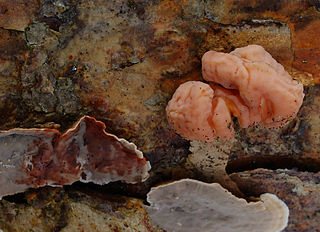
Tremella encephala is a species of fungus producing pink, brain-like, gelatinous basidiocarps. It is widespread in north temperate regions and is parasitic on another species of fungus, that grows on dead attached and recently fallen branches of conifers.

Exidia recisa is a jelly fungus in the family Auriculariaceae. It is a common, wood-rotting species throughout the northern hemisphere, typically growing on dead attached twigs and branches of willow and other broadleaf trees.
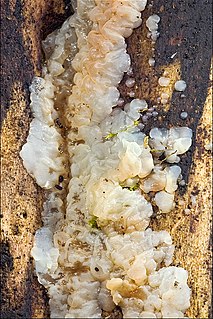
Exidia thuretiana is a jelly fungus in the family Auriculariaceae. The fruit bodies are white and gelatinous with brain-like folds. It is a common, wood-rotting species in Europe, typically growing on dead attached or fallen branches of broadleaf trees, especially beech.

Myxarium nucleatum is a jelly fungus in the family Hyaloriaceae. The sporocarps are watery white and gelatinous with small, white, mineral inclusions. It is a common, wood-rotting species in Europe and North America, typically growing on dead attached or fallen branches of broadleaf trees.

Pholiota nubigena, commonly known as the gastroid pholiota or the bubble gum fungus, is a species of secotioid fungus in the family Strophariaceae. It is found in mountainous areas of the western United States, where it grows on rotting conifer wood, often fir logs. It fruits in spring, often under snow, and early summer toward the end of the snowmelt period in high mountain forests. Fruit bodies appear similar to unopened mushrooms, measuring 1–4 cm (0.4–1.6 in) tall with 1–2.4-centimeter (0.4–0.9 in) diameter caps that are whitish to brownish. They have a short but distinct whitish stipe that extend through the internal spore mass (gleba) of the fruit body into the cap. The gleba consists of irregular chambers made of contorted gills that are brownish in color. A whitish, cottony partial veil is present in young specimens, but it often disappears in age and does not leave a ring on the stipe.


