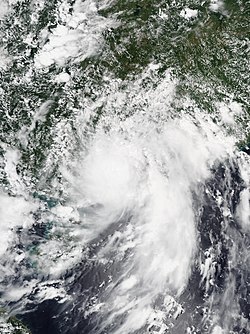
Tropical Storm Higos (2020)

Last updated
Map key
  Tropical depression (≤38 mph, ≤62 km/h)
  Tropical storm (39–73 mph, 63–118 km/h)
  Category 1 (74–95 mph, 119–153 km/h)
  Category 2 (96–110 mph, 154–177 km/h)
  Category 3 (111–129 mph, 178–208 km/h)
  Category 4 (130–156 mph, 209–251 km/h)
  Category 5 (≥157 mph, ≥252 km/h)
  Unknown
Storm type
Disc Plain black.svg Tropical cyclone
Solid black.svg Subtropical cyclone
ArrowUp.svg Extratropical cyclone, remnant low, tropical disturbance, or monsoon depression

A new tropical depression formed from the Intertropical Convergence Zone east of Luzon on August 16. At 15:00 UTC, the PAGASA named the system Helen and began issuing severe weather bulletins for the tropical depression, but dropped the alerts as Helen left the Philippine area of responsibility after 4 hours. [2] [3] Around 21:00 UTC, JTWC issued the first Tropical Cyclone Formation Alert on the developing tropical depression. Early on the next day, JTWC followed suit from JMA and PAGASA by upgrading the system into Tropical Depression 08W. Shortly after, Helen intensified into a tropical storm and were given the name Higos by the JMA. Later in the day, the Joint Typhoon Warning Center also upgraded Higos into a tropical storm. JMA eventually upgraded the system to a severe tropical storm by evening that day. The Hong Kong Observatory and Macau Meteorological and Geophysical Bureau upgraded Higos into a marginal typhoon prior to landfall, with sustained hurricane-force winds in Macau indicating such an intensity. Higos made landfall over Zhuhai, Guangdong at peak intensity at around 06:00 CST on August 19 (22:00 UTC on August 18). [4] After landfall, Higos quickly weakened soon after and would dissipate in Guizhou, China on August 20.

Preparations and impact

In preparation for Higos, the Hong Kong Observatory raised the number 9 tropical cyclone warning signal in Hong Kong to warn of the possibility of hurricane-force winds. Winds generally reached gale to storm force over the southern part of Hong Kong under the influence of Higos's small circulation. [5] The Macao Meteorological and Geophysical Bureau issued the number 10 signal, the highest signal, at 05:00 am local time. [6] Over 65,000 people evacuated and schools were closed across these areas. Power was knocked out in Meizhou, after trees knocked down power lines. [7] Two campers who were unaware of the approaching storm had to be rescued from Tap Mun Island after arriving on August 14. [8] The storm also left 7 deaths and 45 billion đồng (US$2 million) in damages in Vietnam. [9]

See also

References

  1. "Global Catastrophe Recap September 2020" (PDF). Aon. October 8, 2020. Retrieved October 17, 2020.
  2. "Severe Weather Bulletin #1 for Tropical Depression "Helen"" (PDF). PAGASA. 2020-08-17. Archived from the original (PDF) on 2020-08-17. Retrieved 2020-08-17.
  3. "Severe Weather Bulletin #2-FINAL for Tropical Depression "Helen"" (PDF). PAGASA. 2020-08-17. Archived from the original (PDF) on 2020-08-17. Retrieved 2020-08-17.
  4. Xiang Xin (19 August 2020). "台风"海高斯"登陆广东珠海 广东等地遭强风雨冲击" (in Chinese). Beijing, China: National Meteorological Center of CMA. Archived from the original on 19 August 2020. Retrieved 19 August 2020.
  5. "Tropical Cyclone Warning Signals". www.hko.gov.hk.
  6. "Typhoon signal No.10 hoisted". Macau Business. August 19, 2020. Retrieved August 19, 2020.
  7. The Associated Press (August 19, 2020). "Typhoon adds to southern China's rain and flooding woes". ABC News. Retrieved August 20, 2020.
  8. Clifford Lo; Ng Kang-chung (August 19, 2020). "Camper and 70-year-old mum rescued after being trapped on remote island while Typhoon Higos lashes Hong Kong". South China Morning Post. Retrieved August 20, 2020.
  9. Danh Trong (August 20, 2020). "Tropical Storm number 4 caused 7 deaths and more than 45 billion dong in damages". Tuổi Trẻ News. Retrieved August 25, 2020.
Severe Tropical Storm Higos (Helen)
Higos 2020-08-19 Suomi NPP.jpg
Severe Tropical Storm Higos at peak intensity on August 19.