Tropical leatherleaf

Last updated

Tropical leatherleaf
Laevecaulis-2.jpg
Scientific classification
Kingdom:
Phylum:
Class:
(unranked):
Superfamily:
Family:
Genus:
Species:
L. alte
Binomial name
Laevicaulis alte
(Férussac, 1822)
Synonyms

Vaginula alteFérussac, 1821
Vaginulus alteFérussac, 1821

Contents

The tropical leatherleaf, scientific name Laevicaulis alte, is a species of tropical land slug, a terrestrial pulmonate gastropod mollusk in the family Veronicellidae, the leatherleaf slugs.

Description

Laevicaulis alte is a round, dark-coloured slug with no shell, 7 or 8 cm long. Its skin is slightly tuberculated. The central keel is beige in colour.

This slug has a unique, very narrow foot; juvenile specimens have a foot 1 mm wide and adult specimens have a foot that is only 4 or 5 mm wide.

The tentacles are small, 2 or 3 mm long, and they are only rarely extended beyond the edge of the mantle.

View of contracted individual, the anterior end is to the right Laevecaulis.jpg
View of contracted individual, the anterior end is to the right

Parasites

This slug is an intermediate host for Angiostrongylus cantonensis , the rat lungworm, a round worm, the most common cause of eosinophilic meningoencephalitis. [1]

Predators

This slug is eaten by the frog Rana tigrina . [2]

Distribution

This species is probably indigenous to Africa (western Africa and eastern Africa).

It has been introduced and become an invasive species [4] in the following areas:

This species is already established in the USA, and is considered to represent a potentially serious threat as a pest, an invasive species which could negatively affect agriculture, natural ecosystems, human health or commerce. Therefore, it has been suggested that this species be given top national quarantine significance in the USA. [7]

Habitat

This species lives in dry areas, mostly at lower altitudes.[ citation needed ]

Ventral view of foot of juvenile specimen Laevecaulis-small.JPG
Ventral view of foot of juvenile specimen

Feeding habits

What this slug eats in the wild is not known. In captivity this slug will eat:

In captivity it will not eat:

Life cycle

This slug hatches from eggs. This species has several adaptations for living in dry conditions: a rounded shape with as small as possible surface area, and a narrow foot to reduce evaporation.

Juvenile specimens search for food nearly always at night, and stay buried in the soil during the day. Larger specimens are active during the day sometimes. This slug can grow up from 0.5 cm to approximately 4 cm in length in 7 months.

Related Research Articles

Ampullariidae Family of gastropods

Ampullariidae, common name the apple snails, is a family of large freshwater snails, aquatic gastropod mollusks with a gill and an operculum. This family is in the superfamily Ampullarioidea and is the type family of that superfamily.

<i>Limax maximus</i> Species of slug

Limax maximus, known by the common names great grey slug and leopard slug, is a species of slug in the family Limacidae, the keeled slugs. It is among the largest keeled slugs, Limax cinereoniger being the largest.

<i>Achatina fulica</i> Species of land snail

Achatina fulica is a species of large land snail that belongs in the family Achatinidae. It is also known as the Giant African land snail. It shares the common name "giant African snail" with other species of snails such as Achatina achatina and Archachatina marginata.

<i>Euglandina rosea</i> Species of gastropod

Euglandina rosea, common names the rosy wolfsnail or the cannibal snail, is a species of medium-sized to large predatory air-breathing land snail, a carnivorous terrestrial pulmonate gastropod mollusk in the family Spiraxidae.

Kerry slug Species of mollusc

The Kerry slug or Kerry spotted slug is a species of terrestrial, pulmonate, gastropod mollusc. It is a medium-to-large sized, air-breathing land slug in the family of roundback slugs, Arionidae.

<i>Laevicaulis</i> Genus of gastropods

Laevicaulis is a taxonomic genus of air-breathing, tropical land slugs, terrestrial pulmonate gastropod mollusks in the family Veronicellidae, the leatherleaf slugs.

Land snail Common name for many species of snail

A land snail is any of the numerous species of snail that live on land, as opposed to the sea snails and freshwater snails. Land snail is the common name for terrestrial gastropod mollusks that have shells. However, it is not always easy to say which species are terrestrial, because some are more or less amphibious between land and fresh water, and others are relatively amphibious between land and salt water.

Veronicellidae Family of pulmonate land slugs

The Veronicellidae, also known by their common name the leatherleaf slugs, are a family of pulmonate terrestrial slugs.

<i>Phylliroe</i> Genus of gastropods

Phylliroe is a genus of average sized, highly transparent pelagic nudibranchs, marine gastropod molluscs in the order Opisthobranchia, that consists of two known species. It is notable for being an open-ocean hunter that resembles a fish in body plan and locomotion, an example of convergent evolution.

Veronicella cubensis, common name the Cuban slug, is a species of air-breathing land slug, a terrestrial pulmonate gastropod mollusk in the family Veronicellidae, the leatherleaf slugs.

<i>Eobania vermiculata</i> Species of gastropod

Eobania vermiculata also known as Helix vermiculata, common name the "chocolate-band snail" is a species of large, air-breathing, land snail, a terrestrial pulmonate gastropod mollusk in the family Helicidae, the true snails or typical snails.

<i>Veronicella sloanii</i> Species of gastropod

Veronicella sloanii, commonly called the pancake slug, is a species of air-breathing land slug, a terrestrial, pulmonate gastropod mollusk in the family Veronicellidae, the leatherleaf slugs.

<i>Milax gagates</i> Species of gastropod

Milax gagates, known by the common name greenhouse slug, is a species of air-breathing, keeled, land slug, a shell-less terrestrial gastropod mollusc in the family Milacidae.
<i>Archachatina marginata</i> Species of gastropod

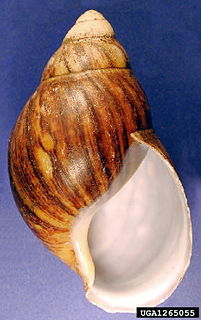
The giant West African snail or banana rasp snail is a species of air-breathing tropical land snail, a terrestrial pulmonate gastropod mollusk in the family Achatinidae. They can grow up to 20 cm long, and live up to 10 years or more.

<i>Quantula striata</i> Species of gastropod

Quantula striata, also known as Dyakia striata, is a species of medium-sized, air-breathing, tropical land snail. It is a terrestrial, pulmonate, gastropod mollusk in the family Dyakiidae. This species appears to be unique among terrestrial gastropods in that it is bioluminescent: Its eggs glow in the dark, and juveniles and most adults give off flashes of green light. It is the only species in the genus Quantula.

<i>Sarasinula plebeia</i> Species of gastropod

Sarasinula plebeia, commonly called the bean slug or the Caribbean leatherleaf slug, is a species of air-breathing land slug, a terrestrial pulmonate gastropod mollusk in the family Veronicellidae, the leatherleaf slugs.

<i>Ovachlamys fulgens</i> Species of gastropod

Ovachlamys fulgens is a species of air-breathing land snail, a terrestrial pulmonate gastropod mollusk in the family Helicarionidae.
<i>Amphibulima patula</i> Species of gastropod

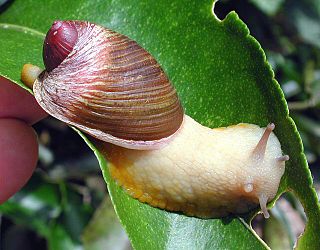
Amphibulima patula is a species of air-breathing land snail, a terrestrial pulmonate gastropod mollusk in the family Amphibulimidae.

<i>Zachrysia provisoria</i> Species of gastropod

Zachrysia provisoria is a species of air-breathing land snail, terrestrial pulmonate gastropod mollusk in the family Camaenidae or Pleurodontidae.

References

  1. "Archived copy". Archived from the original on 2007-12-14. Retrieved 2016-10-05.CS1 maint: archived copy as title (link)
  2. Rowson B., Warren B. H. & Ngereza C. F. (2010). "Terrestrial molluscs of Pemba Island, Zanzibar, Tanzania, and its status as an "oceanic" island". ZooKeys 70: 1-39. doi : 10.3897/zookeys.70.762.
  3. Wu S.-P., Hwang C.-C., Huang H.-M., Chang H.-W., Lin Y.-S. & Lee P.-F. (2007). "Land Molluscan Fauna of the Dongsha Island with Twenty New Recorded Species". Taiwania52(2): 145-151. Original.
  4. Cowie R. H., Dillon R. T., Robinson D. G. & Smith J. W. (2009). "Alien non-marine snails and slugs of priority quarantine importance in the United States: A preliminary risk assessment". American Malacological Bulletin27: 113-132. PDF Archived 2016-06-16 at the Wayback Machine .

Images:

Genome: