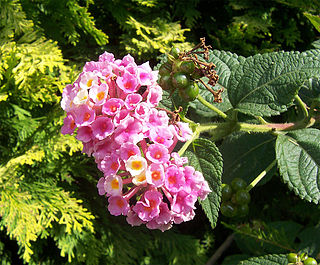
The Verbenaceae, the verbena family or vervain family, is a family of mainly tropical flowering plants. It contains trees, shrubs, and herbs notable for heads, spikes, or clusters of small flowers, many of which have an aromatic smell.

Osteospermum, is a genus of flowering plants belonging to the Calenduleae, one of the smaller tribes of the sunflower/daisy family Asteraceae. They are known as the daisybushes or African daisies. Its species have been given several common names, including African daisy, South African daisy, Cape daisy and blue-eyed daisy.
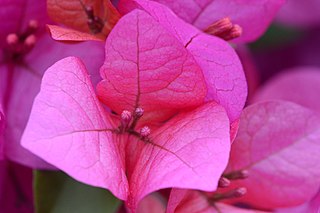
Bougainvillea is a genus of thorny ornamental vines, bushes, and trees belonging to the four o' clock family, Nyctaginaceae. It is native to eastern South America, found from Brazil, west to Peru, and south to southern Argentina. Different authors accept from 4 to 22 species in the genus. The inflorescence consists of large colourful sepal-like bracts which surround three simple waxy flowers, gaining popularity for the plant as an ornamental.

Aloysia citrodora, lemon verbena, is a species of flowering plant in the verbena family Verbenaceae, native to South America. Other common names include lemon beebrush. It was brought to Europe by the Spanish and the Portuguese in the 17th century and cultivated for its oil.

Verbena, also known as vervain or verveine, is a genus in the family Verbenaceae. It contains about 150 species of annual and perennial herbaceous or semi-woody flowering plants. The majority of the species are native to the Americas and Asia; however, Verbena officinalis, the common vervain or common verbena, is the type species and native to Europe.

Scilla peruviana, the Portuguese squill, is a species of Scilla native to the western Mediterranean region in Iberia, Italy, and northwest Africa. It is a bulb-bearing herbaceous perennial plant. The bulb is 6–8 cm in diameter, white with a covering of brown scales. The leaves are linear, 20–60 cm long and 1–4 cm broad, with 5-15 leaves produced each spring. The flowering stem is 15–40 cm tall, bearing a dense pyramidal raceme of 40-100 flowers; each flower is blue, 1–2 cm in diameter, with six tepals. The foliage dies down in summer, re-appearing in the autumn.

Verbena brasiliensis, the Brazilian verbena or Brazilian vervain, is a flowering plant species from the vervain family (Verbenaceae). It is native to parts of South America, namely Brazil, but has spread its range in recent times and has occasionally become an invasive weed. It is an annual plant with purple flowers, and it has been introduced outside of its native range as an ornamental plant, and is now largely considered an invasive weed in these regions.

Glandularia, common name mock vervain or mock verbena, is a genus of annual and perennial herbaceous flowering plants in the family Verbenaceae. They are native to the Americas.

Verbena bonariensis, the purpletop vervain, clustertop vervain, Argentinian vervain, tall verbena or pretty verbena, is a member of the verbena family cultivated as a flowering annual or herbaceous perennial plant. In USA horticulture, it is also known by the ambiguous names purpletop and South American vervain. For the misapplication "Brazilian verbena" see below.

Verbena hastata, commonly known as American vervain, blue vervain, simpler's joy, or swamp verbena, is a perennial flowering plant in the vervain family Verbenaceae. It grows throughout the continental United States and in much of southern Canada.

Glandularia gooddingii is a species of flowering plant in the verbena family known by the common name southwestern mock vervain. It is native to the southwestern United States and northern Mexico, where it occurs in sandy and rocky desert habitat. It is a perennial herb producing several hairy, decumbent to erect stems up to 45 centimeters long. The hairy leaves are generally divided at the base into a few lobes, which are edged with large teeth or small lobes. The plant blooms in large, dense, head-like spikes of many flowers. Each flower has a calyx of hairy sepals and a pale purple-blue corolla up to 1.4 centimeters long.

Glandularia pulchella is a species of flowering plant in the verbena family known by the common name South American mock vervain. It is native to Brazil, Argentina, and Uruguay, and it is present elsewhere as an introduced species and roadside weed. It is an annual or perennial herb producing one or more stems growing decumbent to erect in form and hairy to hairless in texture. The rough-haired leaves are divided deeply into lobes. The inflorescence is a dense, headlike spike of many flowers up to 1.5 centimeters wide. Each flower corolla is up to 1.4 centimeters wide and white to purple in color.

Verbena rigida, known as slender vervain or tuberous vervain, is a flowering herbaceous perennial plant in the family Verbenaceae. It is native to Brazil and Argentina, and is not fully hardy in temperate climates, where consequently it is grown from seed as an annual.

Verbena stricta, also known as hoary verbena or hoary vervain, is a small purple wildflower native to a large region of the central United States.
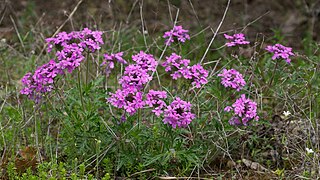
Verbena canadensis, commonly known as rose mock vervain, rose verbena, clump verbena or rose vervain is a perennial herbaceous flowering plant in the verbena family (Verbenaceae) with showy pink to purple flowers.. It is native to the eastern and south-central areas of the United States. This species is widely cultivated as an ornamental, and naturalized populations have been established outside its native range, such as in the northeastern U.S.
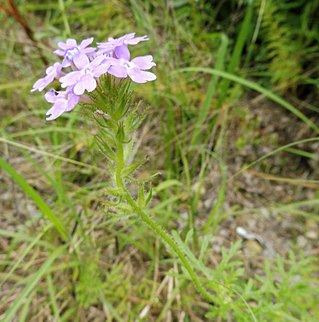
Glandularia bipinnatifida, commonly called Dakota mock vervain, prairie verbena, and Moradilla, among others, is a species of flowering plant in the verbena family (Verbenaceae).
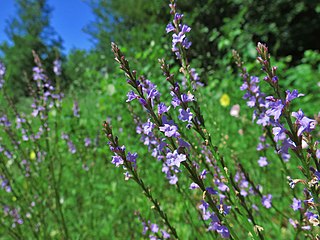
Verbena halei, commonly known as Texas vervain, Texas verbena, or slender verbena, is a flowering plant in the vervain family, Verbenaceae. It is native to much of the southern United States and Mexico. Scattered populations have been found along the east coast, and its range stretches south to Florida, west to Arizona, and throughout most of Mexico. It is a perennial shrub and grows in thickets and woodland borders. Flowers bloom March to June. It has been introduced to Australia, in Queensland, New South Wales, Victoria, and South Australia.

Glandularia lilacina is a species of flowering plant in the verbena family known by the common name Cedros Island verbena. It is native to Cedros Island and the adjacent Baja California coast. It is a perennial herb growing to 3 feet tall by 3 feet wide, with erect stems, narrow and elongate bipinnatifid leaves. The plant is available in multiple cultivars for gardens.

Verbena aristigera, variously called the moss verbena, desert verbena, fine leafed verbena, wild verbena, tuber vervain, South American mock vervain, Mayne's curse and Mayne's pest, is a species of flowering plant in the family Verbenaceae. It is native to Bolivia, southern Brazil, northern Argentina, Paraguay and Uruguay. It has been widely introduced to the rest of the world's drier tropics and subtropics, including California, Guatemala, Honduras, Nicaragua, Venezuela, Greece, Nigeria, eastern and southern Africa, India, and all of Australia except Tasmania.
Glandularia chiricahensis is a species of flowering plant in the family Verbenaceae with the common name Chiricahua Mountain mock vervain or Chiricahua vervain. The specific name is sometimes misspelled as "chiricahuensis".


