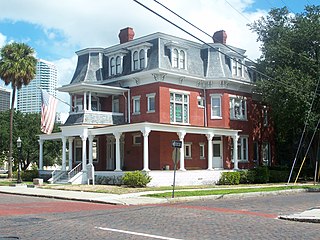
The Hutchinson House is a historic home completed in 1908 in Tampa, Florida, United States. It is a three-story brick building in the Second Empire architecture. The building includes a high mansard roof and large porch with tall Corinthian columns.

The T. Thomas Fortune House, also known historically as Maple Hall, is a historic house at 94 Drs. James Parker Boulevard in Red Bank, Monmouth County, New Jersey, United States. Built in the mid-19th century, it was the home of Timothy Thomas Fortune (1856–1928), a leading African-American journalist and civil rights advocate, from 1901 to 1908. The house was named a National Historic Landmark in 1976. It is now owned by a nonprofit organization dedicated to preserving and promoting Fortune's legacy of activism and community involvement.
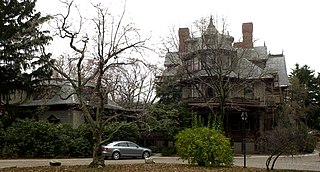
The Adams-Nervine Asylum was incorporated in 1877 and opened in 1880 in Jamaica Plain, Massachusetts. The estate provided an attractive, picturesque setting, as it was situated on Centre Street, in the neighborhood of Bussy Park and the Arnold Arboretum. Having previously been owned by J. Gardiner Weld, it was purchased by Seth Adams with his fortune acquired from his sugar refinery in South Boston. With his brother Isaac, Seth had formerly manufactured printing presses and machinery. On his death, his estate bequeathed $600,000 for the establishment of a curative institution for the benefit of indigent, debilitated and nervous people: inhabitants of the State who were not insane. The trustees purchased neighboring properties for the Asylum in 1879.The estate was vacated in 1976 and left to The Adams Trust.

The Bennink-Douglas Cottages are a collection of four historic worker duplexes in Cambridge, Massachusetts. Built in 1874 as a speculative venture, they typify the housing built for low and middle-income workers in the 1870s. They were listed on the National Register of Historic Places in 1986.

The Belchertown Center Historic District is a historic district which encompasses the historic village center of Belchertown, Massachusetts. Centered on Belchertown's 1,200-foot (370 m) common, the district includes 55 contributing properties along South Main Street, Maple Street, and a few adjacent streets. It was listed on the National Register of Historic Places in 1982.

Maple-Union Corners is a historic district centered at the intersection of Maple and Union Streets in Springfield, Massachusetts. The area is prominent as the location of the Springfield Female Seminary building, and for the distinctive homes of several of Springfield's prominent 19th century citizens. The house at 83 Maple Street, was first owned by Solomon Merrick, inventor of the monkey wrench, and was later owned by Ansel Phelps, the fourth mayor of Springfield. Townhouses at 76-78 and 80-84 Maple Street comprise the rest of the district; owners or occupants included Francis Fuller, owner of the Fuller Block, and Edmund Chapin, president of the John Hancock National Bank. The district was listed on the National Register of Historic Places in 1976.

Larrabee's Brick Block is a historic commercial and residential building at 500–504 Main Street in Melrose, Massachusetts. It is one of only two relatively unaltered 19th century commercial buildings in Melrose. The three-story brick Second Empire building was built in 1880 by John Larrabee, on the site of a wood frame meeting hall. The block is built of brick laid in stretcher bond, and its third floor is under a mansard roof typical of the style. The ground floor consists of two storefronts with recessed entrances and plate glass windows, and a separate recessed entrance giving access to the upper residential floors. The second floor facade has two projecting bay windows, decorated with brackets and panel trim, above the two store fronts, and a sash window above the residential entrance. The mansard roof originally had single window dormers, but c. 1910, all but one of these were removed and replaced by extensions of the second story bay windows.

The S. E. Brackett House is a historic house in Somerville, Massachusetts, United States. Built about 1880, it is one of the city's most elaborate examples of Second Empire architecture. It was listed on the National Register of Historic Places in 1989.

16 Mineral Street in Reading, Massachusetts is a well-preserved Second Empire cottage. It was built c. 1874 and probably moved to its present location not long afterward, during a building boom in that part of the town. It was listed on the National Register of Historic Places in 1984.
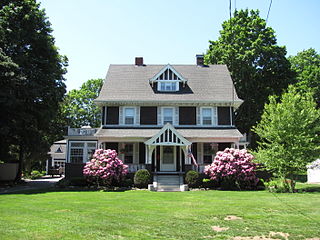
The House at 199 Summer Avenue in Reading, Massachusetts is designated as historic. The original two-and-a-half-story house was designed by architect Horace G. Wadlin and built in 1878 for Robert Kemp, leader of the popular Old Folks Concerts. The house was the second in Reading that Kemp had built; the first also is still standing.

The Charles Holbrook House is a historic house in Sherborn, Massachusetts. Built c. 1870–75, this modest house is the town's finest example of Second Empire styling. It was built for Charles Albert Holbrook (1846-1899), whose family operated a large apple cider mill in town. The house was listed on the National Register of Historic Places on January 3, 1986.

The Yale Avenue Historic District is a residential historic district near the center of Wakefield, Massachusetts. It encompasses eight residential properties, all but one of which were developed in the 1860s and 1870s, after the arrival of the railroad in town. These properties were built primarily for Boston businessmen, and mark the start of Wakefield's transition to a suburb.

The Oddfellows Building is a historic mixed-use commercial building at Central Square in Stoneham, Massachusetts. Built in 1868, it is one of three Second Empire buildings that give downtown Stoneham its character, despite some exterior alterations. It was added to the National Register of Historic Places in 1984, and was included in the Central Square Historic District in 1990.
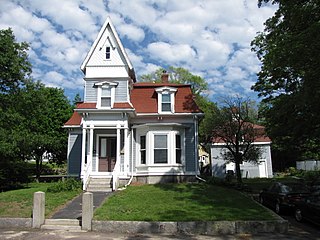
The E. A. Durgin House is a historic house at 113 Summer Street in Stoneham, Massachusetts. The two-story wood-frame Second Empire style house was built c. 1870 for E. A. Durgin, a local shoe dealer, and is one of Stoneham's most elaborately styled 19th century houses. Its main feature is a square tower with a steeply pitched gable roof that stands over the entrance. The gable of the tower is clad in scalloped wood shingles, and includes a small window that is topped by its own gable. The house has a typical mansard roof, although the original slate has been replaced with asphalt shingling, with a cornice that is decorated with dentil molding and studded by paired brackets.

The Lucius Knowles House is a historic house located at 838 Main Street in Worcester, Massachusetts. It is locally significant as one of the city's best preserved Second Empire style buildings.

The House at 20 Lawrence Street in Wakefield, Massachusetts is a complex residential structure with elements of Queen Anne, Stick style, and Colonial Revival style. Built about 1880, it was listed on the National Register of Historic Places in 1989.

The Moses-Kent House is a historic house at 1 Pine Street in Exeter, New Hampshire. Built in 1868 for a prominent local merchant, it is one of the town's finest examples of Victorian residential architecture. It was added to the National Register of Historic Places on September 12, 1985.
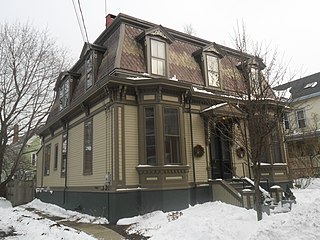
The A. B. Butler House is an historic house at 4 Walker Street in Portland, Maine, United States. Built in 1868, it is a remarkably little-altered high-quality example of Second Empire architecture, and one of two surviving designs in the city of architect Matthew Stead. It was listed on the National Register of Historic Places on May 8, 1974.

Old Gym is one of the surviving Victorian buildings that characterized the early style of the Vanderbilt University campus in Nashville, Tennessee. The Old Gym was originally a gymnasium, later served as the Fine Arts Building, and currently houses the university's admissions office.

The G.O. Sanders House is a historic house at 10 Derry Street in the center of Hudson, New Hampshire. Built in 1873-75 by George Sanders, this 2+1⁄2-story wood-frame house is a well-preserved example of French Second Empire style. It was listed on the National Register of Historic Places in 1986.