Fantails are small insectivorous songbirds of the genus Rhipidura in the family Rhipiduridae, native to Australasia, Southeast Asia and the Indian subcontinent. Most of the species are about 15 to 18 cm long, specialist aerial feeders, and named as "fantails", but the Australian willie wagtail is a little larger, and, though still an expert hunter of insects on the wing, concentrates equally on terrestrial prey.

The grey fantail is a small insectivorous bird. There is no sexual dimorphism. It is a common fantail found in Australia, the Solomon Islands, Vanuatu and New Caledonia. The species is considered by many to be conspecific with the New Zealand fantail ; however, differences in its calls lead some authorities to treat it as a separate species. The studies of grey fantail in 1999 by Richard Schodde and Ian Mason recommended that Tasmanian grey fantail was formally classified as R. albiscapa and New Zealand fantails populations as R. fuliginosa

The white-throated fantail is a small passerine bird. It is found in forest, scrub and cultivation across tropical southern Asia from the Himalayas, India and Bangladesh east to Indonesia. The white-spotted fantail until recently was considered a subspecies.

The Australian rufous fantail is a small passerine bird, most commonly known also as the black-breasted rufous-fantail or rufous-fronted fantail, which can be found in Australia.

The black monarch is a species of bird in the family Monarchidae. It is found in the New Guinea Highlands. Its natural habitats are subtropical or tropical moist lowland forest and subtropical or tropical moist montane forest.

The golden monarch is a species of passerine bird in the family Monarchidae found in New Guinea. Its natural habitats are subtropical or tropical moist lowland forests and subtropical or tropical moist montane forest. The golden monarch displays marked sexual dimorphism, the male a striking golden colour with black mask, wings and tail, the female a golden or golden-olive colour. Both bear a characteristic 'teardrop' white pattern below the eye.
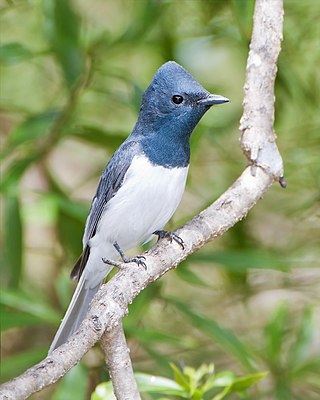
The leaden flycatcher is a species of passerine bird in the family Monarchidae. Around 15 cm (6 in) in length, the male is lustrous azure with white underparts, while the female possesses leaden head, mantle and back and rufous throat and breast. It is found in eastern and northern Australia, Indonesia, and Papua New Guinea. Its natural habitat is subtropical or tropical mangrove forests in the northern parts of its range, in the south and inland it is eucalypt woodland.

The Palau fantail is a species of bird in the fantail family Rhipiduridae. It is endemic to Palau.

The black thicket fantail is a species of bird in the family Rhipiduridae. It is found in the Aru Islands and New Guinea. This species is one of 47 in the genus Rhipidura.

The Samoan fantail is a species of bird in the family Rhipiduridae. It is endemic to Samoa and is found in Upolu and Savaiʻi islands.
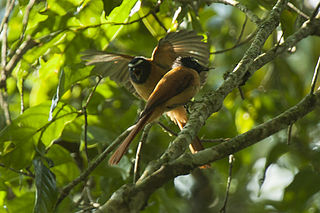
The black-and-cinnamon fantail is a species of bird in the fantail family Rhipiduridae. It is endemic to the island of Mindanao in the Philippines. There are two subspecies, the nominate R. n. nigrocinnamomea, from central and southern Mindanao; and R. n. hutchinsoni in north, western and eastern Mindanao. The specific name is derived from Latin niger for 'black', and cinnamomeus for 'cinnamon'.
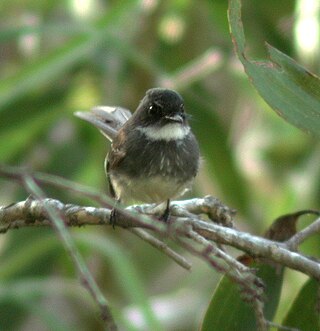
The northern fantail is a species of bird in the family Rhipiduridae. It is found in New Guinea and northern Australia . Its natural habitats are subtropical or tropical moist lowland forests and subtropical or tropical mangrove forests. The Biak fantail was formerly considered a subspecies.

The sooty thicket fantail is a species of bird in the family Rhipiduridae. It is found in New Guinea.

The white-spotted fantail or spot-breasted fantail is a small passerine bird. It is found in forest, scrub and cultivation in southern and central India. It was formerly considered a subspecies of the white-throated fantail.

The New Zealand fantail is a small insectivorous bird, the only species of fantail in New Zealand. It has four subspecies: R. f. fuliginosa in the South Island, R. f. placabilis in the North Island, R. f. penita in the Chatham Islands, and the now-extinct R. f. cervina formerly on Lord Howe Island. It is also known by its Māori names, pīwakawaka, tīwakawaka or piwaiwaka, and the Chatham Island subspecies by the Moriori name tchitake; the common pied morph is also known as pied fantail, and the uncommon dark morph is also known as black fantail. The species has been considered by many to be conspecific as the grey fantail of Australia and New Caledonia; however, due to significant differences in its calls, many authorities now treat it as a separate species.