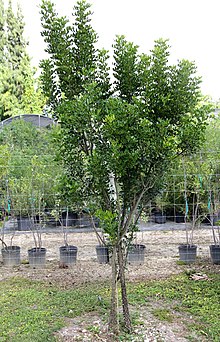
The Rutaceae are a family, commonly known as the rue or citrus family, of flowering plants, usually placed in the order Sapindales.

Aralia spinosa, commonly known as devil's walking stick, is a woody species of plant in the genus Aralia, family Araliaceae, native to eastern North America. The various names refer to the viciously sharp, spiny stems, petioles, and even leaf midribs. It has also been known as Angelica-tree.

Zanthoxylum is a genus of about 250 species of deciduous and evergreen trees and shrubs in the family Rutaceae, native to warm temperate and subtropical areas worldwide. It is the type genus of the tribe Zanthoxyleae in the subfamily Rutoideae. Several of the species have yellow heartwood, to which their generic name alludes.

Zanthoxylum clava-herculis, the Hercules' club, Hercules-club, pepperwood, or southern prickly ash, is a spiny tree or shrub native to the southeastern United States. It grows to 10–17 m tall and has distinctive spined thick, corky lumps 2–3 cm long on the bark. The leaves are glabrous and leathery, pinnately compound, 20–30 cm long with 7-19 leaflets, each leaflet 4–5 cm long. The flowers are dioecious, in panicles up to 20 cm long, each flower small, 6–8 mm diameter, with 3-5 white petals. The fruit is a two-valved capsule 6 mm diameter with a rough surface, and containing several small black seeds. The tree has also been called Z. macrophyllum. The genus name is sometimes spelled Xanthoxylum.

Zanthoxylum flavum is a medium-sized tree in the family Rutaceae. Common names include noyer, West Indian satinwood, yellow sanders, tembetaria, and yellow sandalwood. It is found in Anguilla, Antigua and Barbuda, the Bahamas, Bermuda, Cuba, the Dominican Republic, Guadeloupe, Haiti, Jamaica, Puerto Rico, and the Florida Keys, exclusive of Key West where it has been extirpated. It is threatened by habitat loss and harvesting for its dense, durable wood used in fine woodworking.

Zanthoxylum fagara or wild lime, is a species of flowering plant that—despite its name—is not part of the genus Citrus with real limes and other fruit, but is a close cousin in the larger citrus family, Rutaceae. It is native to southern Florida and Texas in the United States, Mexico, Central America, the Caribbean, and South America as far south as Paraguay. Common names include: lime prickly-ash, wild lime, colima, uña de gato, and corriosa.

Zanthoxylum brachyacanthum, known as thorny yellowwood or satinwood, is an Australian rainforest tree. The natural range is from the Clarence River in New South Wales to tropical Queensland in the Eungella National Park and the Wet Tropics region.
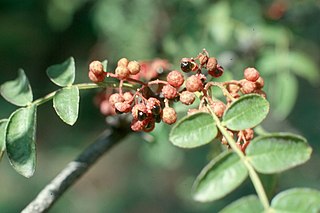
Zanthoxylum americanum, the common prickly-ash, common pricklyash, common prickly ash or northern prickly-ash, is an aromatic shrub or small tree native to central and eastern portions of the United States and Canada. It is the northernmost New World species in the citrus family, Rutaceae, and is the type species in its genus, which includes sichuan pepper. It can grow to 10 meters (33 ft) tall with a diameter at breast height (DBH) of 15 cm (5.9 in). It produces membranous leaflets and axillary flower clusters. The wood is not commercially valuable, but oil extracts from the bark have been used in traditional and alternative medicine, and have been studied for antifungal and cytotoxic properties. The genus name is sometimes spelled Xanthoxylum.

Ranunculus pusillus, commonly called low spearwort, is a species of flowering plant in the buttercup family (Ranunculaceae). It is native to much of the eastern United States from New York to Florida and west to Texas; it is also known in California. It grows in wet habitat, where it is semi-aquatic growing partially submerged or terrestrially on muddy substrates.

Lupinus aridorum is a rare species of lupine known by the common name scrub lupine. It is endemic to Florida in the United States, where there were 10 known populations remaining in 2003. Fewer than 6000 individual plants were counted. It is threatened by the loss and degradation of its habitat. The scrub lupine is a federally listed endangered species of the United States.

Polygala lewtonii is a rare species of flowering plant in the milkwort family known by the common name Lewton's polygala, or Lewton's milkwort. It is endemic to Florida in the United States, where it is limited to the central ridge of the peninsula. There are about 49 occurrences of the plant remaining. Most occurrences contain very few plants. The species is threatened by the loss and degradation of its habitat. This is a federally listed endangered species of the United States.

Ophioglossum lusitanicum, the least adder's-tongue, is a small fern of the family Ophioglossaceae. It is a pan-tropically species categorised as least concern by the IUCN (2001).

Vaccinium myrsinites is a species of flowering plant in the heath family known by the common name shiny blueberry. It is native to the southeastern United States from Alabama, Georgia, South Carolina and Florida. It may occur as far west as Louisiana.
Zanthoxylum coreanum, the Korean lime tree, is a rare shrub that only grows in Korea and China. In Korea it is called wang-cho-pi tree and is used for many purposes.
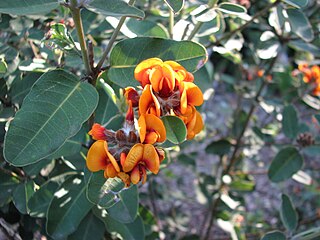
Gastrolobium coriaceum is a shrub species in the family Fabaceae. It is endemic to the south west of Western Australia.

Placospermum is a genus of a single species of large trees, constituting part of the plant family Proteaceae. The species Placospermum coriaceum is endemic to the rainforests of the wet tropics region of northeastern Queensland, Australia. Common names include rose silky oak and plate-seeded oak.
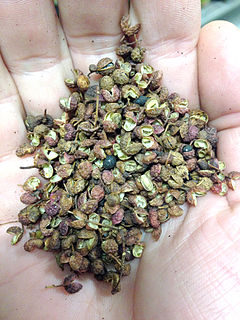
Sichuan pepper is a spice from the Sichuan cuisine of China's southwestern Sichuan Province. It has a unique aroma and flavor that is neither hot like chili peppers nor pungent like black pepper. Instead, it has slight lemony overtones and creates a tingly numbness in the mouth due to hydroxy-α-sanshool. It is commonly used in Sichuanese dishes such as mapo doufu and Chongqing hot pot, and is often added together with chili peppers to create a flavor known in Mandarin as málà.
Dendrobium coriaceum, commonly known as the inland rock orchid, is a species of lithophytic orchid that is endemic to North Queensland. It has tapered pseudobulbs, up to three thick, leathery leaves and up to forty yellow or cream-coloured flowers with purple markings on the labellum.

Leptospermum coriaceum, commonly known as green tea-tree or mallee teatree, is a shrub species that is endemic to south-eastern Australia. It has smooth bark on the younger stems, elliptic to narrow egg-shaped leaves, white flowers and woody fruit. The usual habitat is mallee on sand dunes.