
Bellis is a genus of flowering plants in the family Asteraceae.

Poa pratensis, commonly known as Kentucky bluegrass, smooth meadow-grass, or common meadow-grass, is a perennial species of grass native to practically all of Europe, North Asia and the mountains of Algeria and Morocco. It is a common and incredibly popular lawn grass in North America with the species being spread over all of the cool, humid parts of the United States, despite the fact that it is not native to North America. The Spanish Empire brought the seeds of Kentucky bluegrass to the New World in mixtures with other grasses. In its native range, Poa pratensis forms a valuable pasture plant, characteristic of well-drained, fertile soil. It is also used for making lawns in parks and gardens and has established itself as a common invasive weed across cool moist temperate climates like the Pacific Northwest and the Northeastern United States. When found on native grasslands in Canada, for example, it is considered an unwelcome exotic plant, and is indicative of a disturbed and degraded landscape.

A botanical name is a formal scientific name conforming to the International Code of Nomenclature for algae, fungi, and plants (ICN) and, if it concerns a plant cultigen, the additional cultivar or Group epithets must conform to the International Code of Nomenclature for Cultivated Plants (ICNCP). The code of nomenclature covers "all organisms traditionally treated as algae, fungi, or plants, whether fossil or non-fossil, including blue-green algae (Cyanobacteria), chytrids, oomycetes, slime moulds and photosynthetic protists with their taxonomically related non-photosynthetic groups ."

Pimelea, commonly known as rice flowers, is a genus of plants belonging to the family Thymelaeaceae. There are about 150 species, including 110 in Australia and 36 in New Zealand.

Iva annua, the annual marsh elder or sumpweed, is a North American herbaceous annual plant in the family Asteraceae that was historically cultivated by Native Americans for its edible seed.

Anthyllis is a genus of flowering plants in the family Fabaceae. This genus contains both herbaceous and shrubby species and is distributed in Europe, the Middle East and North Africa. The most widespread and familiar species is A. vulneraria, a familiar grassland flower which has also been introduced to New Zealand.
Iva is a genus of wind-pollinated plants in the family Asteraceae, described as a genus by Linnaeus in 1753. Plants of this genus are known generally as marsh elders. The genus is native to North America.

Bellis annua, the annual daisy, is a small daisy species native to Mediterranean countries eastward to Iran.
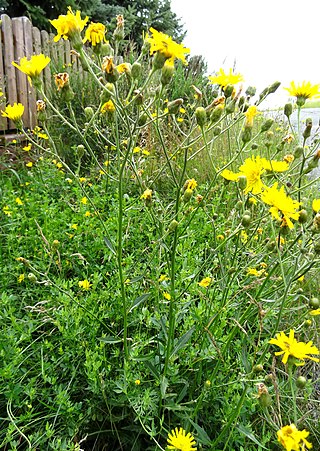
Hieracium laevigatum, or smooth hawkweed, is a Eurasian plant species in the tribe Cichorieae within the family Asteraceae. It is widespread across much of Europe and western Asia. It is very similar to Hieracium sabaudum and can be found on dry, more or less nutrient rich soil in light woods, grassy embankments and fields, or on walls.

Pimelea microcephala, commonly known as mallee rice-flower or shrubby rice-flower is a species of flowering plant in the family Thymelaeaceae and is endemic to mainland Australia. It is an erect shrub with compact heads of male or female, white to yellow or greenish flowers on separate plants, the heads surrounded by 2 or 4 leaf-like involucral bracts.
Leifsonia xyli subsp. xyli is the bacterium that causes ratoon stunting disease, a major worldwide disease of sugarcane. It is Gram positive and grows slowly in the laboratory.

Monardella breweri is a species of flowering plant in the mint family, known by the common name Brewer's monardella.
Nebria angusticollis microcephala is a subspecies of ground beetle in the Nebriinae subfamily that can be found in the Alps of France, Italy, and Switzerland.

The flora of Lebanon includes approximately 2,600 plant species. Situated on the eastern coast of the Mediterranean Basin, Lebanon is a reservoir of plant diversity and one of the world's biodiversity hotspots for conservation priorities. Endemic species constitute 12% of the Lebanese flora; 221 plant species are broad endemics and 90 are narrow endemics. Important Plant Areas (IPAs) featuring the country exceptional botanical richness were defined in 2018.

Alder Moors is a 8.5-hectare (21-acre) Local Nature Reserve in Woodley, a suburb of Reading in Berkshire. It is owned and managed by Wokingham District Council.

Stachys annua, called the annual yellow woundwort, is a widespread species of flowering plant in the hedgenettle genus Stachys, native to Europe, the Middle East, and western Siberia, and introduced in Cyprus, eastern North America, and Amur Oblast and Primorsky Krai in far eastern Russia. It is a common plant in fields, road verges and waste places.
Bellis sylvestris subsp. pappulosa is a species of daisy in the genus Bellis and is a subspecies of Bellis sylvestris.
Bellis annua subsp. minuta is a subspecies of daisy in the genus Bellis and is a subspecies of Bellis annua. It is endemic to the areas of the eastern and central Mediterranean.


